USAID DEC
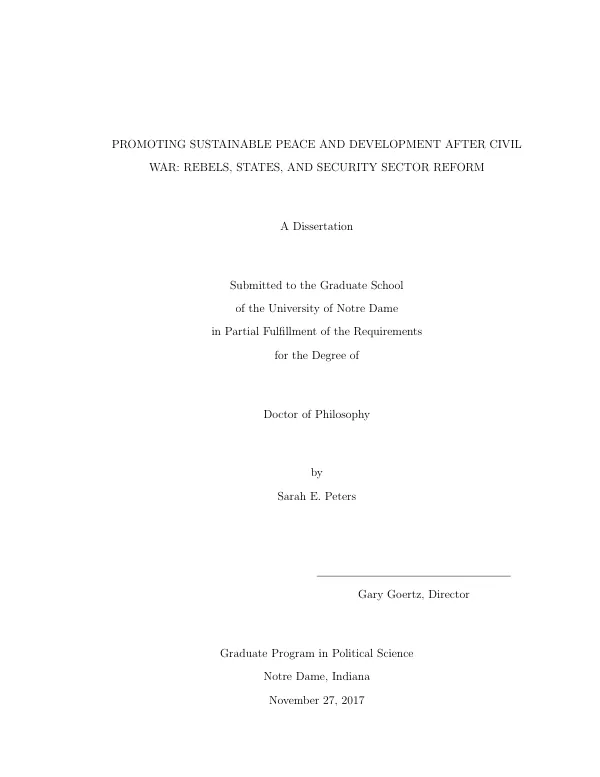
PROMOTING SUSTAINABLE PEACE AND DEVELOPMENT AFTER CIVIL WAR: REBELS, STATES, AND SECURITY SECTOR REFORM
Sign inUSAID DEC
PROMOTING SUSTAINABLE PEACE AND DEVELOPMENT AFTER CIVIL WAR: REBELS, STATES, AND SECURITY SECTOR REFORM
Civil war recurrence and post-conflict human development are significant concerns for countries emerging from conflict.
2017 · 147 pages
Sign in to readA free account is required to download.
Abstract
Research has shown that some countries experience enduring, high-quality peace after ending civil war, while others experience recurring violence and limited improvement in ordinary people's lives. This dissertation explores the relationship between government reforms, particularly security sector reforms, and the achievement of lasting, quality peace. Security sector reform refers to the process of transforming a country's security institutions to make them more accountable, transparent, and effective in protecting civilians. The dissertation argues that where government implements reforms that reduce politically motivated violence against civilians, states are likely to achieve lasting, quality peace. This is because the reduction of political violence against civilians directly lowers civilian grievances against the state and reduces political exclusion, allowing opposition parties to compete and gain political power without fearing violent intimidation. The dissertation proposes to test these arguments using a multi-method research design. The first part of the research involves process tracing on the pathway case of El Salvador. After ending civil war in 1992, El Salvador implemented security sector reforms, saw a significant reduction in politically motivated violence, and achieved reasonable improvement in health and education levels. The case fits into the nodes of the theoretical model, and process tracing is used to understand the causal mechanisms linking these nodes. The second part of the research involves testing the theoretical model using cross-national data on a sample of civil wars ending between 1985 and 2006. The results show statistical support for the theory, indicating that security sector reform is associated with a reduction in conflict recurrence and an increase in post-conflict human development. The dissertation also explores the impact of security sector reform on post-conflict human development. The results show that security sector reform is associated with improvements in health and education indicators, as well as increased access to basic services such as healthcare and education. The dissertation concludes that security sector reform is a critical factor in achieving lasting, quality peace after civil war. The reduction of political violence against civilians and the promotion of civilian control over the security sector are key mechanisms through which security sector reform contributes to peace and development. The findings of this dissertation have implications for policy and future research, highlighting the importance of prioritizing security sector reform in post-conflict reconstruction efforts. The case of El Salvador is presented as a model of enduring peace and human development. The country's experience demonstrates the potential for security sector reform to reduce conflict recurrence and promote post-conflict human development. The dissertation argues that the El Salvador case can be applied to explain variation in post-civil war experiences, highlighting the importance of considering the role of security sector reform in shaping peace and development outcomes. The dissertation's findings have implications for policy and future research. The results suggest that security sector reform should be prioritized in post-conflict reconstruction efforts, particularly in countries emerging from civil war. The dissertation also highlights the need for further research on the relationship between security sector reform and post-conflict human development, as well as the importance of considering the role of security sector reform in shaping peace and development outcomes. The dissertation's methodology involved a multi-method research design, combining process tracing and cross-national analysis. The process tracing component involved an in-depth examination of the El Salvador case, while the cross-national analysis involved a statistical analysis of a sample of civil wars ending between 1985 and 2006. The results of the dissertation provide new insights into the relationship between security sector reform and peace and development outcomes, highlighting the importance of prioritizing security sector reform in post-conflict reconstruction efforts.