CATHOLIC RELIEF SERVICES ORGANIZATION
Delivering practical, research-driven solutions to global development challenges
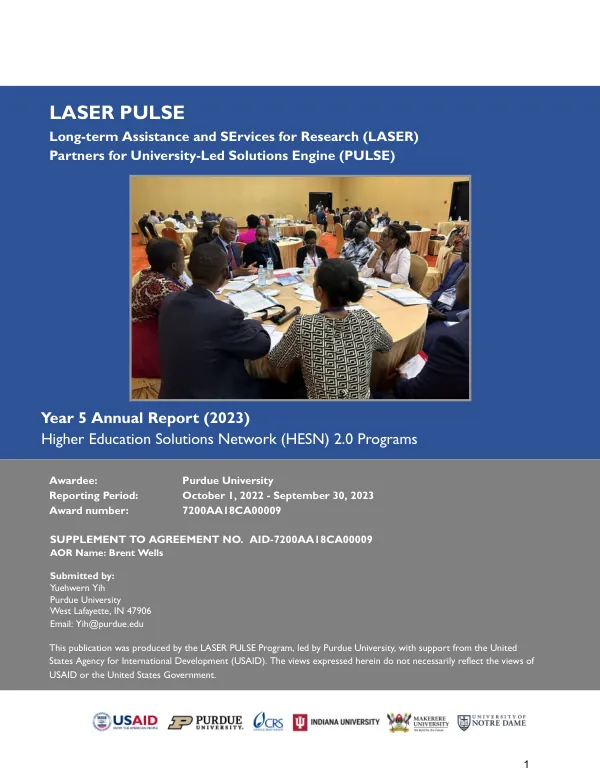
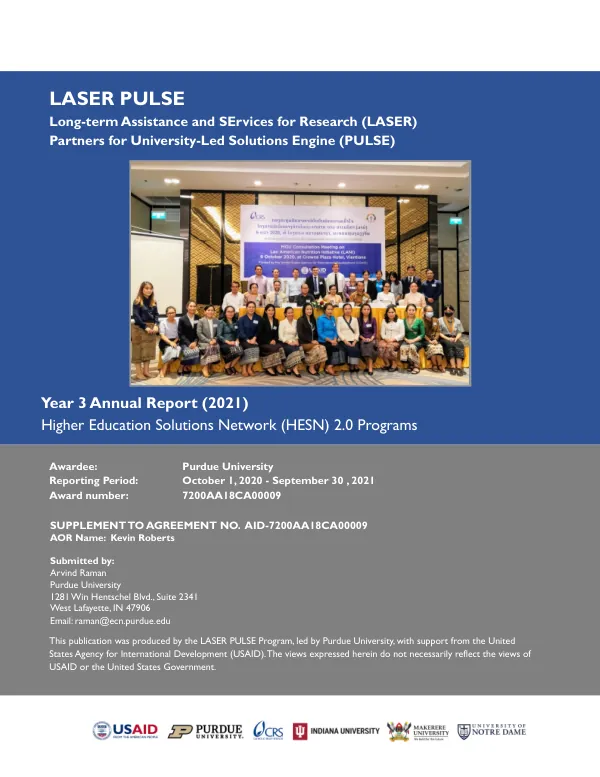
The LASER PULSE initiative is a five-year program funded through USAID's Innovation, Technology, and Research (ITR) Hub.
2021 · 19 pages
Sign in to readA free account is required to download.
Abstract
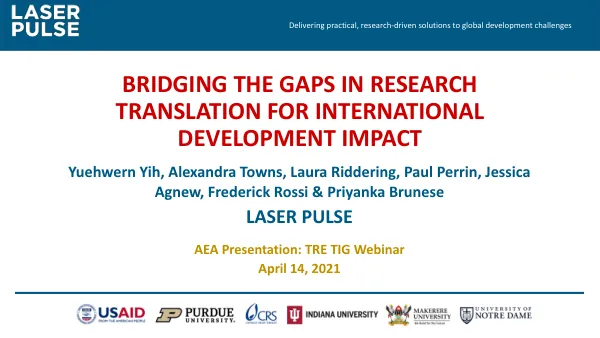
The program aims to deliver practical, research-driven solutions to global development challenges by bridging the gaps in research translation for international development impact. LASER PULSE is a network of over 2,600 members, comprising development practitioners and researchers from various institutions, including Purdue University, Catholic Relief Services, Indiana University, Makerere University, and the University of Notre Dame. The program's theory of change is based on the idea that closer collaboration between academic researchers, development practitioners, policymakers, and donors can lead to new research that is readily translated into useful policies, products, and practices as evidence-based solutions to development challenges. To achieve this, LASER PULSE employs an Embedded Research Translation (ERT) model, which is an iterative co-design process among academics, practitioners, and other stakeholders. The ERT model has four pillars: partnership, process, product, and dissemination. The partnership pillar emphasizes the importance of integrating partners early and throughout the project to ensure that solutions are more likely to be adopted and applied. The process pillar focuses on ensuring a solid foundation to work together effectively, while the product pillar involves co-designing a translation product that informs policy and/or practice. The dissemination pillar plans for wider application and scale-up beyond the partnership and toward a larger uptake in the field or region. LASER PULSE has implemented various research projects, including a private sector engagement project that utilized the ERT model. The project involved co-creation, user analysis, and the development of a user guide and FAQ. The project also included launch events, document categorization, and design options. Another project, the Blockchain Technology in Food Security Project, demonstrated the application of adaptive management and the ERT model. The ERT model involves several phases, including a call for applications, co-creation of a program description and budget, and implementation. The model also includes a progress tracker, biannual online surveys, and needs assessments. The LASER ERT team participates in virtual meetings at mid-term and closure, and learns about challenges, successes, progress, and dissemination plans. Overall, LASER PULSE aims to bridge the gaps in research translation for international development impact by employing the ERT model and collaborating with various stakeholders. The program's focus on adaptive management and impact measurement ensures that research is translated into practical solutions that address global development challenges.