UNIVERSITY OF CALIFORNIA AT DAVIS
Promoting the Adoption of Stochastic Agricultural Technologies
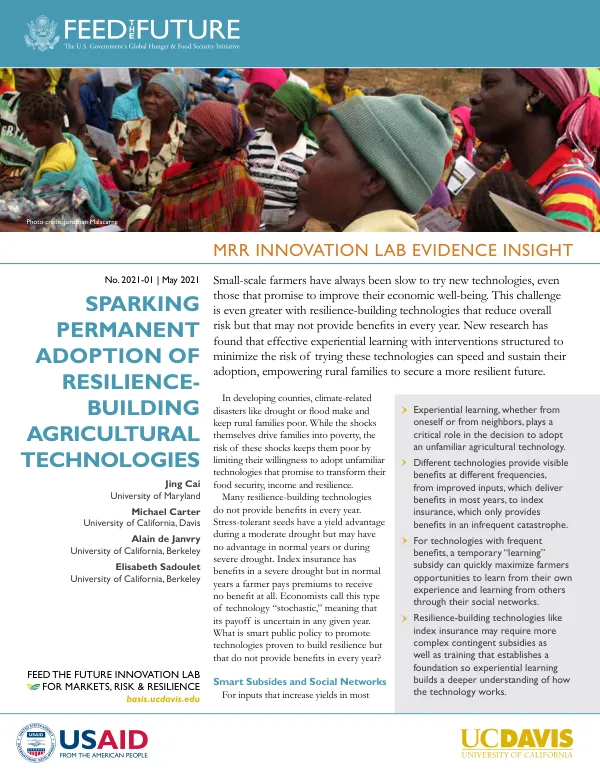
Small-scale farmers in developing countries face significant challenges in adopting new technologies, particularly those that promise to improve their economic well-being but may not provide benefits in every year.
2021 · 2 pages
Sign in to readA free account is required to download.
Abstract
Resilience-building technologies, such as stress-tolerant seeds and index insurance, are designed to reduce overall risk but may not provide benefits in every year. Effective experiential learning with interventions structured to minimize the risk of trying these technologies can speed and sustain their adoption, empowering rural families to secure a more resilient future. In developing countries, climate-related disasters like drought or flood make and keep rural families poor. While the shocks themselves drive families into poverty, the risk of these shocks keeps them poor by limiting their willingness to adopt unfamiliar technologies that promise to transform their food security, income, and resilience. Many resilience-building technologies do not provide benefits in every year. Stress-tolerant seeds have a yield advantage during a moderate drought but may have no advantage in normal years or during severe drought. Index insurance has benefits in a severe drought but in normal years a farmer pays premiums to receive no benefit at all. Economists call this type of technology "stochastic," meaning that its payoff is uncertain in any given year. What is smart public policy to promote technologies proven to build resilience but that do not provide benefits in every year? Smart subsidies and social networks can play a critical role in promoting the adoption of these technologies. For inputs that increase yields in most years, temporary "learning" subsidies can quickly maximize farmers' opportunities to learn from their own experience and learning from others through their social networks. Resilience-building technologies like index insurance may require more complex contingent subsidies as well as training that establishes a foundation so experiential learning builds a deeper understanding of how the technology works. Temporary subsidies create an opportunity for a farmer to experience for herself how profitable they can be. In a recent field study in Mozambique, farmers who received a temporary fertilizer subsidy had 66 percent higher maize yields on average for at least two years after the subsidy ended. The study also documented spillover benefits for farmers who did not receive a subsidy. One year after the subsidy ended, neighbors who did not receive subsidies also had similar yield gains that ultimately accounted for 69 percent of the total benefits of the program. These spillover benefits increased the subsidy program's benefit-cost ratio from 2.0 to an almost unbelievable 20.5. In this case, the subsidies created an opportunity for two types of experiential learning: learning from one's own experience and learning from others through social networks. The temporary subsidy accelerated both types of learning by boosting the early adoption of an input that was profitable even when farmers had to buy it at local market rates. However, even a familiar technology like chemical fertilizer does not provide benefits every year. In Mozambique, the research team extended the subsidy for an extra year because a severe drought gave farmers no chance to see the benefit of the fertilizer. Technologies that Promote Resilience For climate-resilient inputs, such as stress-tolerant seeds, the greatest benefit comes during more infrequent circumstances like moderate drought. For these technologies, temporary subsidies and social networks on their own may not be enough. Two recent large-scale field trials measured adoption rates for two of such technologies. One examined flood-tolerant rice in India, where flooding takes place one out of every five years. The other examined drought-tolerant maize in Mozambique and Tanzania, where mid-season drought happens roughly four out of every ten years. In both studies, the experience of the named peril—either flood or drought—had the biggest impact on whether farmers sustained their adoption of the technology in the following year. In fact, farmers who experienced these perils later expanded their adoption and had even higher yields, while farmers who did not experience the peril reduced their adoption. In both cases, the varieties produced higher yields than local varieties even in normal years. The same appears to be true with insurance, though experiencing first-hand how insurance works with payouts may not lead to permanent adoption. Index insurance is fundamentally different than an input like chemical fertilizers in that it provides no benefits in most years and is an unfamiliar technology that is much harder to understand. A new field study in China combined a subsidy with a learning intervention to improve financial literacy. The financial literacy training and the experience of receiving an insurance payout were both necessary to spark permanent insurance take-up. With the training, farmers learned how insurance works. The payouts reinforced that learning with their own experience and seeing neighbors also receive payouts. The subsidy was less important for permanent adoption. In fact, farmers who paid part of the cost of the insurance were more likely to purchase it in the second year. Maximizing Experiential Learning A critical first step to promoting lasting adoption for resilience-building technologies is to build-in ways to maximize farmers' experience and learning. For productive inputs, farmer field days or other community events can reinforce individual experiential learning with a deeper understanding of how the technology works. Index insurance may require financial literacy or other training that gets reinforced by the experience of receiving a payout for
Related documents