USAID
Family Planning Program Overview
The Family Planning Program is a critical initiative aimed at expanding access to family planning and reproductive health services in developing countries.
2015 · 2 pages
Sign in to readA free account is required to download.
Abstract
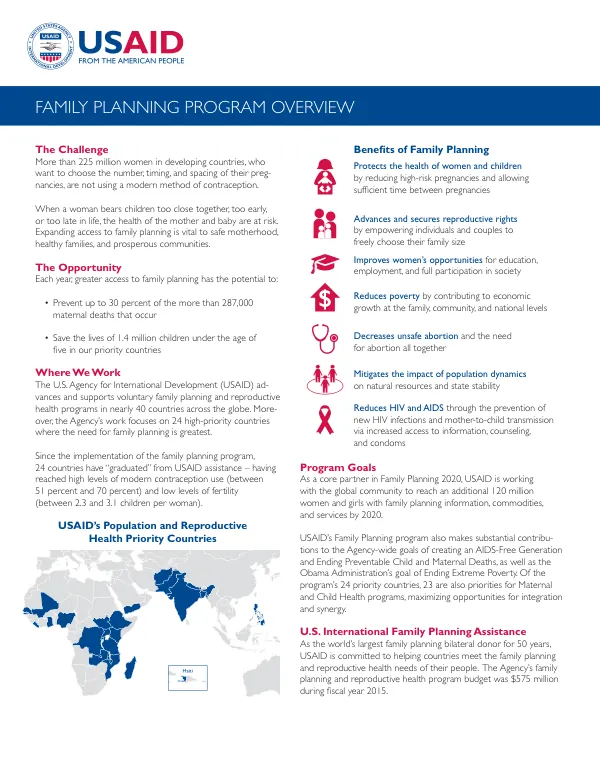
The program focuses on 24 high-priority countries where the need for family planning is greatest, with the goal of reaching an additional 120 million women and girls with family planning information, commodities, and services by 2020. The program's objectives are multifaceted, with a primary focus on protecting the health of women and children by reducing high-risk pregnancies and allowing sufficient time between pregnancies. Additionally, the program aims to advance and secure reproductive rights by empowering individuals and couples to freely choose their family size. Other key benefits of the program include improving women's opportunities for education, employment, and full participation in society, reducing poverty, and mitigating the impact of population dynamics on natural resources and state stability. USAID's Family Planning program is a core partner in Family Planning 2020, a global initiative aimed at increasing access to family planning information, commodities, and services. The program also contributes to the Agency-wide goals of creating an AIDS-Free Generation and Ending Preventable Child and Maternal Deaths, as well as the Obama Administration's goal of Ending Extreme Poverty. In addition, the program's 24 priority countries are also priorities for Maternal and Child Health programs, maximizing opportunities for integration and synergy. The program's approach is rooted in voluntarism and informed choice, with a focus on promoting equal access to family planning and reproductive health services. To achieve this, the program prioritizes investing in research, informing policy, improving monitoring and evaluation, and empowering underserved groups, particularly youth and rural and remote populations. The program's technical focus areas include broad method choice, social and behavior change, supply chains, family planning workforce, and total market approach. Since the launch of the family planning program in 1965, modern contraceptive use in the 27 countries with the largest USAID-supported programs has increased from under 10 percent to 37 percent, and the number of children per family has dropped from more than 6 to 4.5. In fiscal year 2015, the Guttmacher Institute estimates that U.S. international family planning assistance had the potential to reach 28 million women and couples with contraceptive services and supplies, helping to prevent 12,000 maternal deaths and 6 million unintended pregnancies. The program's impact is evident in the significant increase in commodities donated, with 841 million male condoms, 29.3 million injectables, 25.6 million oral pills, 2.3 million IUDs, and 1.8 million implants donated in fiscal year 2014. The program's commitment to helping countries meet the family planning and reproductive health needs of their people is a testament to its dedication to improving the health and well-being of women and children worldwide.
Related documents