USAID
Promoting the Quality of Medicines Program in the Philippines
The Philippines is considered a high-burden tuberculosis (TB) country by the World Health Organization (WHO), ranking among the top 15 for many years.
2012 · 2 pages
Sign in to readA free account is required to download.
Abstract
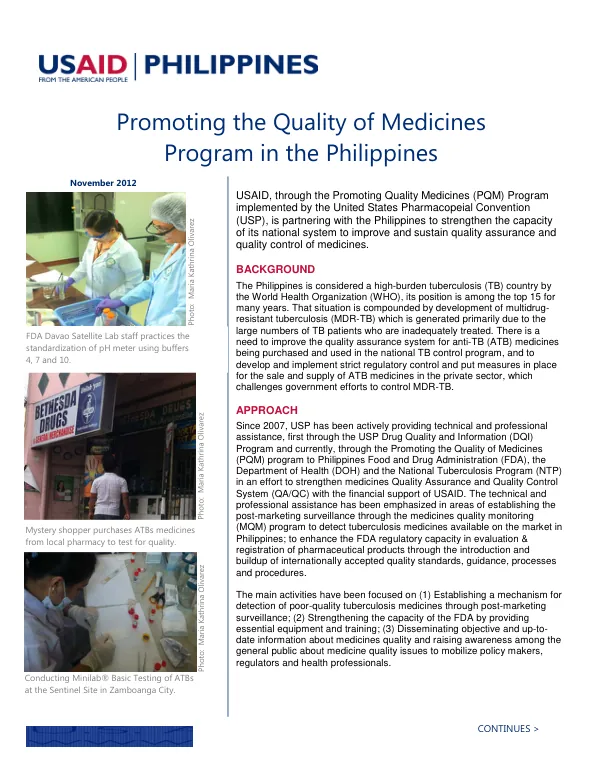
The situation is compounded by the development of multidrug-resistant tuberculosis (MDR-TB), primarily due to inadequately treated TB patients. To address this issue, there is a need to improve the quality assurance system for anti-TB (ATB) medicines being purchased and used in the national TB control program. The Philippines Food and Drug Administration (FDA), the Department of Health (DOH), and the National Tuberculosis Program (NTP) have been working with the Promoting the Quality of Medicines (PQM) program, implemented by the United States Pharmacopeial Convention (USP), to strengthen the medicines Quality Assurance and Quality Control System (QA/QC). The PQM program has been providing technical and professional assistance to the FDA, DOH, and NTP since 2007, with financial support from USAID. The main activities of the PQM program have focused on establishing a mechanism for detecting poor-quality tuberculosis medicines through post-marketing surveillance, strengthening the capacity of the FDA by providing essential equipment and training, and disseminating objective and up-to-date information about medicines quality and raising awareness among the general public about medicine quality issues. The program has also worked closely with the Centers for Health Development (CHDs) and Local Government Units (LGUs) to monitor the quality of TB medicines. The Philippines FDA, DOH, NTP, and PQM agreed to establish a Medicines Quality Monitoring (MQM) program for TB medicines to obtain evidence-based data on the quality of selected TB medicines. The MQM program was established at 6 sites in the Philippines in 2009 and has since been extended to 8 sentinel sites, including Davao, Cebu, Iloilo, Malolos, Zamboanga, La Union, Bicol, and Calabarzon. The program has collected and tested over 360 TB samples from 3 LGUs and 3 CHDs, with 1.5% of samples not conforming to quality specifications. The PQM program has also achieved significant progress in strengthening the quality control and quality assurance systems. FDA laboratories have become ISO 17025 accredited, and PQM has provided GLP training, technical assistance, and feedback regarding the documentation submitted to the Philippine Accreditation Office. PQM has also conducted a Rapid Review of the Medicines Quality Assurance and Quality Control Activities of the FDA to determine needs for capacity-building and has identified strengths and weaknesses and made suggestions for future PQM technical assistance. In addition, PQM has brought two FDA scientists for a ten-week training program at USP headquarters in Rockville, Maryland, and has conducted a Training Workshop: Evaluation of Analytical Validation and Stability Protocols and Reports for FDA staff. PQM has also delivered hands-on training on Compendial Analysis of Anti-TB medicines and introduction to Good Lab Practices for FDA staff in Davao, Cebu, and Central lab, and has delivered a Training Workshop to FDA's regulatory staff, scientist, and officers on Pharmaceutical Process Validation in November 2012. The PQM program has been working closely with various partners, including the Philippines FDA, National Tuberculosis Control Program, Center for Health Development (CHD), and Local Government Unit (LGU). The program has also received support from USAID, with Dr. Yolanda Oliveros serving as the Development Assistance Specialist, Office of Health, USAID/Philippines.
Related documents