USAID
PROPERTY RIGHTS AND FOREST MANAGEMENT - WHOSE REALITY COUNTS?
Land tenure and forest management in Kenya are complex issues, with multiple stakeholders and competing interests.
3 pages
Sign in to readA free account is required to download.
Abstract
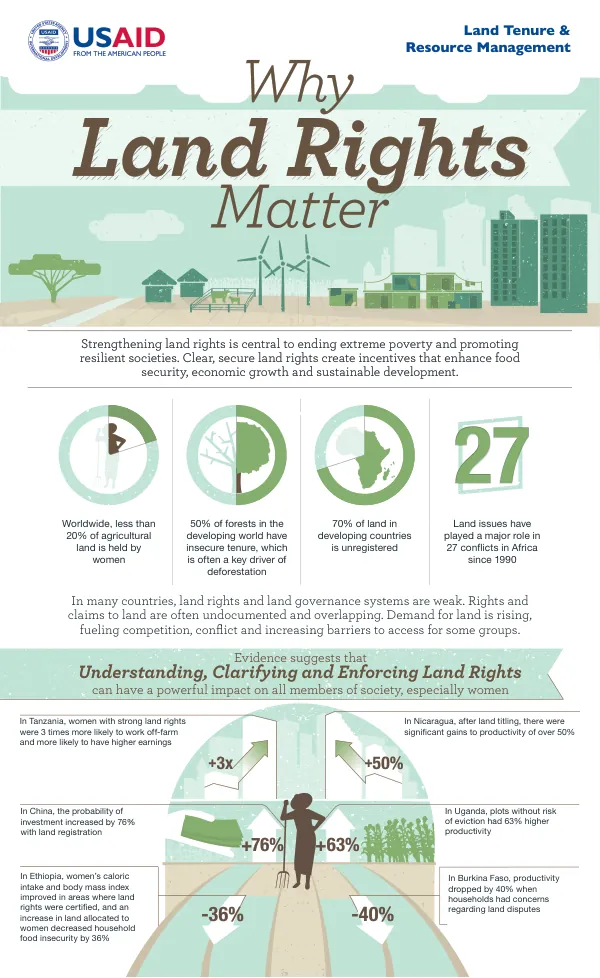
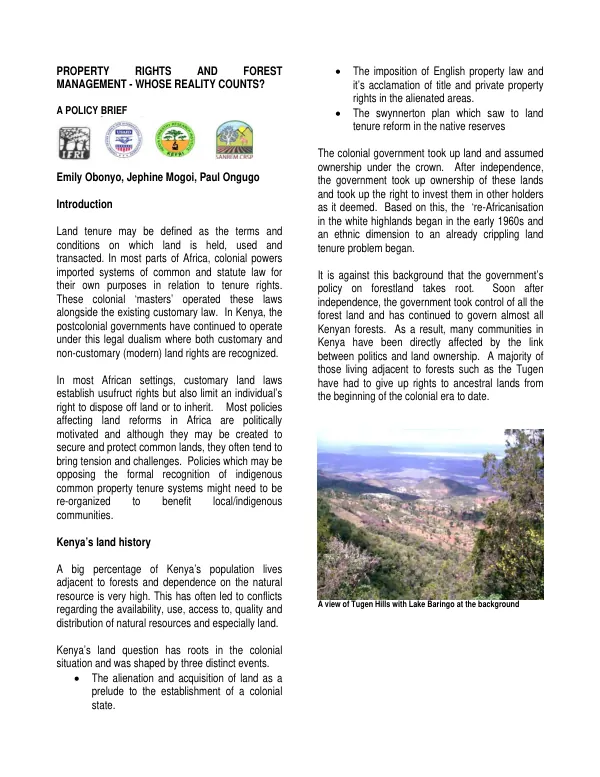
The country's land tenure system is characterized as modern, communal, public, and state-owned, with the government holding the majority of the land. Forested landscapes, including the Tugen Hills and Gathiuru forest in Mt. Kenya, are also subject to these categories. The history of land tenure in Kenya dates back to the colonial era, when the British colonial powers introduced systems of common and customary law for their own purposes. This led to a dualistic system, where both customary and non-customary land rights are recognized. The post-colonial governments have continued to operate under this system, with the government owning most of the land. The relationship between land ownership, political power, and ethnic dominance has increased, particularly during the closing decade of the last century. Poverty is a significant issue in Kenya, with millions of people facing exclusion from access to land and other resources. Most communities measure wealth in terms of land ownership, and those without land are often considered the poorest of the poor. The Tugen Hills forest, located in Baringo district of the Rift Valley province, is a prime example of the challenges faced by communities in Kenya. The forest is characterized by high agricultural potential, fertile soils, and well-drained land. However, the increase in population has led to intensified property rights problems, resulting in social and economic pressures on the forest, leading to shortages of resources. Encroachment into forest land has become a significant issue, with many households relying on renewable biomass fuels due to the increasing prices of petroleum products. This has put immense pressure on land, leading to a significant increase in the problem of squatters among forest adjacent communities. Policy considerations suggest that the complexity and sensitivity of tenure issues, particularly with regard to common pool resources such as forests, require a more integrated approach to solving the issues. The livelihoods of communities have been adversely affected by the slow process of dealing with sensitive land issues, and changes in ownership structures should be put in place. The government's role in dealing with sensitive land issues has been criticized, with many communities facing exclusion from access to land and other resources. The use of traditional and local institutions must be promoted to better understand the complexities surrounding land issues. Tenure dualism can be acknowledged as a resource rather than an obstacle in changing livelihoods of the poor. The indigenous management system, governed by customary laws, rules, and local institutions, has strong roots based on ethics and moral values. The potential for including communities in decision-making to resolve property rights conflicts at the community level remains significant. Combining this with the current forest management system could lead to improved outcomes. The land question in Kenya remains unsolved, with the former President's government disregarding the communities' land problem and aggravating the issue by rewarding loyalists through land allocations that sometimes included forest excisions. This has reduced the country's dwindling forest and increased conflict with local groups. There is a need to lobby for policy changes that will positively address the needs of local communities, particularly those living at the peripheries.