INTERNATIONAL YOUTH FOUNDATION
Population, Health, and Environment Approaches Can Improve Youth Development
Young people are critical to achieving global development goals such as the Sustainable Development Goals, Family Planning 2020, and the 2008 Abuja Call to Action, as well as national development plans.
2018 · 4 pages
Sign in to readA free account is required to download.
Abstract
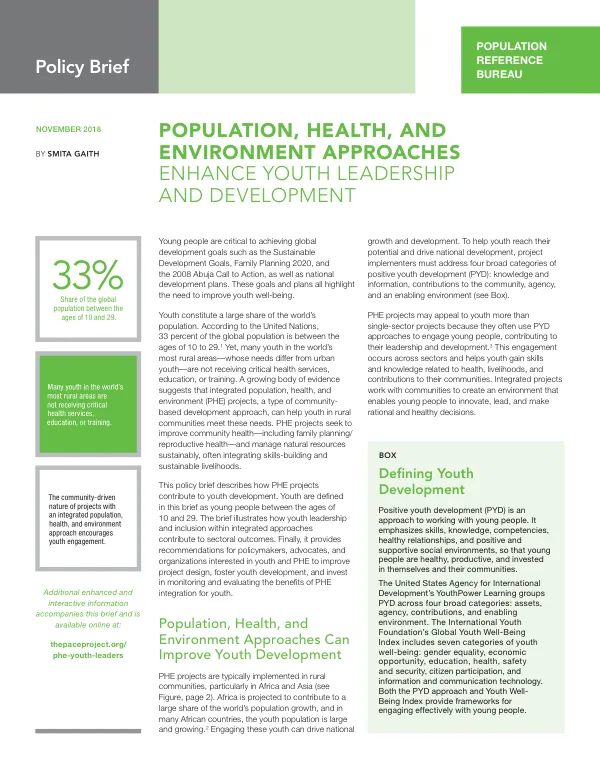
These goals and plans all highlight the need to improve youth well-being. Youth constitute a large share of the world's population, with 33 percent of the global population between the ages of 10 and 29. Many youth in the world's most rural areas are not receiving critical health services, education, or training. A growing body of evidence suggests that integrated population, health, and environment (PHE) projects, a type of community-based development approach, can help youth in rural communities meet these needs. PHE projects seek to improve community health, including family planning/reproductive health, and manage natural resources sustainably, often integrating skills-building and sustainable livelihoods. PHE projects are typically implemented in rural communities, particularly in Africa and Asia. Africa is projected to contribute to a large share of the world's population growth, and in many African countries, the youth population is large and growing. Engaging these youth can drive national growth and development. To help youth reach their potential and drive national development, project implementers must address four broad categories of positive youth development (PYD): knowledge and information, contributions to the community, agency, and an enabling environment. PHE projects may appeal to youth more than single-sector projects because they often use PYD approaches to engage young people, contributing to their leadership and development. This engagement occurs across sectors and helps youth gain skills and knowledge related to health, livelihoods, and contributions to their communities. Integrated projects work with communities to create an environment that enables young people to innovate, lead, and make rational and healthy decisions. The community-driven nature of projects with an integrated population, health, and environment approach encourages youth engagement. Many PHE projects use peer education to reach young people, and projects often include livelihoods training. The Sustaining Partnerships to Enhance Rural Enterprise and Development (SPREAD) Project in Rwanda established youth clubs to increase knowledge about health and environmental challenges, while the Integrated Bonga Forest Project in Ethiopia addressed sexual and reproductive health and rights, environmental protection, and business and leadership. Research demonstrates that engaging young people in community interventions can have multisectoral benefits. Involving all community members increases the likelihood that projects will address multiple priorities and encourages sustainability beyond the life of a project. In addition to the benefits to youth well-being and development, PHE projects that engage youth may also contribute to sectoral outcomes such as those described below. Health outcomes can be improved through PHE projects that engage youth, enabling them to delay and space pregnancies, reducing the number of births and improving household health. Many PHE projects introduce sustainable livelihoods in agriculture, helping youth develop confidence, leadership skills, and team work skills. By leveraging associations, such as farmer's groups, PHE projects can help youth enter farming and contribute to environmentally sustainable pathways to improved food security. PHE projects can also develop a range of technical and leadership skills, improving young people's entrepreneurial capacity. Sectors such as agribusiness present an opportunity to generate jobs for youth, provided they have the skills and traits to succeed. Projects sometimes train young people as assistants and create opportunities for them to develop sector-specific skills, helping prepare youth for the workforce. Including youth in PHE projects can also improve their participation in governance, enabling them to contribute to decision-making processes and shape policies that affect their lives.
Related documents