DAI GLOBAL, LLC
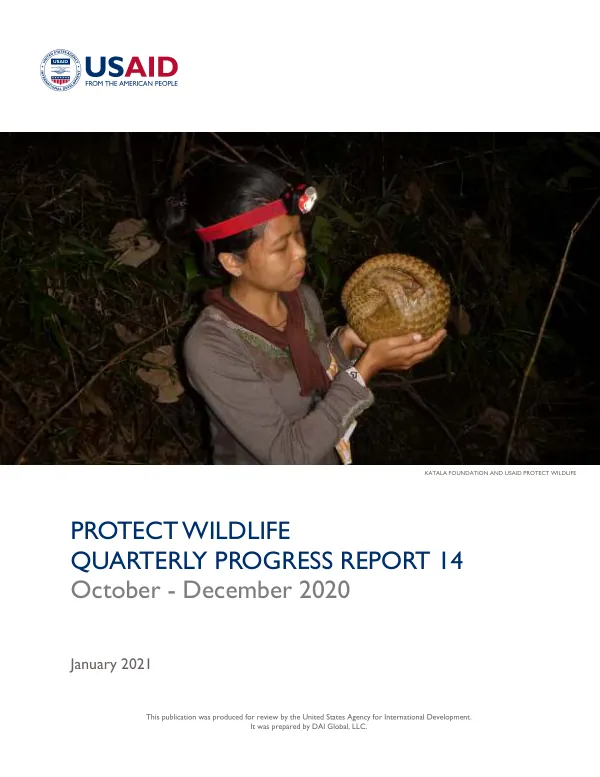
Protect Wildlife Quarterly Progress Report 14
The Protect Wildlife activity supports initiatives to align conservation policy with on-the-ground wildlife management actions and enforcement.
2021 · 87 pages
Sign in to readA free account is required to download.
Abstract
The activity works in target landscapes to reduce threats to biodiversity, reduce poaching and use of illegally harvested wildlife and wildlife products, and improve ecosystem goods and services for human well-being. Protect Wildlife fits within the USAID Biodiversity Policy (USAID 2014) that "builds upon the Agency's long history of conserving a global biological heritage for current and future generations and reflects a deep understanding of the role that healthy natural systems play in achieving the Agency's human-development goals." The activity is the first USAID/Philippines initiative to combat wildlife trafficking and directly implement the U.S. Government's Eliminate, Neutralize and Disrupt Wildlife Trafficking Act of 2016. Protect Wildlife's principal counterpart is the DENR-Biodiversity Management Bureau (DENR-BMB) in coordination with the DENR-Forest Management Bureau (DENR-FMB), Department of Agriculture-Bureau of Fisheries and Aquatic Resources (DA-BFAR), the National Commission on Indigenous Peoples (NCIP), and various national level law enforcement agencies. At the local level, Protect Wildlife works directly with DENR Regional Offices; Provincial and Community Environment and Natural Resources Offices (PENROs and CENROs); and provincial, city and municipal local government units (LGUs), as well as local offices of DA-BFAR and NCIP. In Palawan, the activity coordinates with the Palawan Council for Sustainable Development Staff (PCSDS). At various levels, the activity works with non-government and civil society organizations (NGOs and CSOs); colleges and universities; and land and resource managers, such as ancestral domain and tenure holders and fisherfolk and coastal community organizations. The Philippines is a megadiverse country, claiming to be the "center of the center" of nearshore marine diversity, including corals and reef fishes. It is home to approximately 1,100 terrestrial vertebrates and five percent of the world's flora, a significant proportion of which is endemic. However, much of these biodiversity assets continue to face risks and pressures from both natural and human interventions, such as land conversion for agriculture and settlements; illegal, unregulated and unreported harvesting; and destructive mining and quarrying. The value of biodiversity and the ecosystem goods and services they provide are not effectively communicated to local stakeholders. Capacities are limited with unrealized economic incentives and inadequate financial support to manage wildlife habitats and regulate uses in highly diverse areas. Protect Wildlife strives to target wildlife trafficking hotspots and work with local stakeholders with initiatives to improve local capacities; incentivize communities and LGUs; leverage financing support; and deepen knowledge, attitudes and behaviors for the effective management, regulation and enforcement of wildlife habitats and wildlife trafficking transshipment points such as ports. The activity works across geographies in the Philippines to address wildlife trafficking transshipment, but implements a more comprehensive ecosystem-based approach in biologically significant areas. These areas include Palawan, Zamboanga City-Sulu Archipelago, General Santos City (GenSan), Sarangani and South Cotabato in Region 12, and Region 3 or Central Luzon, with selected sites in Aurora, Nueva Ecija and Bataan. The Manila office maintains the national advisors and specialists who lead the development of the activity and Strategic Approach (SA) work plans; provide technical support to field activities; and work with national-level agencies, Manila-based private and non-government organizations, and relevant donor-funded projects.