CONSERVATION INTERNATIONAL FOUNDATION
Protect Wildlife Quarterly Progress Report 8
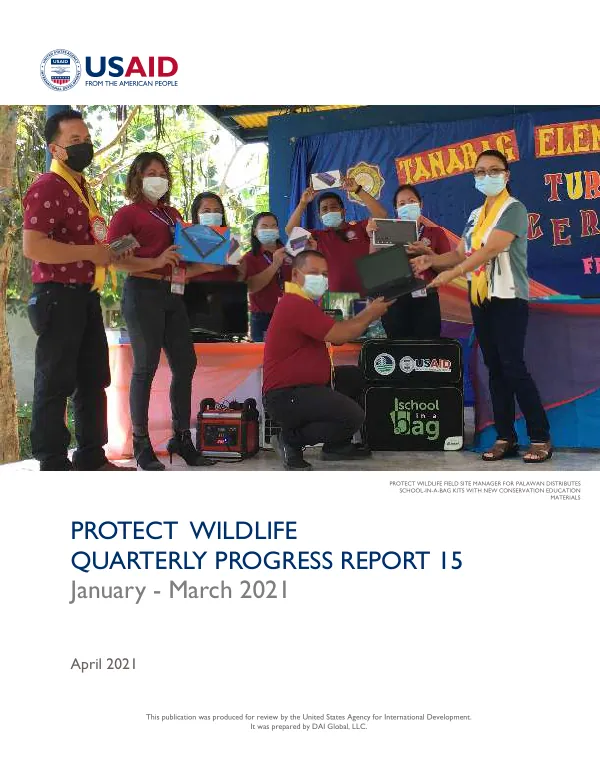
The Protect Wildlife activity in the Philippines aims to reduce threats to biodiversity, poaching, and the use of illegally harvested wildlife and wildlife products.
2019 · 58 pages
Sign in to readA free account is required to download.
Abstract
The activity works in target landscapes to improve ecosystem goods and services for human well-being. Protect Wildlife supports the Philippines' current policies and programs on biodiversity conservation and reduction of wildlife trafficking under the National Integrated Protected Areas System (NIPAS) Act and the Wildlife Resources Conservation and Protection Act. The activity's principal counterpart is the DENR-Biodiversity Management Bureau (DENR-BMB) in coordination with the Department of Agriculture-Bureau of Fisheries and Aquatic Resources (DA-BFAR), the National Commission on Indigenous Peoples (NCIP), and various national-level enforcement law agencies. At the local level, Protect Wildlife works directly with DENR Regional Offices; Provincial and Community Environment and Natural Resources Offices (PENROs and CENROs); and provincial, city, and municipal local government units (LGUs), as well as local offices of DA-BFAR and NCIP. The Philippines is a megadiverse country, home to approximately 1,100 terrestrial vertebrates and five percent of the world's flora, a significant proportion of which is endemic. However, much of these biodiversity assets continue to face risks and pressures from both natural and human interventions, such as land conversion for agriculture and settlements; illegal, unregulated, and unreported harvesting; and destructive mining and quarrying. The value of biodiversity and the ecosystem goods and services they provide are not effectively communicated to local stakeholders. Protect Wildlife targets wildlife trafficking hotspots and local stakeholders with initiatives to improve local capacities; incentivize communities and LGUs; leverage financing support; and deepen knowledge, attitudes, and behaviors for the effective management, regulation, and enforcement of wildlife habitats and wildlife trafficking transshipment points such as ports. The activity works across geographies in the Philippines to address wildlife trafficking transshipment, but implements a more comprehensive ecosystem approach in the biologically significant areas. The activity focuses on several key areas, including Palawan and Zamboanga City-Sulu Archipelago. In Palawan, Protect Wildlife implements technical activities in threatened terrestrial, marine, and coastal areas wildlife habitats in forest lands and protected areas, such as the Mount Mantalingahan Protected Landscape, Tubbataha Reefs Natural Park, Rasa Island Wildlife Sanctuary, Ursula Island Game Refuge and Bird Sanctuary, and mangroves in Palawan. In Zamboanga City-Sulu Archipelago, the activity works to address wildlife trafficking transshipment and implement a comprehensive ecosystem approach in the biologically significant areas. Protect Wildlife's principal activities include behavior change communication, combating wildlife trafficking, and improving ecosystem goods and services. The activity also works to improve local capacities, incentivize communities and LGUs, leverage financing support, and deepen knowledge, attitudes, and behaviors for the effective management, regulation, and enforcement of wildlife habitats and wildlife trafficking transshipment points such as ports. The activity's progress is monitored and evaluated through regular reporting and assessment. The Protect Wildlife Quarterly Progress Report 8 covers the period of October 1 to December 31, 2018, and provides a summary of accomplishments based on planned activities set out in the Protect Wildlife Quarterly Progress Report 7 for the same period. The report highlights key achievements and problem areas that require senior management intervention and provides details on management and operations and expenditures for the quarter and projected spending for the next.
Related documents