USAID DEC
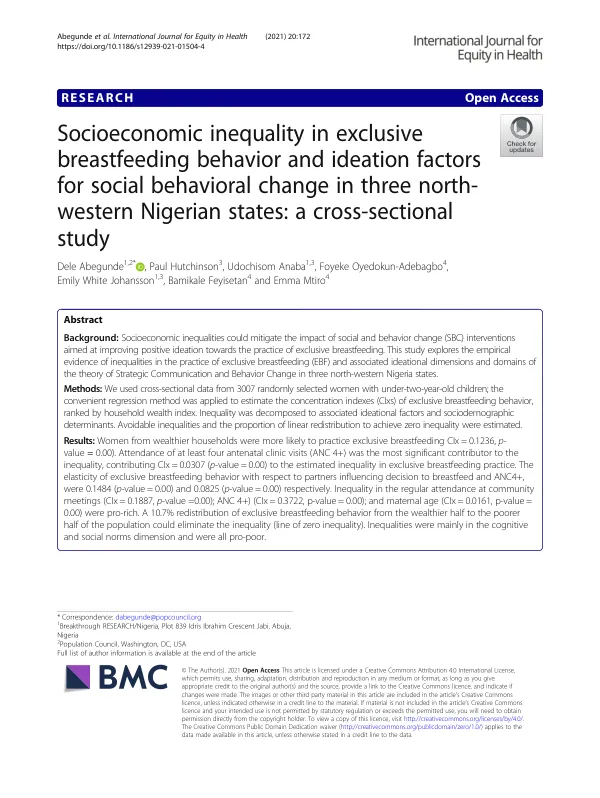
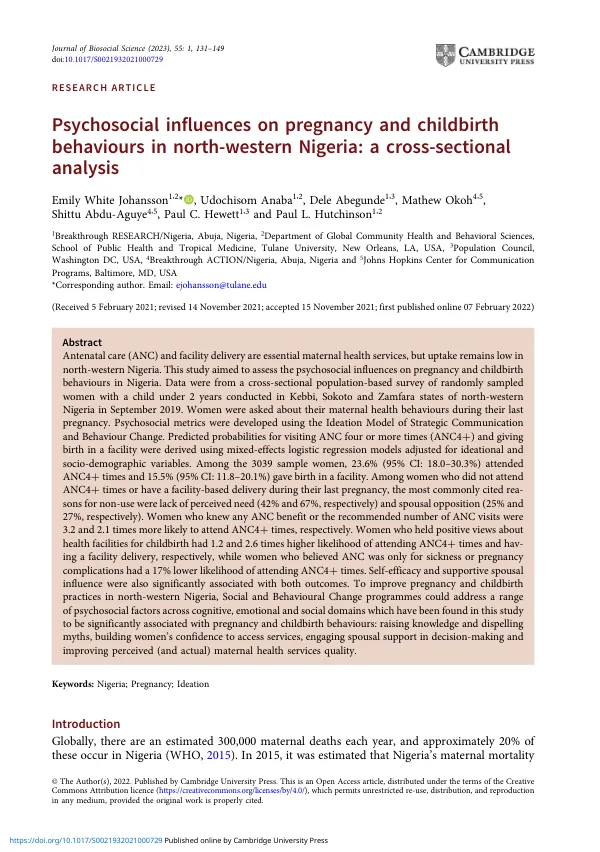
Psychosocial influences on pregnancy and childbirth behaviours in north-western Nigeria: a cross-sectional analysis
Sign inGOVERNMENT OF LIBERIA
Psychosocial influences on pregnancy and childbirth behaviours in north-western Nigeria: a cross-sectional analysis
The study aimed to assess the psychosocial influences on pregnancy and childbirth behaviours in north-western Nigeria.
2023 · 19 pages
Sign in to readA free account is required to download.
Abstract
Data were collected from a cross-sectional population-based survey of randomly sampled women with a child under 2 years conducted in Kebbi, Sokoto, and Zamfara states in September 2019. The survey asked women about their maternal health behaviours during their last pregnancy. Psychosocial metrics were developed using the Ideation Model of Strategic Communication and Behaviour Change. Among the 3039 sample women, 23.6% attended antenatal care (ANC) four or more times, and 15.5% gave birth in a facility. The most commonly cited reasons for non-use of ANC and facility-based delivery were lack of perceived need and spousal opposition. Women who knew any ANC benefit or the recommended number of ANC visits were 3.2 and 2.1 times more likely to attend ANC four or more times, respectively. Women who held positive views about health facilities for childbirth had 1.2 and 2.6 times higher likelihood of attending ANC four or more times and having a facility delivery, respectively. The study found that self-efficacy and supportive spousal influence were significantly associated with both outcomes. Women who believed ANC was only for sickness or pregnancy complications had a 17% lower likelihood of attending ANC four or more times. The study suggests that Social and Behavioural Change programmes could address a range of psychosocial factors across cognitive, emotional, and social domains to improve pregnancy and childbirth practices in north-western Nigeria. The study area, which includes Kebbi, Sokoto, and Zamfara states, has some of the highest poverty rates within Nigeria and among the worst maternal and child mortality outcomes. The region has a high total fertility rate, with 6.6 births per woman, and a high under-five mortality rate of 187 deaths per 1000 live births. Women's empowerment measures in the region are among the lowest nationally, including low levels of education, employment, and mobile phone ownership. Early child marriage is common in the area, with a mean age of first marriage at 15.4 years for women. The study's findings have implications for improving maternal health outcomes in north-western Nigeria. Addressing psychosocial factors such as knowledge, attitudes, and beliefs about ANC and facility-based delivery could help increase uptake of these essential maternal health services. The study suggests that Social and Behavioural Change programmes could target these factors to improve pregnancy and childbirth practices in the region.
Related documents