ANA AND VLADE DIVAC FOUNDATION
The Attitudes of Serbian Citizens Towards Refugees
The attitudes of Serbian citizens towards refugees and the refugee crisis underwent significant changes between the first and second waves of a survey conducted in 2016.
2016 · 2 pages
Sign in to readA free account is required to download.
Abstract
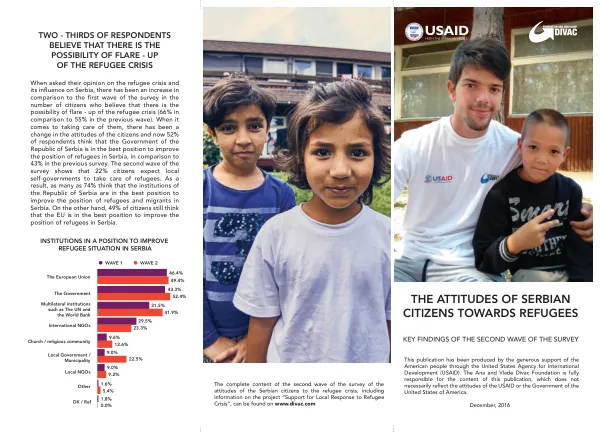
The second wave, which took place in December 2016, involved 2,792 people aged 15 and above from eight municipalities in Serbia. The survey was conducted by ProPozitiv, an agency for public opinion research, and was part of the "Support for Local Response to Refugee Crisis" project implemented by the Ana and Vlade Divac Foundation with the support of the United States Agency for International Development (USAID). The survey revealed that 66% of respondents believed there was a possibility of a flare-up of the refugee crisis, a 11% increase from the previous wave. In contrast, 52% of respondents thought the Government of the Republic of Serbia was in the best position to improve the position of refugees in Serbia, a 9% increase from the previous wave. The second wave also showed that 74% of respondents believed the institutions of the Republic of Serbia were in the best position to improve the position of refugees and migrants in Serbia. The survey also found that 47% of citizens had a positive attitude towards refugees, a 2% increase from the previous wave. However, there was an increase in negative attitudes towards refugees, with 34% of respondents expressing a negative attitude, a 15% increase from the previous wave. The survey also revealed that 60% of respondents sympathized with the refugees and understood the problem they were facing, although this number had decreased from the previous wave. The survey also found that 51% of respondents were afraid or worried that the refugees might transfer diseases to Serbian citizens, an increase from the previous wave. Additionally, half of the respondents had had some sort of contact with the refugees, with an average of ¾ of them still having positive contact. The contact was best graded in the municipalities of Sjenica and Tutin, where over 90% of respondents had positive contact. The survey results also showed that the majority of respondents believed Serbia had accepted refugees much better in comparison to other countries. However, there was a decrease in the number of respondents who believed Serbia had accepted refugees much better, from 84% in the first wave to 78% in the second wave. The survey also found that 49% of respondents believed the EU was in the best position to improve the position of refugees in Serbia, a 3% decrease from the previous wave. The survey results provide valuable insights into the attitudes of Serbian citizens towards refugees and the refugee crisis. The findings suggest that while there is a significant increase in negative attitudes towards refugees, there is also a growing recognition of the need for the Government of the Republic of Serbia to take a more active role in improving the position of refugees in Serbia.
Related documents