USAID DEC
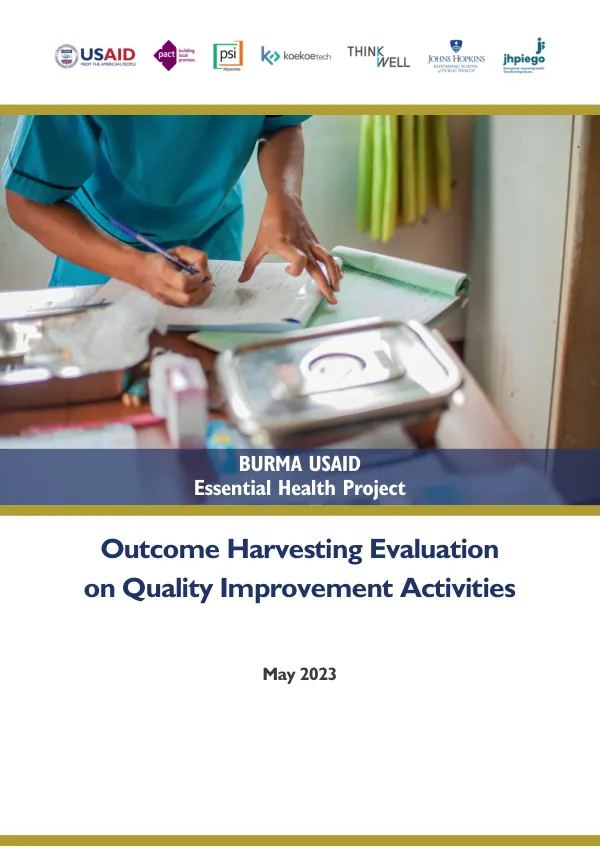
Quality Improvement: Partnership to improve the quality of care at maternity homes and clinics
Sign inJHPIEGO
Quality Improvement: Partnership to improve the quality of care at maternity homes and clinics
The Myanmar National Health Plan (NHP) 2017-2021 emphasizes providing quality health services as a guiding principle.
2023 · 9 pages
Sign in to readA free account is required to download.
Abstract
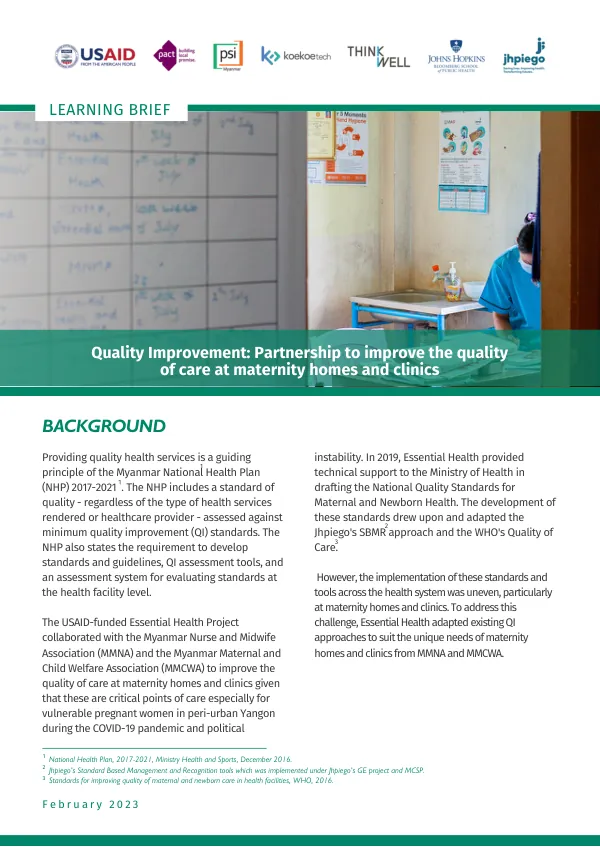
The NHP includes a standard of quality, assessed against minimum quality improvement (QI) standards, and requires the development of standards and guidelines, QI assessment tools, and an assessment system for evaluating standards at the health facility level. The USAID-funded Essential Health Project collaborated with the Myanmar Nurse and Midwife Association (MMNA) and the Myanmar Maternal and Child Welfare Association (MMCWA) to improve the quality of care at maternity homes and clinics. These facilities are critical points of care, particularly for vulnerable pregnant women in peri-urban Yangon during the COVID-19 pandemic and political instability. Essential Health provided technical support to the Ministry of Health in drafting the National Quality Standards for Maternal and Newborn Health, which drew upon and adapted the Jhpiego's SBMR approach and the WHO's Quality of Care. The Quality Improvement (QI) model used by Essential Health is a proactive management methodology for improving the performance and quality of health services. The eight steps of the model include forming QI committees, identifying and training assessors, conducting initial assessments, analyzing results, prioritizing areas for improvement, developing action plans, implementing the QI process, and monitoring progress. Essential Health supported MMCWA and MNMA in adapting existing QI approaches to suit the unique needs of maternity homes and clinics. Implementation of the QI process involved forming QI committees, which consisted of 5 to 7 members from the clinic team, support team, and administrative units of each organization. Assessors were identified and selected by QI committees and trained by Essential Health. QI assessments were conducted by facility staff on a six-monthly basis, with new/revised action plans developed to address gaps based on internal assessments. Essential Health staff accompanied the assessment process for cross-checking. The QI process included recognizing and rewarding improvements and high performance, sustaining and expanding the QI process, and exploring future activities linking to existing professional regulation, accreditation, and prequalification mechanisms. Support included relevant material support and technical support, such as conducting technical update sessions during monthly Continuing Medical Education (CME) and training QI committees and assessors in QI implementation. The project concluded seven QI cycles in MNMA clinics and five QI cycles in MMCWA clinics over the course of three years. Improvements were achieved across all QI areas, with 80% of average QI scores reached in almost all areas. Implementation of the QI process in maternity homes improved clinical performance of health providers, client satisfaction, and utilization of health facilities for quality maternal and newborn care.