USAID DEC
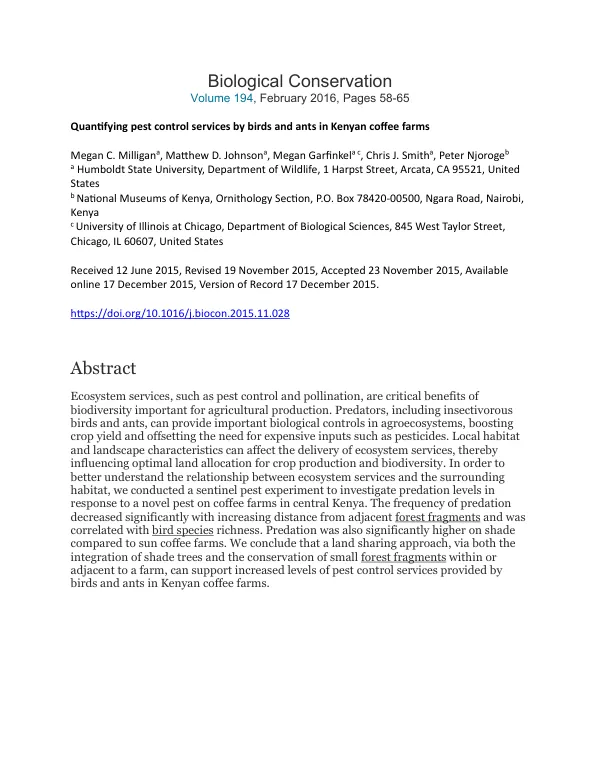
QuanƟfying pest control services by birds and ants in Kenyan coffee farms
Ecosystem services, such as pest control and pollination, are critical benefits of biodiversity important for agricultural production.
2016 · 1 pages
Sign in to readA free account is required to download.
Abstract
Predators, including insectivorous birds and ants, can provide important biological controls in agroecosystems, boosting crop yield and offsetting the need for expensive inputs such as pesticides. Local habitat and landscape characteristics can affect the delivery of ecosystem services, thereby influencing optimal land allocation for crop production and biodiversity. A sentinel pest experiment was conducted to investigate predation levels in response to a novel pest on coffee farms in central Kenya. The study aimed to better understand the relationship between ecosystem services and the surrounding habitat. The experiment revealed that the frequency of predation decreased significantly with increasing distance from adjacent forest fragments. Predation was also found to be correlated with bird species richness, indicating that a greater variety of bird species can lead to increased pest control services. The study compared predation levels on shade and sun coffee farms. Results showed that predation was significantly higher on shade compared to sun coffee farms. This suggests that shade coffee farms, which often incorporate trees and other vegetation, can provide a more favorable environment for predators to control pest populations. The findings of this study support a land sharing approach, which involves integrating shade trees and conserving small forest fragments within or adjacent to a farm. The conservation of small forest fragments and the integration of shade trees can support increased levels of pest control services provided by birds and ants in Kenyan coffee farms. This approach can help to reduce the need for pesticides and promote more sustainable agricultural practices. By understanding the relationship between ecosystem services and the surrounding habitat, farmers and conservationists can work together to develop more effective strategies for managing pests and promoting biodiversity. The results of this study have implications for the management of coffee farms in central Kenya and potentially other regions with similar ecosystems. By incorporating shade trees and conserving small forest fragments, farmers can create a more favorable environment for predators to control pest populations, leading to increased crop yields and reduced pesticide use. This approach can also contribute to the conservation of biodiversity and the promotion of sustainable agricultural practices.