USAID DEC
Exploring perceived effects from loss of PEPFAR support for outreach in Kenya and Uganda
Sign inJOHNS HOPKINS UNIVERSITY BLOOMBERG SCHOOL OF PUBLIC HEALTH/INFO PROJECT
Exploring perceived effects from loss of PEPFAR support for outreach in Kenya and Uganda
The President's Emergency Plan for AIDS Relief (PEPFAR) underwent policy shifts in 2015 to increase efficiency in its programming, including transitioning HIV/AIDS funding from low-burden areas.
2021 · 14 pages
Sign in to readA free account is required to download.
Abstract
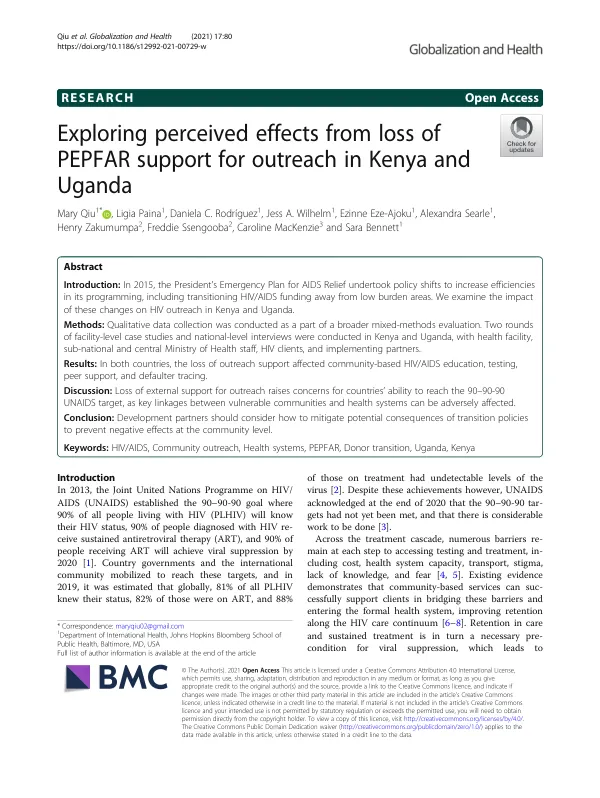
This change had a significant impact on HIV outreach in Kenya and Uganda. The loss of external support for outreach raised concerns about the ability of these countries to reach the 90-90-90 UNAIDS target, which aims to have 90% of people living with HIV know their status, 90% of those diagnosed receive sustained antiretroviral therapy (ART), and 90% of those on treatment achieve viral suppression by 2020. In Kenya and Uganda, the loss of outreach funding affected community-based HIV/AIDS services, including testing, peer support, and defaulter tracing. The reduction in outreach services had a negative impact on the health systems in these countries, making it challenging to reach marginalized populations and marginalized populations who have fewer interactions with the health system. Community-based services, such as defaulter tracing, adherence counseling, and sensitization programs, are critical to reducing transmission risk among those who are not reached by existing mechanisms. Historically, outreach services in sub-Saharan Africa have been funded by donors through vertical programs, with limited integration into local health systems and community structures. The costs of these programs have rarely been incorporated into domestic budgets, operating externally or in parallel with local systems. This has created parallel structures, which are problematic, as donor-funded outreach takes away health care workers from their regular duties or requires the use of informal cadres from outside the health system. Global trends in development assistance for health (DAH) have stagnated since 2010, with an annual growth rate of 1.8% from 2010 to 2016. This is a significant decline from the 11.3% growth rate between 2000 and 2010. The "middle-income" countries, which are losing eligibility under global funding mechanisms, are expected to increase their domestic resource mobilization. However, evidence suggests that many of these countries are still unable to fully fund their health systems using domestic resources, resulting in the concept of the "middle-income" countries. The President's Emergency Plan for AIDS Relief (PEPFAR) has been one of the largest funders for HIV programming globally since its launch in 2003. In 2015, PEPFAR underwent policy shifts to increase efficiency, including re-classifying community-level activities as "non-core" and de-emphasizing them. The PEPFAR strategy also introduced a "Geographic Prioritization" (GP) process, which targeted strategic emphasis and resources on sub-national units (SNUs) with the highest burden of disease. The GP process designated SNUs into three key categories: Scale-Up SNUs, Maintenance SNUs, and Central-Support (CS) SNUs. In Kenya and Uganda, a mixed-methods evaluation was conducted to understand the effects of the PEPFAR GP policy on HIV services and health systems. The study explored the effects in CS and Maintenance SNUs, which were expected to lose site support from PEPFAR. The study aimed to understand the impact of the policy shift on HIV services and health systems in these countries. The study found that the loss of external support for outreach had a significant impact on HIV services and health systems in Kenya and Uganda. The reduction in outreach services affected community-based HIV/AIDS services, including testing, peer support, and defaulter tracing. The study also found that the PEPFAR GP policy had a negative impact on the health systems in these countries, making it challenging to reach marginalized populations and marginalized populations who have fewer interactions with the health system. The study's findings highlight the importance of community-based services in reducing transmission risk among those who are not reached by existing mechanisms. The study also emphasizes the need for PEPFAR and other donors to consider how to mitigate the consequences of transition policies and prevent negative effects at the sub-national level. The study's recommendations include increasing domestic resource mobilization, improving the efficiency of health systems, and strengthening community-based services.
Related documents