USAID DEC
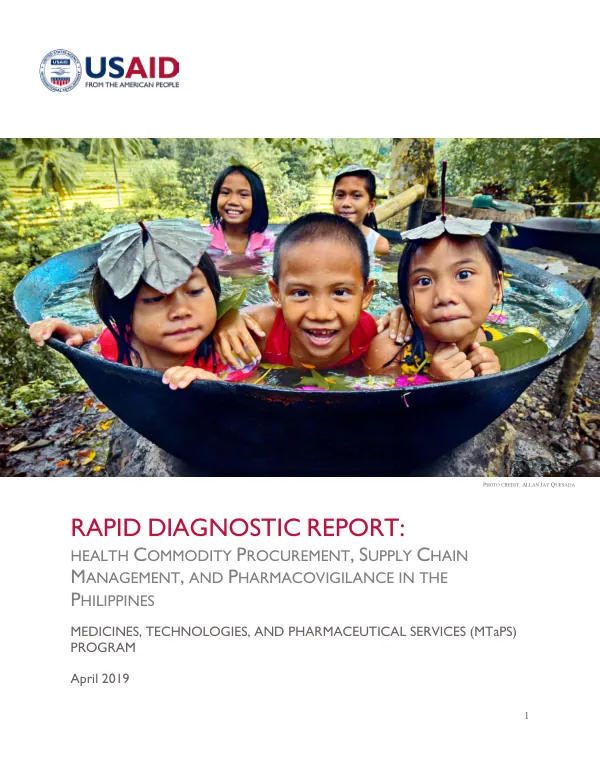
Rapid Diagnostic Report: Health Commodity Procurement, Supply Chain Management, and Pharmacovigilance in the Philippines
Sign inDEPARTMENT OF HEALTH
Rapid Diagnostic Report: Health Commodity Procurement, Supply Chain Management, and Pharmacovigilance in the Philippines
Health commodity procurement and supply chain management (PSCM) play a crucial role in achieving better health outcomes in the Philippines.
2019 · 30 pages
Sign in to readA free account is required to download.
Abstract
The Philippine Health Agenda 2016–2022 aims to provide better health services to people at all stages of life, create functional service delivery networks, and expand health insurance to every Filipino. However, frequent stock-outs, high prices of health commodities, and a shortage of professional workforce hinder progress toward achieving these goals. The Department of Health (DOH) has implemented measures to address these limitations, including the establishment of the Philippine National Formulary System (PNFS) and the procurement and supply chain management team (PSCMT). The PSCMT is responsible for improving PSCM functions, including last-mile health commodity delivery to health facilities. The team is also required to use the PNF as the basis for objective, transparent, and efficient processes in DOH health commodities procurement and distribution. A rapid diagnostic assessment was conducted through stakeholder consultations and a literature review to inform strategic and tactical interventions for the national PSCM strategic plan. The assessment identified nine focus areas for potential system strengthening interventions, including governance of procurement and supply chain management, capacity at the central, regional, and local government unit (LGU) levels, information systems and the use of data for PSCM decision making, and demand and supply of health commodities. The diagnostic approach included a literature review and in-person stakeholder consultations with DOH-targeted institutions, including the Bureau of Local Health Systems Development, Finance, Disease Prevention and Control Bureau, Food and Drug Authority, Health Emergency Management Bureau, HIV Program, Knowledge Management and Information Technology Service, Logistic Management Division, Pharmaceutical Division, PhilHealth, Procurement Services, and the Research Institute for Tropical Medicine. Interviews were also carried out among representatives from the USAID mission and its implementing partners, World Health Organization country representatives, and the Supply Chain Management Office. The assessment found that the DOH has made significant progress in strengthening its PSCM system, including the establishment of the PSCMT and the implementation of the PNFS. However, challenges remain, including the need for improved governance of procurement and supply chain management, increased capacity at the central, regional, and LGU levels, and enhanced information systems and data management. The report recommends several interventions to address these challenges, including stopgap and systemwide strategic PSCM system strengthening interventions. Stopgap interventions are geared toward the immediate transactional and operational issues within each PSCM functional area that contribute to stock-outs of essential health commodities at health facilities. Systemwide strategic PSCM system strengthening interventions are long-term strategic approaches that seek to guarantee higher holistic PSCM and PV system performances and better health outcomes for Filipinos. The report also highlights the importance of pharmacovigilance in ensuring the safety and efficacy of health commodities. The DOH has established a pharmacovigilance system, which includes the Pharmacovigilance Monitoring System (PViMS) and the Human and Institutional Capacity for Pharmacovigilance. However, challenges remain, including the need for improved data management and analysis, and enhanced human and institutional capacity for pharmacovigilance. In conclusion, the report highlights the importance of strengthening the PSCM system in the Philippines to ensure the uninterrupted availability of quality-assured, safe, and affordable health commodities. The report recommends several interventions to address the challenges identified, including stopgap and systemwide strategic PSCM system strengthening interventions, and highlights the importance of pharmacovigilance in ensuring the safety and efficacy of health commodities.
Related documents