COLORADO STATE UNIVERSITY. DEPT. OF ECONOMICS
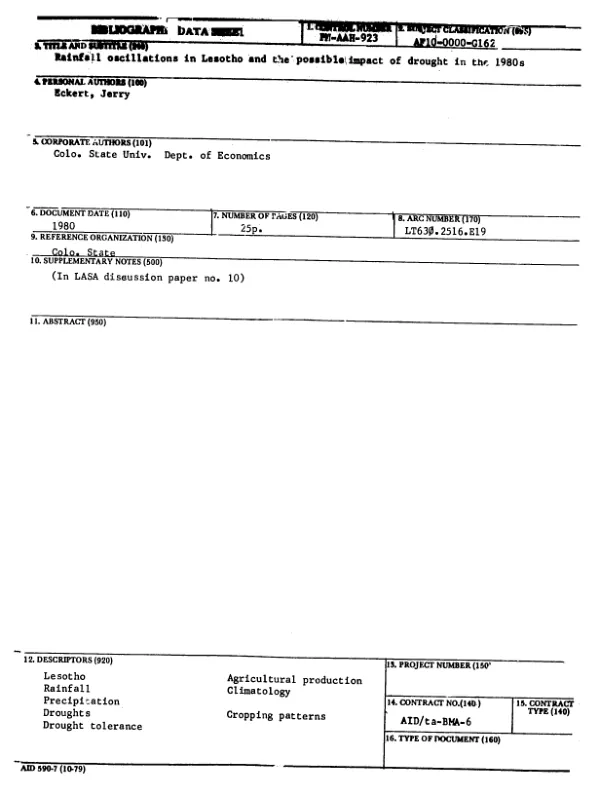
QUANTITATIVE ANALYSES OF LESOTHO"S OFFICIAL YIELD DATA FOR MAIZE AND SORGHUM
Crop yield estimates computed by Lesotho"s Bureau of Statistics have undergone considerable scrutiny recently.
ECKERT, JERRY B. · 1970
Sign in to readA free account is required to download.
Abstract
The Bureau"s data seem unreliable, showing a long-term decline in yields, a high degree of variability both within each year and between districts, and, in 1976/77, a jump of more than 50% over earlier averages. Climate fluctuation, however, heavily influences cropping patterns in Lesotho and may account for these anomalies. This paper analyzes, at the macro-data level, the relationships between crop yields and rainfall in Lesotho and develops mathematical equations to estimate maize and sorghum crop yields. Equally importantly, it tests the validity of Lesotho"s official crop yield statistics. Multiple linear regression, run on 39 of 59 selected recorded yield averages, was applied to determine the relationship between yield levels and monthly rainfall totals. Illustrating his conclusions with charts and mathematical equations, the author quantifies yield relationships for maize and sorghum; analyzes the accuracy of his equations and the variability in official statistics; discusses yield discontinuities, such as that for 1949/50 and 1976; and determines the applicability of the equations in predicting crop yields. The results suggest that Lesotho"s maize and sorghum yield figures are highly reliable and that their variation reflects actual agronomic and environmental determinants; proceeding with other analyses based on these data now appears warranted. Because the equations accurately model existing data, estimates are calculated for the early 1970"s when no official statistics were collected. With the help of the equations presented, government officials can make pre-harvest predictions of crop yields and can formulate better policy decisions on such issues as food imports, food aid negotiations, inter-district food movements, and strategic food reserves. A 14-item reference list (1952-80), as well as two appendices explaining the use of "dummy variables" in the equations and discussing the metholodogy used in estimating 1976 crop yields, are appended.
Related documents