COLORADO STATE UNIVERSITY. DEPT. OF ECONOMICS
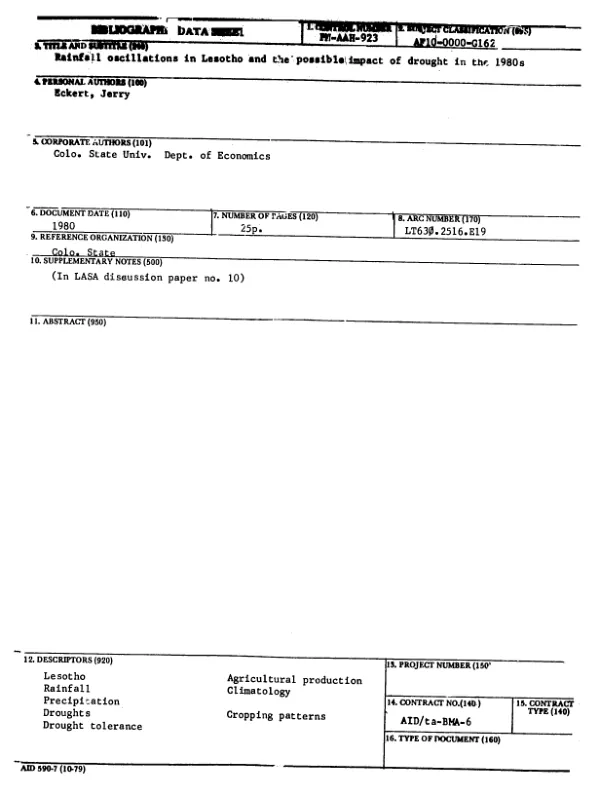
Rainfall oscillations in Lesotho and the possible impact of drought in the 1980"s
T.G.J.
Eckert, Jerry B. · 1970
Sign in to readA free account is required to download.
Abstract
Dyer and P.D. Tyson proved scientifically that rainfall over much of the "summer rainfall region" of southern Africa follows a pattern of regularly spaced wet and dry spells each 9-10 years in duration, a situation known as the "quasi 20-year oscillation" which has existed since 1841. If the pattern holds, southern Africa will enter a period of below-average rainfall in the 1980"s, with potentially ominous implications for food production. This report examines closely the findings of Dyer and Tyson, especially as they pertain to Lesotho which is situated entirely within the "summer rainfall region" and which is now coming to the end of a wet spell. Research by the Lesotho Agricultural Sector Analysis Project confirms that the model derived by the two scientists is applicable to Lesotho, whose rainfall patterns have definitely exibited the 20-year oscillation since 1945. The decrease in rainfall during this predicted dry spell will be most serious in southern Africa"s summer months, November-February. Compared to average wet-spell rainfall, average yearly summer rainfall will decrease by 20% and winter rainfall by nearly 14%. Such a dry spell may affect both maize and wheat production severely because initial, moisture-sensitive stages of growth occur during November, which may be the month of least rainfall. Drought-resistant sorghum, however, will be only slightly affected. Watercourse levels will also decline. The Ministry of Agriculture should take the following steps to minimize the effects of the predicted dry spell during the 1980"s: conduct research to improve farmer management of soil-plant-water interactions under indigenous farming conditions and test new tree and vine crops whose value per water unit is high; give priority to water conservation programs such as repair and maintenance of conservation structures; utilize the government"s seed importation capacity to obtain and spread seeds of drought-resistant varieties; and seek a high level of technical assistance to identify needs and suggest optional forms for national water rights legislation. A 15-item reference list (1971-80), as well as average monthly rainfall observations made at district headquarters stations, are appended.
Related documents