USAID DEC
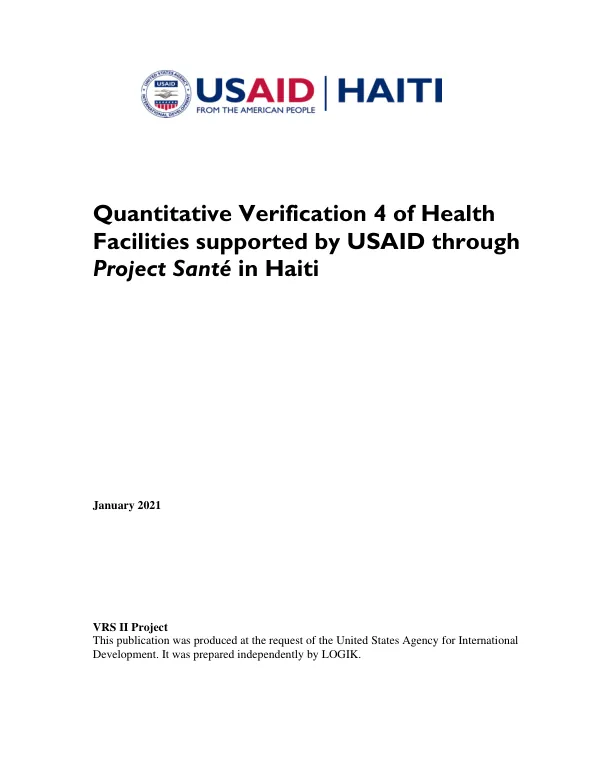
Quantitative Verification 4 of Health Facilities supported by USAID through Project Santé in Haiti
Sign inUSAID
Quantitative Verification 4 of Health Facilities supported by USAID through Project Santé in Haiti
The Vérification des Résultats pour la Santé (VRS II) contract is a four-year initiative that aims to support the verification of health service delivery quantity and quality outputs at sites supported by the Project Santé in Haiti.
2021 · 21 pages
Sign in to readA free account is required to download.
Abstract
The contract is implemented by LOGIK and funded by the U.S. Agency for International Development (USAID) under contract no. 72052119C00003, beginning August 1, 2019. The overall purpose of the VRS II contract is to certify that facility-based performance data submitted by Project Santé-supported health facilities are reliable. The two objectives of this contract are to certify that facility-based performance data submitted are reliable and to certify that, at the community level, data related to health care services provided are reliable. To achieve these objectives, VRS II conducted a service quality assessment and a quantitative verification for the quarter January-March 2020 at 61 Project Santé-supported health facilities under Results-Based Financing (RBF). These health facilities are located in seven departments: Centre, Grand'Anse, Nippes, Nord, Nord-Est, Nord-Ouest, and Sud. The quantitative and qualitative verification falls under the first objective of VRS II, which is to certify that facility-based performance data submitted by Project Santé-supported health facilities are reliable. The goals of this quantitative verification were to compare data reported by health facilities with the content of the registers or other data sources for the quarter January-March 2020. The auditors recounted the results from source documents and compared the verified figures to the ones reported by health facilities for each quantitative indicator. The results of the quantitative verification show data quality issues. In more than one-third of the facilities, there was a large difference (more than 25%) between verified and reported figures for the following indicators: "Number of children from 6 to 59 months old screened for acute malnutrition at the health facility" and "Number of infants born to HIV positive mother placed on ARV prophylaxis within 72 hours." The proportion of data quality issues is 20 percent. The data quality issues are due mainly to the following factors: the data collected from the source documents may not have sufficient precision to measure the indicator, health facility staff are not always aware of the indicator definitions, and missing source documents, especially for community-based services, are a factor. To address these issues, it is recommended that health facility staff be trained on indicator definitions so that they collect all data and aggregate the data according to the definition. Additionally, the standard MSPP registers should be used at all health facilities to record data, and they should be properly stored and be available for verification. The quantitative verification was conducted using the revised quality checklists developed by the Ministère de la Santé Publique et de la Population (MSPP) as part of the RBF model. The senior technical team monitored the fieldwork and provided on-the-spot guidance to auditors. The results of the quantitative verification show that there are data quality issues that need to be addressed to ensure the reliability of facility-based performance data submitted by Project Santé-supported health facilities.
Related documents
![Measurement Approaches for Effective Coverage Estimation [MR31]](https://covers.devme.ai/gen/138167.webp)