USAID
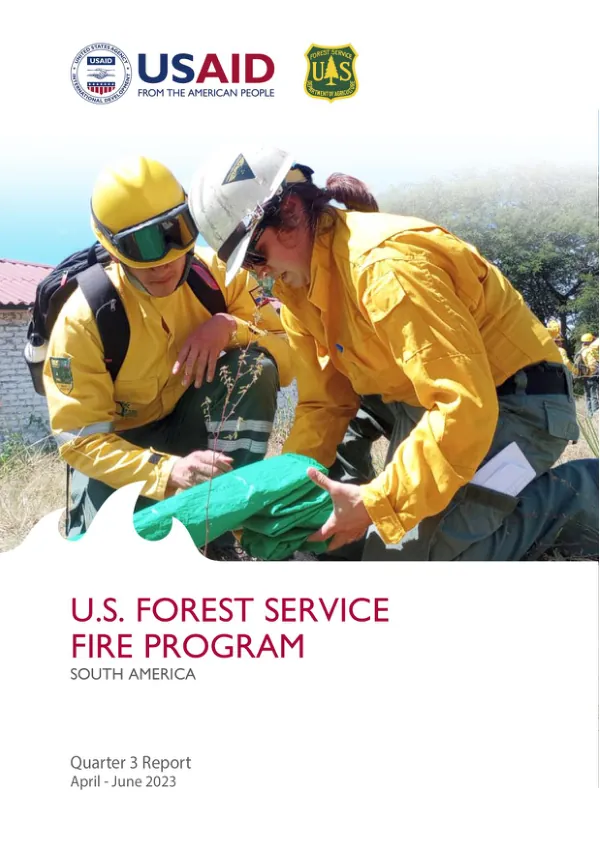
Quarter 3 Report, 2023: South America Regional Fire Program
The South America Regional Fire Program made significant progress in Quarter 3 (Q3) on multiple program strategies.
2023 · 36 pages
Sign in to readA free account is required to download.
Abstract
Despite political disruptions in Ecuador, which caused an activity to be postponed from Q2 to Q3, all planned activities and tasks were completed with successful results. During the quarter, the Fire Program supported Ecuador's Amazon without Fire Program (PASF), part of The Ministry of Environment, Water and Ecological Transition (MAATE), in the continuation of the Wildland Fire Prevention Backpack. The program organized an additional train-the-trainer workshop to be completed in the first week of Q4. A change in leadership for the project within PASF caused a slight delay in the national rollout of the project, but Q4 looks to complete additional workshops to distribute Backpacks to all trained personnel and implement an action plan to begin engaging with strategic communities facing wildland fire risks across the country. In Brazil, Operação Amazônia Nativa (OPAN) finished the design and production of the Wildland Fire Prevention Backpack and Guide for the Xavante Marawaitsede Indigenous Land. The Wildland Fire Prevention Backpack has now been adapted to every country in the Fire Program with at least one train-the-trainer session completed and a national rollout plan in progress. A large activity, including the instruction of a series of basic courses, was completed along the border of Ecuador and Peru. This training involved 15 students from Ecuador and 15 from Peru who all work in fire management within the Bosques de Paz Transboundary Biosphere Reserve (RBTF-BP), an important international reserve facing increasing threats from wildfire. These courses marked the first step toward assisting Ecuadorian and Peruvian partners to build capacity in fire management along the border, resulting in more resilient communities and cohesive fire response and prevention along an international border. Peru's National Meteorology and Hydrology Service (SENAHMI) participated in a technical study exchange in the United States that served as the culmination event of all the work they have completed with the USFS implementing improvements to their fire danger forecasting systems. In Q4, these improvements will be published on their platform and will finalize the process of improvements at the national level. Peru is the first of the Fire Program participating countries to finalize this process with the USFS and will serve as an example for the rest of the countries as they quickly advance along the same path. Proposals are now being analyzed to bring the forecasting information down to an accessible, local level for use by land users and rural communities. The Fire Program strives to continuously build and strengthen cooperation with other international entities working on fire management to build capacity and complement similar programs. This quarter, a representative from the Fire Program presented during the International Wildland Fire Conference (IWFC, Oporto, Portugal, May 16-19th), sharing programmatic strategies and achievements, thereby strengthening institutional relationships with key international agencies. Additionally, the Fire Program continues to meet periodically with The German Society for International Cooperation (GIZ), to ensure synergies are identified and replications are avoided while they create a regional fire program with funding from Amazon Cooperation Treaty Organization (ACTO). An important milestone was reached in Q3 regarding the Standardized Curriculum and Qualifications System (SCCE) in Peru. The Peruvian agencies that have operational personnel for wildland fire response, the National Institute of Civil Defense (INDECI), the National Forest Service (SERFOR), the National Service of Natural Protected Areas by the State (SERNANP), the Ministry of Culture, the Ministry of Environment (MINAM), and the National Fire Department of Volunteer Firefighters (INBP-CGBVP), sent institutional letters to the Fire Program reaffirming their commitment to the implementation of the SCCE. The Fire Program continues to assist the Peruvian agencies with the full adoption of the system. Once again, Peru is serving as the example in successful implementation for the rest of the participating countries, in which Ecuador and Colombia have both seen great progress toward the same outcome in the coming year. Blue Forest Conservation, USFS-IP NGO partner, completed their economic feasibility study to identify potential stakeholders, opportunities, and limitations to establish a Forest Resilience Bond (FRB) to engage private sector funds in wildland fire prevention and preparedness in Machu Picchu. Findings culminated into a cohesive presentation to USFS and presentations to stakeholders, highlighting the potential for private sector investment in wildland fire prevention and preparedness in the region.
Related documents