KNCV
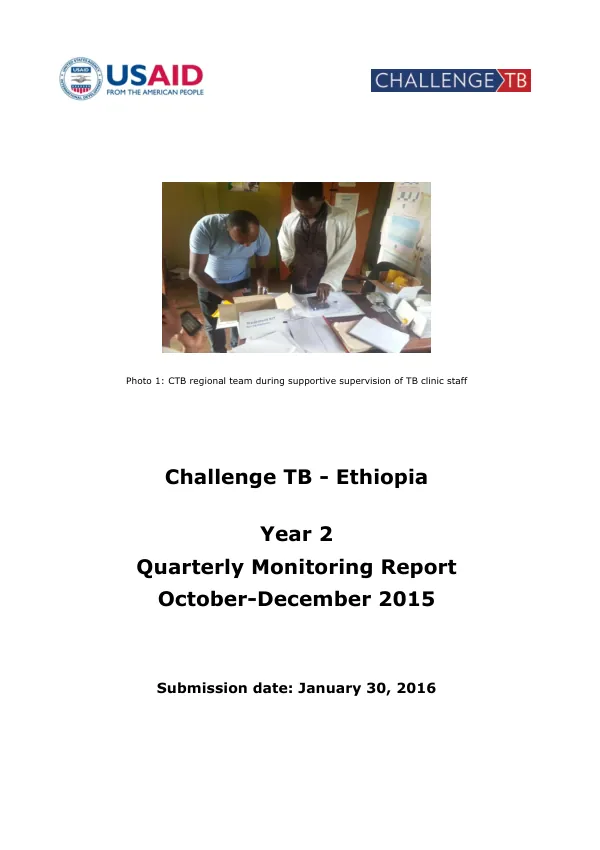
Quarterly Monitoring Report: Challenge TB - Ethiopia Year 2
Challenge TB in Ethiopia is a program aimed at controlling tuberculosis (TB) in the country.
2016 · 38 pages
Sign in to readA free account is required to download.
Abstract
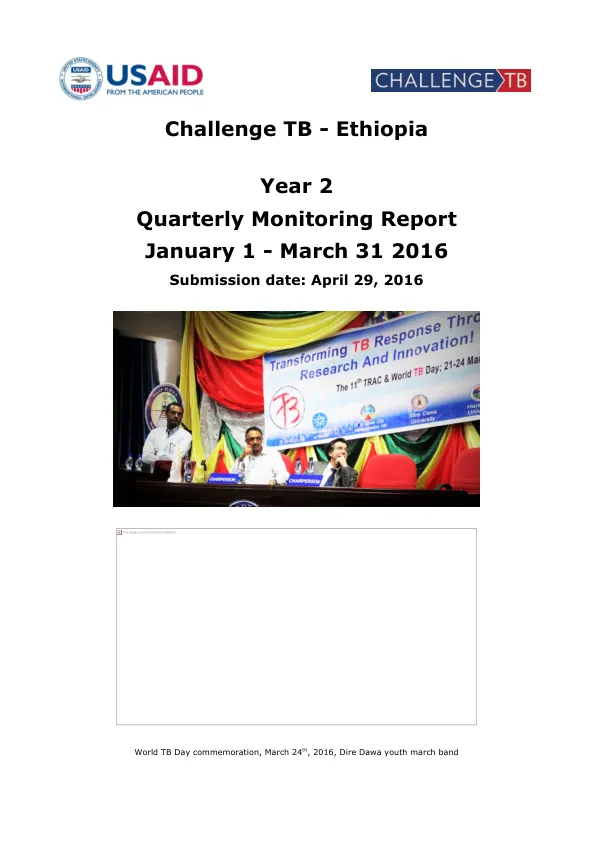
The program is led by KNCV, in collaboration with other partners including the Ministry of Health (MOH) and the World Health Organization (WHO). The program's workplan for the period from October 2015 to September 2016 focuses on several key objectives, including enabling environment, comprehensive diagnostics, patient-centered care and treatment, infection control, and quality data, surveillance, and monitoring and evaluation (M&E). One of the key achievements of the program in the second quarter of 2016 was the completion of a TB situation assessment in the Southern Nations, Nationalities, and Peoples' Region (SNNPR) and Tigray regions. The assessment identified several challenges, including a shortage of proper rooms, power interruptions, and a lack of water supply in some health facilities. The program has committed to supporting the implementation of action plans to address these gaps. The program also conducted an external quality assurance (EQA) onsite assessment in 40 health facilities in the two CTB-supported zones of SNNPR. The assessment identified several gaps, including low coverage of training of lab personnel, weak EQA participation of health facilities, and underutilization of Xpert. The program has committed to continuing to support the implementation of action plans to address these gaps. In addition, the program supported the participation of four laboratory staff in a hands-on training on first- and second-line drug susceptibility testing (DST) at the Uganda supranational reference lab. The training aimed to build national capacity on culture and DST and establish a Centre of Excellence (CoE) for TB diagnostics. The program also conducted a comprehensive TB-IC package assessment, which aimed to ensure best practices in infection control, including the use and maintenance of Germicidal UV (GUV) in ALERT and St Peter's hospitals as MDR/XDR-TB Centers of Excellence and other MDR-TB Treatment Initiation Centers (TICs) and Follow-up Centers (TFCs) in the country. Furthermore, the program supported the development of an operational research protocol titled "Households and community hot-spots of MDR-TB transmission: Assessment of TB infection control status in SNNPR." The evidence generated from this research will be used to guide community-level TB infection control implementation in the region. The program also supported the use of QuanTB, an electronic forecasting, quantification, and early warning tool designed to improve procurement processes, ordering, and planning for TB treatment. The Federal Ministry of Health (FMOH), in collaboration with a GLC/GDF mission, conducted a national quantification exercise for anti-TB drugs using the QuanTB tool. The exercise resulted in the cancellation of two shipments for second-line drugs (SLDs), the placement of an emergency order for INH for both adult and pediatric patients, and the cancellation of Ethambutol-100mg due to overstock. In addition, the program trained 35 pharmacy professionals and MDR TB focal persons from all Treatment Initiating Centers (TICs) in Tigray on the management of second-line TB drugs (SLDs). The training aimed to improve the management of SLDs at the health facility level to avoid unforeseen stockouts or expiry of SLDs. The program also supported the commemoration of the 11th annual national TB research conference and World TB Day in Dire Dawa City Administrative from March 21st-24th, 2016. The events were organized by the NTP/FMOH, Dire Dawa regional health bureau, Dire Dawa University, and Haromaya University with technical and financial support from CTB and other partners working on TB and TB/HIV.
Related documents