USAID DEC
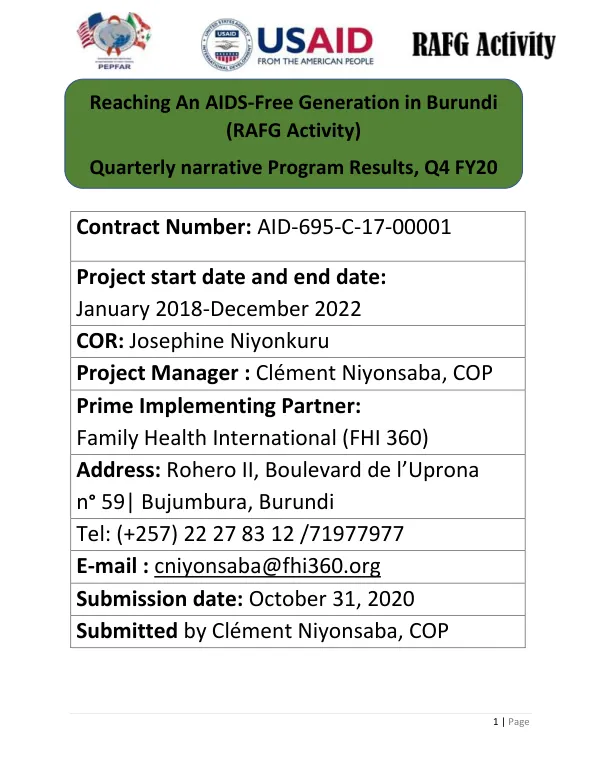
Quarterly Narrative Program Results, Q4 FY20: Reaching An AIDS-Free Generation in Burundi (RAFG Activity)
Sign inFAMILY HEALTH INTERNATIONAL
Quarterly Narrative Program Results, Q4 FY20: Reaching An AIDS-Free Generation in Burundi (RAFG Activity)
The Reaching An AIDS-Free Generation in Burundi (RAFG Activity) project is a five-year USAID/PEPFAR-funded initiative implemented by Family Health International (FHI 360) in Burundi.
2020 · 56 pages
Sign in to readA free account is required to download.
Abstract
The project began in January 2018 and aims to accelerate the achievement of the first 95, with a focus on optimizing case-finding through index testing and highly-targeted testing strategies. The project also focuses on the second 95, retention for those who enrolled on Antiretroviral Therapy (ART), and the third 95, viral load test demand creation and results return. During the fourth quarter of fiscal year 2020 (Q4 FY20), the project implemented HIV activities based on three intermediate results. The project reinforced and strengthened strategies implemented in Q3 FY20, which are aligned with UNAIDS's three 95s. The project continued to report on key indicators on a weekly basis according to High-Frequency Report (HFR) requirements. The key indicators reported include HIV Testing Service (HTS) tests conducted, HTS tests positive, index testing, index testing positive, new ART initiations, current ART patients, and tuberculosis prevalence. The project also reported on the proportion of same-day ART initiation, community ART distribution points, and tuberculosis/HIV coverage. In Q4 FY20, the project implemented index testing, including Partner Notification Services (PNS), and highly-targeted testing strategies through other high-yield modalities such as Provider-Initiated Testing and Counseling (PITC) and TB clinics. The project continued to accelerate the implementation of test-and-start, same-day ART initiation, transition to TLD, Differentiated Model of Care, and decentralized drug distribution approach to strengthen community linkage and ART retention. The project also focused on viral load test demand creation and results return by facilitating sample collection, transport, and reducing the viral load result turnaround time using the IBIPIMO application. The project continued to work in close collaboration with health districts and civil society organizations, including ANSS, SWAA, Nouvelle Esperance, Service Yezu Mwiza, and RBP+. The project's achievements in Q4 FY20 include a 27% increase in HIV testing services, a 25% increase in ART initiations, and a 30% increase in viral load tests conducted. The project also reported a 95% retention rate for ART patients and a 90% viral load suppression rate. The project's challenges in Q4 FY20 included laboratory capacity constraints, which resulted in a 20% decrease in viral load test results return. The project also faced challenges in implementing index testing, particularly in rural areas, due to limited resources and infrastructure. The project's future plans include continuing to implement index testing and highly-targeted testing strategies, accelerating the implementation of test-and-start, same-day ART initiation, and transition to TLD. The project also plans to strengthen community linkage and ART retention through decentralized drug distribution and Differentiated Model of Care.