USAID DEC
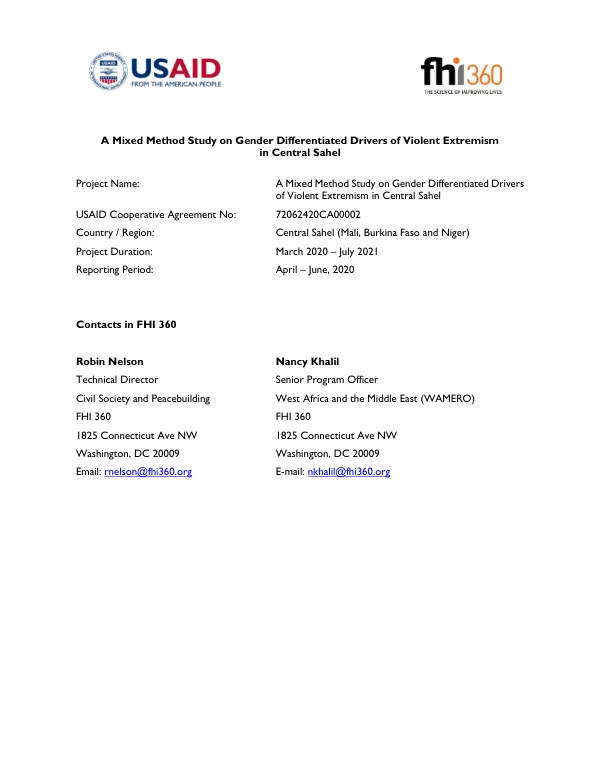
Quarterly Performance Report #2 (April – June, 2020) for A Mixed Method Study on Gender Differentiated Drivers of Violent Extremism in Central Sahel
Sign inFHI 360
Quarterly Performance Report #2 (April – June, 2020) for A Mixed Method Study on Gender Differentiated Drivers of Violent Extremism in Central Sahel
The project, A Mixed Method Study on Gender Differentiated Drivers of Violent Extremism in Central Sahel, is a research initiative funded by the United States Agency for International Development (USAID) Cooperative Agreement No.
2020 · 5 pages
Sign in to readA free account is required to download.
Abstract
72062420CA00002. The project aims to investigate the gender-differentiated drivers of violent extremism in the Central Sahel region, which includes Mali, Burkina Faso, and Niger. The project began in March 2020 and is scheduled to conclude in July 2021. The reporting period for this quarterly performance report spans from April to June 2020. The project is led by FHI 360, a global health and development organization, with technical support from various partners. The research methodology employed by the project involves a mixed-methods approach, combining both quantitative and qualitative analysis. The quantitative study utilizes data from open sources, including Afrobarometer and ACLED (Armed Conflict Location & Event Data project), to identify the best statistical models for analysis. The qualitative study involves a literature review to update and diversify sources, including French-language sources, to provide different perspectives. During the reporting period, the project made significant progress in data collection and analysis. Dr. Gabriel Katz, the analyst, imported and cleaned data from various sources and developed several statistical models to determine the best 'fit' according to statistical criteria. The project also held a call with USAID to present the multi-level mixture model and received feedback, which was incorporated into the statistical models. The project also made progress in the qualitative study, with Technical Officer Sarah Gates and Research Officer Loubna Rais conducting a literature review to update and diversify sources. The first draft of the literature review will be submitted during the next reporting period. In terms of project management, the project team finalized the request for applications (RFA) for local research partners and submitted a list of potential partners to USAID for review and comment. The RFA will be issued early in the next reporting period. The project also submitted the first draft of the Annual Work Plan, which was approved by USAID/WA on June 16, 2020. The project's dissemination plan includes validation workshops, but no activities related to these workshops were implemented during the reporting period. The project team also identified challenges and lessons learned, including a slight delay in submitting the revised Activity Monitoring and Evaluation Plan (AMEP) to USAID/WA. However, the project team has brought on a new technical officer to mitigate any further delays. The project's financial summary indicates that FHI 360 has obligated $734,061 and spent $26,239, with an obligation available of $707,822. The project has spent 4% of the total obligation to date. The project's next reporting period will focus on presenting preliminary findings from the Quantitative Study to USAID, revising and submitting the Annual Work Plan, completing and submitting the literature review, and submitting the first draft of the Quantitative Study. The project team will also review applications from potential local partners, select a partner, and submit for approval to USAID.
Related documents
Documents in this collection
 2020
2020USAID DEC
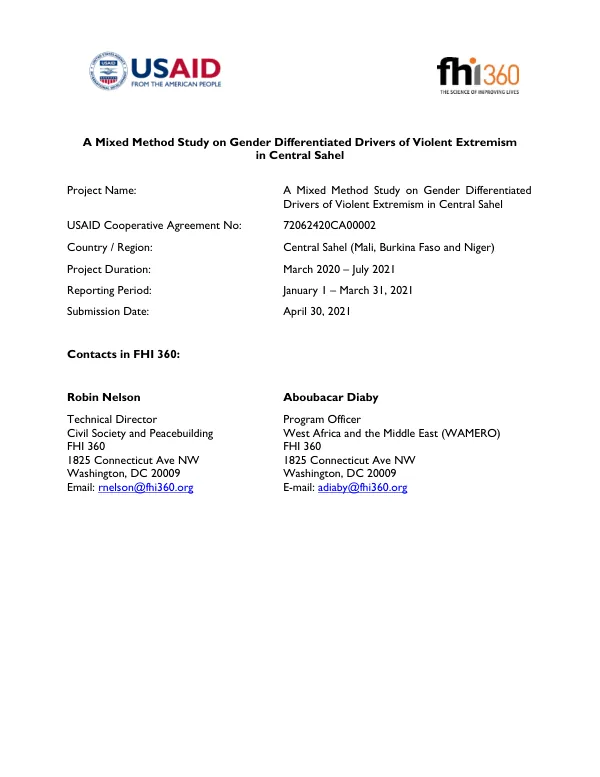
Quarterly Performance Report #5 (January 1 – March 31, 2020) for A Mixed Method Study on Gender Differentiated Drivers of Violent Extremism in Central Sahel
Open record 2020
2020USAID DEC