MANAGEMENT SYSTEMS INTERNATIONAL
Violent Extremism, Conflict, and Trafficking Dynamics in Libya and the Sahel
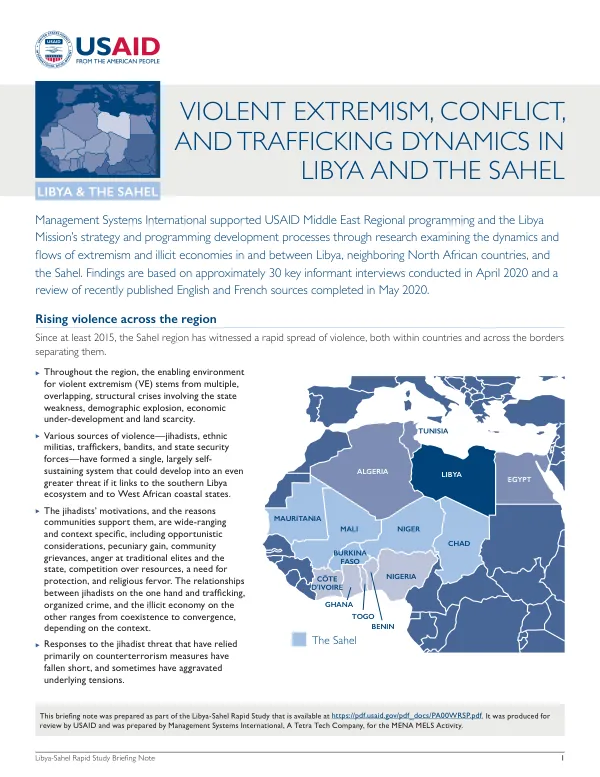
The Sahel region has witnessed a rapid spread of violence since at least 2015, with multiple, overlapping structural crises contributing to an enabling environment for violent extremism.
2020 · 2 pages
Sign in to readA free account is required to download.
Abstract
State weakness, demographic explosion, economic under-development, and land scarcity are among the key factors driving this trend. Various sources of violence, including jihadists, ethnic militias, traffickers, bandits, and state security forces, have formed a single, largely self-sustaining system that poses a significant threat to regional stability. The motivations of jihadists and the reasons communities support them are wide-ranging and context-specific, including opportunistic considerations, pecuniary gain, community grievances, anger at traditional elites and the state, competition over resources, a need for protection, and religious fervor. The relationships between jihadists and trafficking, organized crime, and the illicit economy range from coexistence to convergence, depending on the context. Counterterrorism measures have fallen short, and sometimes have aggravated underlying tensions. The Sahel-Sahara region's illicit economies have undergone significant changes since 2015, with tighter linkages between different types of illicit cross-border flows and a more integrated illicit economy as a whole. Trading routes have become more militarized, posing a greater risk of violence. Trafficking in high-value commodities such as cocaine and heavy weapons has contracted, while trade in easily portable tramadol has expanded significantly, reflecting and fueling an epidemic of drug abuse. The spread of insecurity in central Mali, western and northern Niger, and across Burkina Faso has stimulated illicit trade in light weapons. The artisanal gold trade has become an increasingly important factor in the region's illicit economies and to violent extremist organizations. Arms flows now go at least as often from the Sahel to Libya as in the opposite direction. The earlier northbound migration of migrants to Libya has lessened, while southbound, reverse migration to Niger is now taking place. The human-smuggling industry has contracted considerably since its peak in 2015, but has also gone largely underground, leading to even greater abuse of migrants. These trends largely reflect traffickers' efforts to adapt to anti-immigration and anti-trafficking policies adopted by the European Union and supported by governments in the region. In Libya, the violent competition between the Government of National Accord (GNA) in Tripoli and a parallel administration in the East, along with the overall breakdown of effective governance across the country, has enabled a wide array of non-state armed groups to compete for territory. The Fezzan, a region in southwestern Libya, is of particular concern from the perspective of violent extremism, conflict, and trafficking. Most of Libya's minority groups live in the Fezzan, and their longstanding grievances toward the state, along with tribal and ethnic conflicts, could be exploited by violent extremist groups. The Fezzan remains the hub of Libya's illicit economy and functions as a conveyor belt to and from illicit markets in the Sahel and West Africa.