CHEMONICS
Quarterly Performance Report (April-June 2015)
The Mongolia Business Plus Initiative (BPI) project, funded by the United States Agency for International Development (USAID), supports the Government of Mongolia's (GOM) efforts to establish an enabling business environment conducive to diversified economic growth.
2015 · 34 pages
Sign in to readA free account is required to download.
Abstract
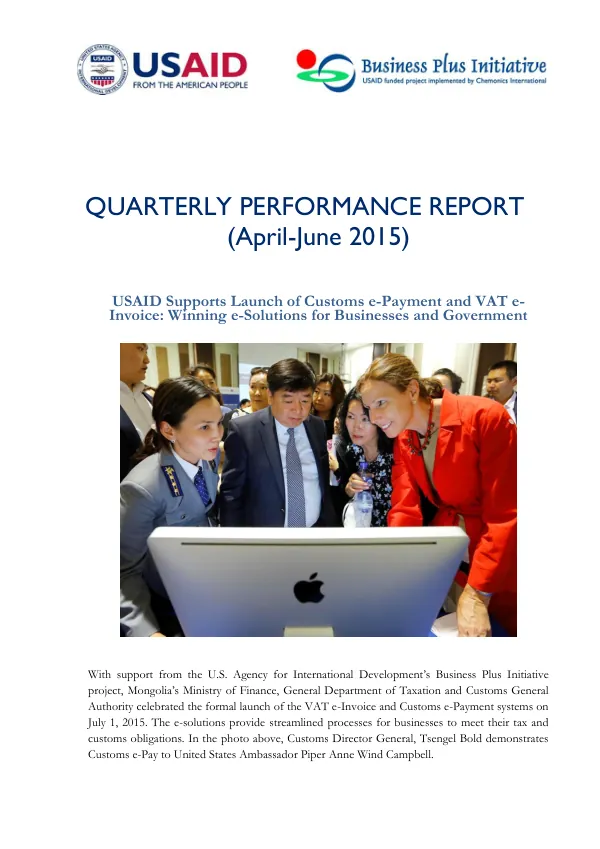
The project aims to create improved economic opportunities for the people of Mongolia by ensuring the participation of the private sector in a structured and productive dialogue with government. This report describes project activity from April through June 2015. During the reporting period, BPI largely completed the technical assistance activities laid out in the Memoranda of Understanding (MOUs) between USAID and the Customs General Authority (CGA) and the General Department of Taxation (GDT). BPI activities with CGA focused on enhancing the customs valuation module, completing the customs e-payment system, and strengthening post-clearance audit capacity. BPI activities with GDT focused on finalizing the development of the VAT e-invoicing system. On July 1, Ambassador Piper Anne Wind Campbell and Mongolian Deputy Minister of Finance Purev Surenjav opened the formal launch of the VAT e-Invoice and Customs e-Payment Systems. BPI also assisted the GDT and CGA to develop communications materials to launch strategic public awareness and education campaigns to promote broad usage of the agencies' new e-systems. Furthermore, BPI made great strides in supporting a draft Arbitration Law that is in-line with the UNCITRAL Model Law on Commercial Arbitration. Working in close collaboration with the Ministry of Justice (MOJ) Working Group and international experts, the law now reflects the spirit of the model law while incorporating MOJ comments and accounting for the Mongolian context. The law is to be submitted to the Cabinet in August 2015. In addition, BPI continued to support capacity building in arbitration through a partnership with Asia's leading international arbitration center, the Singapore International Arbitration Center (SIAC), to train over 150 lawyer, judges, academics, and arbiters in the fundamentals of international arbitration. As of the end of the reporting period, the Quality Supplier Development Center (QSDC) is providing assistance to 29 Small and Medium Enterprises (SME) clients under the project. The project's progress in implementing the work plan is reflected in the achievement of several Key Result Areas (KRAs). PIR 1: Business enabling environment, governance, and country competitiveness policies and practices improved, with significant accomplishments in enhancing the customs valuation module and completing the customs e-payment system. PIR 2: Private sector capacity and competitiveness strengthened, with notable progress in supporting the development of the VAT e-invoicing system and capacity building in arbitration. PIR 3: National dialogue on business enabling environment and country competitiveness strengthened, with the launch of the VAT e-Invoice and Customs e-Payment Systems and the development of communications materials to promote broad usage of the agencies' new e-systems. The project's next steps for the coming quarter include continuing to support the implementation of the customs e-payment system and the VAT e-invoicing system, as well as providing assistance to SME clients under the project. The project will also continue to support capacity building in arbitration and the development of the Arbitration Law.
Related documents