CHEMONICS
Quarterly Performance Report (April - June 2012)
The Mongolia Business Plus Initiative (BPI) is a USAID-funded project aimed at enhancing the role of the private sector in Mongolia's economic growth.
2012 · 30 pages
Sign in to readA free account is required to download.
Abstract
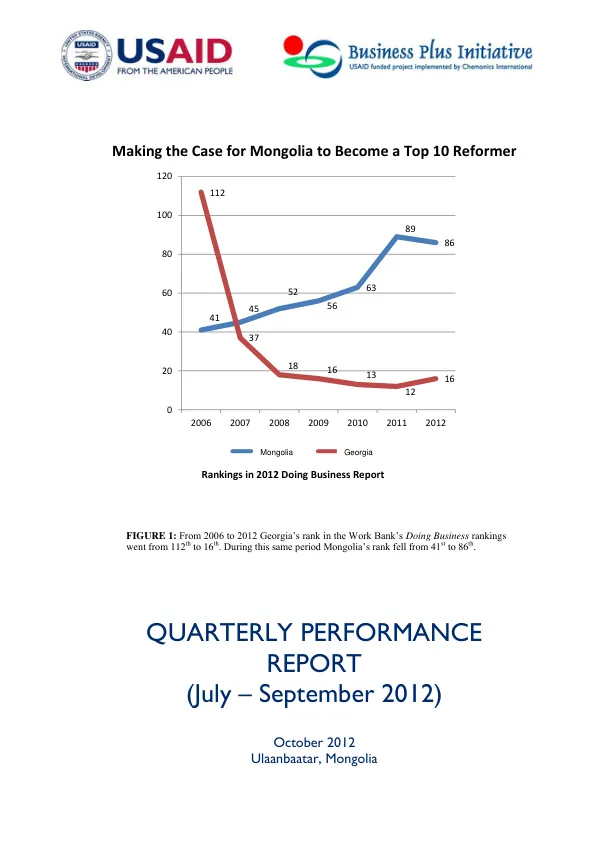
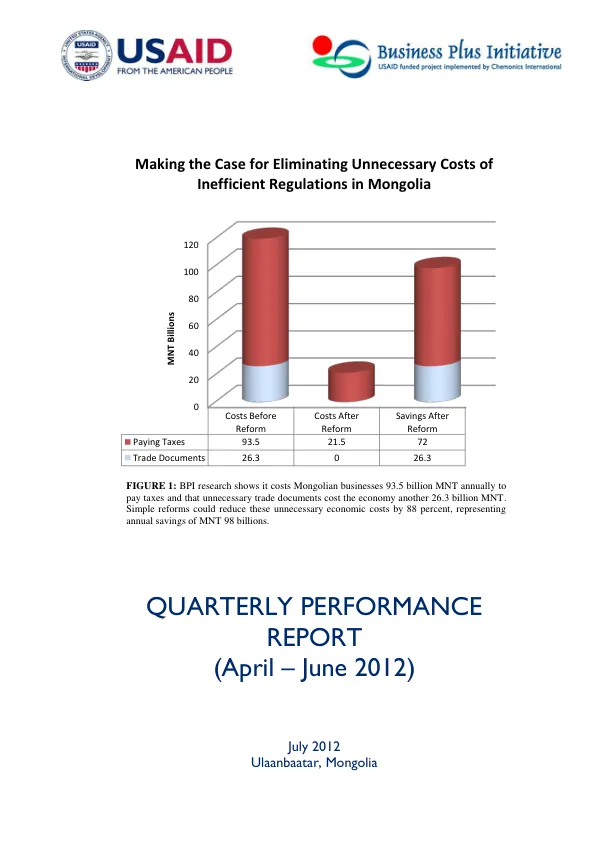
The project's vision is to develop the capacity of business and civil society to participate in a structured and productive dialogue with government to improve the business environment and address bottlenecks to country competitiveness. BPI complements and supports the Government of Mongolia's strategy to advance business enabling policies, strengthen private sector competitiveness, and increase financial sector capacity. The project focuses on business enabling environment (BEE), governance, and country competitiveness initiatives with high impact potential in the medium term. BPI engages and develops the capacity of business and civil society to develop actionable proposals to address BEE, governance, and country competitiveness issues. The project facilitates public-private dialogue on BEE, governance, and country competitiveness issues, publicizes examples of best international practices and successful country experiences, and leverages project resources through partnerships that contribute tangible resources. According to Figure 1, BPI research shows that it costs Mongolian businesses 93.5 billion MNT annually to pay taxes and that unnecessary trade documents cost the economy another 26.3 billion MNT. Simple reforms could reduce these unnecessary economic costs by 88 percent, representing annual savings of MNT 98 billion. The project has made significant accomplishments in the first quarter of Year Two. BPI initiated an innovative approach to build meaningful engagement between public and private sectors in reducing the high cost of doing business and improving economic governance. The project has also engaged and developed the capacity of business and civil society to develop actionable proposals to address BEE, governance, and country competitiveness issues. BPI's work plan implementation is divided into three components. Component 1 focuses on improving the business enabling environment, governance, and country competitiveness policies and practices. Key results for this component include simplifying trade, paying taxes, getting new electricity connections, and construction procedures, as well as strengthening the enabling legal and regulatory environment for trade, business, and finance. Component 2 focuses on strengthening private sector capacity and competitiveness. Key results for this component include strengthening the capacity of Mongolian private sector firms to sell products and services meeting buyers' demand, as well as facilitating partnerships that leverage resources to improve business and country competitiveness. Component 3 focuses on strengthening the national dialogue on business enabling environment, governance, and competitiveness. Key results for this component include increasing public awareness of country competitiveness and governance issues, business enabling environment reforms, international experiences, and best practices. BPI's activities by the numbers include training over 2,500 farmers in sustainable agriculture techniques, establishing demonstration plots in 15 communities, and facilitating public-private dialogue on BEE, governance, and country competitiveness issues. The project has also deployed short-term technical assistance and has a strong team of long-term expatriate and local personnel. The project's next steps for the coming quarter include continuing to focus on business enabling environment, governance, and country competitiveness initiatives with high impact potential, engaging and developing the capacity of business and civil society, and facilitating public-private dialogue on BEE, governance, and country competitiveness issues.
Related documents