BATANGAS PROVINCE CHAMBER OF COMMERCE AND INDUSTRY, INC.
Quarterly Performance Report (January – March 2013)
The Mongolia Business Plus Initiative (BPI) project, funded by the USAID, supports the Government of Mongolia's reform efforts to establish an enabling business environment conducive to diversified economic growth and the creation of better economic opportunities for the population.
2013 · 40 pages
Sign in to readA free account is required to download.
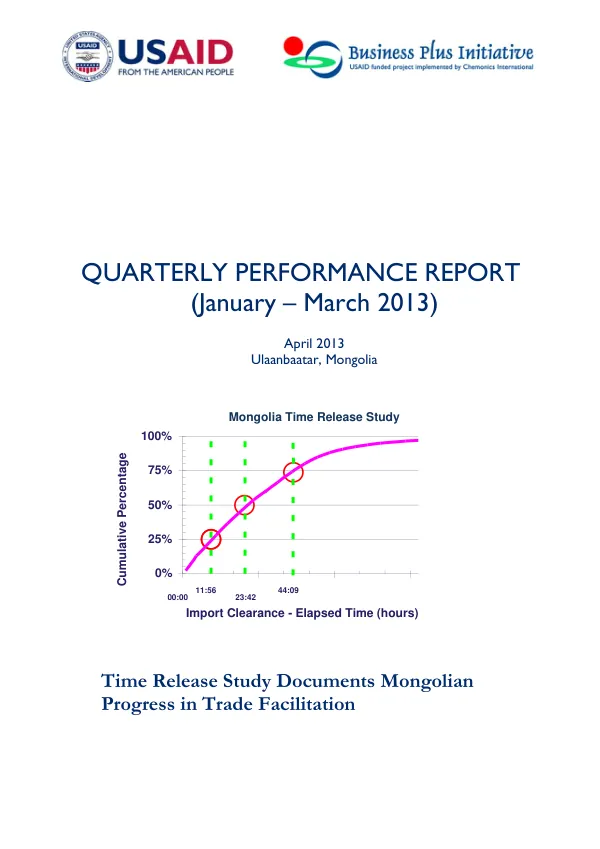
Abstract
The BPI project ensures the participation of Mongolia's private sector in a structured and productive dialogue with government to inform business enabling environment reforms and works with Mongolian private sector to address bottlenecks to country competitiveness. Throughout the reporting period, the data analysis and summary report for the Trade Release Study was concluded. Additionally, inroads in the implementation of reforms were observed in the areas of dealing with construction permitting, starting a business, getting electricity, and paying taxes. The BPI supported Quality Supplier Development Center (QSDC) delivered its first training series in the areas of food safety and Hazard Analysis and Critical Control Point (HACCP). The BPI project focuses on three key areas: improving the business enabling environment, governance, and country competitiveness policies and practices; strengthening private sector capacity and competitiveness; and facilitating national dialogue on business enabling environment, governance, and competitiveness. Key results achieved during the reporting period include the presentation of the Time Release Study summary report to the Customs General Authority, the General Authority for State Inspections, and the Mongolian National Chamber of Commerce and Industry. The Time Release Study, conducted by BPI international and national experts, as well as technical representatives of participating agencies, reported results consistent with international standards and highly credible. The study provides evidence-based data to determine the clearance time for trading across borders, which will enable Mongolia to report an elapsed clearance time for imports of less than 24 hours for the 2014 Doing Business report. This represents a reduction of 2 days from the elapsed time reported in the 2013 Doing Business Report. Furthermore, the Energy Regulatory Commission (ERC) approved a package of reformed procedures for applying for and receiving electrical connections, which is expected to reduce the time and cost to the trading community. The BPI project also supported the QSDC in delivering its first training series in food safety and HACCP, which aims to enhance the capacity of Mongolian private sector firms to meet buyers' demand. The BPI project has made significant progress in improving the business enabling environment, governance, and country competitiveness policies and practices. The project has also strengthened private sector capacity and competitiveness, and facilitated national dialogue on business enabling environment, governance, and competitiveness. The project's achievements are expected to contribute to the creation of a more favorable business environment in Mongolia, which will promote economic growth and development. The BPI project has implemented various activities to support the Government of Mongolia's reform efforts. These activities include the presentation of the Time Release Study summary report, the approval of reformed procedures for applying for and receiving electrical connections, and the delivery of training series in food safety and HACCP. The project has also supported the QSDC in delivering its first training series, which aims to enhance the capacity of Mongolian private sector firms to meet buyers' demand.