USAID DEC
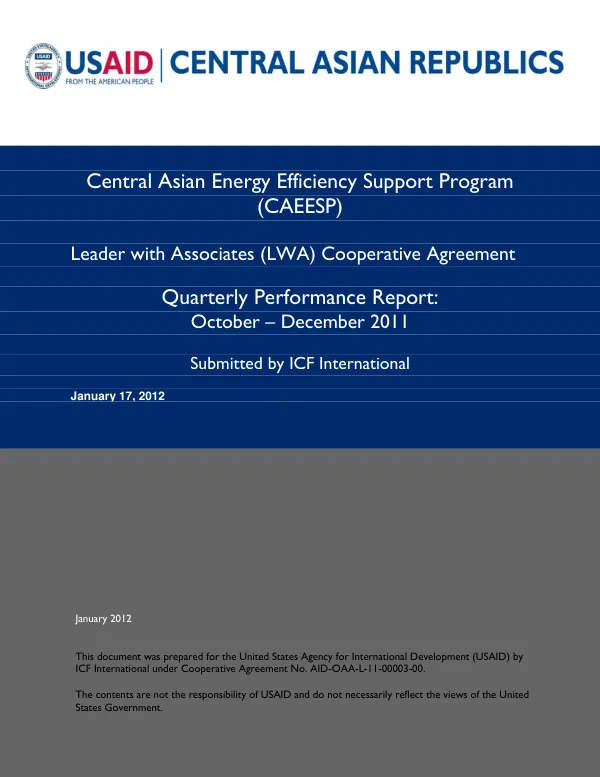
Quarterly Performance Report: October – December 2011 for Central Asian Energy Efficiency Support Program (CAEESP)
Sign inICF
Quarterly Performance Report: October – December 2011 for Central Asian Energy Efficiency Support Program (CAEESP)
The Central Asian Energy Efficiency Support Program (CAEESP) was launched in October 2011 by ICF International under a Cooperative Agreement with the United States Agency for International Development (USAID).
2011 · 13 pages
Sign in to readA free account is required to download.
Abstract
The program aims to lower existing barriers to energy efficiency improvements in Kazakhstan by focusing on enabling activities in commercial, residential, and industrial energy efficiency opportunities. The primary outcome of CAEESP is improved use and management of energy through the development of energy efficiency measures and applications. The program comprises five major tasks: initial assessment and quick start prioritization, stakeholder awareness raising and training in energy efficiency approaches and technologies, energy efficiency project development and financing facilitation, support for private sector energy efficiency service providers, and regional analysis and recommendations in the area of energy efficiency. During the first quarter of the program, ICF focused its efforts on project start-up and mobilization, completing early planning, management, and initial stakeholder consultation and analysis activities under Task 1. The team made progress on each of the primary objectives for the quarter, including program start-up and staff mobilization, early outreach and program coordination with key stakeholders, work plan development, and development of program management and administrative systems. However, the team encountered typical start-up obstacles, including working within the complex legal structure of Kazakhstan and acquiring legal support and addressing legal requirements for local staffing and registration. The project team was able to meet a variety of stakeholders and conducted three visits to Kazakhstan during the quarter. The approved Chief of Party, Evgeniy Nadezhdin, began the project and traveled to Kazakhstan in October but was not able to fulfill his requirements under the project and had to be replaced. This contributed to additional project delays as the ICF team had to recruit and seek approval for a replacement candidate. The emphasis during the end of the first quarter was to build up a strong momentum to recover time lost on technical program implementation during the early phase of the project start-up and mobilization. This requires refining the research and intelligence gathering activities of the program to maximize and optimize impact in the next phases. The logistical preparations for CAEESP are almost complete, and early meetings with stakeholders have been positive. The CAEESP team will seek to build momentum as quickly as possible and will start up activities that are more discrete and have less dependency with other project actions. The team will continue to work to improve its energy efficiency intelligence and will measure the success and conduct an internal risk assessment against every policy action considered. The CAEESP will consider the impact of the proposed laws on the program activities and will work to create a program that has internal integrity and corresponds with external events. The CAEESP team will also focus on developing the revised work program to maximize impact, extract the highest qualitative use of resources, and work towards sustainable long-term policy aims. The team will re-examine the logical flow of tasks within the current draft CAEESP work plan and will look to create a program that corresponds with external events. The CAEESP will consider the impact of the proposed laws on the program activities and will work to improve its energy efficiency intelligence. The program has made significant progress in its first quarter, despite encountering some start-up obstacles. The team has gained additional programmatic insights that will help further shape the CAEESP moving forward. The CAEESP team will continue to work to build momentum and will focus on developing the revised work program to maximize impact and work towards sustainable long-term policy aims.
Related documents