BANK FOR WEST AFRICAN DEVELOPMENT
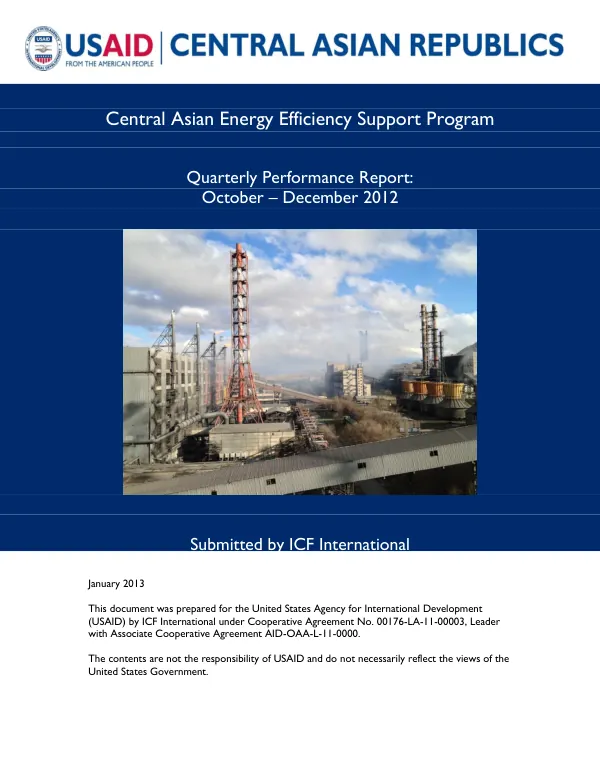
Quarterly Performance Report: October – December 2012
The Central Asian Energy Efficiency Support Program (CAEESP) was awarded to ICF International in September 2011 to effectively lower the existing barriers to energy efficiency improvements in Central Asia, particularly Kazakhstan.
2012 · 16 pages
Sign in to readA free account is required to download.
Abstract
The program comprises five major tasks: Initial Assessment and Prioritization, Stakeholder Awareness and Education in Energy Efficiency, Energy Efficiency Project Development and Financing Facilitation, Support for Private Sector Energy Efficiency Service Providers, and Regional Analysis and Recommendations. Substantial progress was made in the period October – December 2012, putting the CAEESP back on track and prepared to meet its overall goals and performance targets. Highlights of the period included official requests from several major companies to cooperate with CAEESP on conducting ISO 50001 gap analyses and analysis of their energy management systems. Gap analysis at KazPhosphate Taraz facility was successfully conducted in December, and cooperation and assistance were provided to the US Department of Energy (DOE)/Oak Ridge National Laboratory on its deep dive assessments at KazPhosphate and in other DOE activities in Kazakhstan. CAEESP participated in more than 8 events that included over 315 participants during the quarter, including presentations at two Covenant of Mayors kick-off events, one in Astana, Kazakhstan, and the second in Bishkek, Kyrgyzstan. An agreement was reached with the United Nations Economic Commission for Europe (UNECE) and the Economic and Social Commission for Asia and the Pacific (ESCAP) to co-sponsor a workshop on energy efficiency financing in April 2013. The Year 2 Work Plan and Year 1 Annual Report were submitted and USAID-approved. Task 2 – Stakeholder Awareness and Education in Energy Efficiency – was a major focus of the quarter. CAEESP organized several sessions of the energy audit and ISO training held October 8-12 by the Energy Auditor’s Association for KazakhMys energy engineers. CAEESP also participated in the kick-off event for the KAVIEK association that took place in Astana on November 15-16, and made presentations for a KAVEIK kick-off event in Almaty on October 31. Presentations were given on CAEESP and financial evaluation of residential energy efficiency measures at the Covenant of Mayors kick-off event on November 23 in Astana. The team completed a draft proposal for the Central Asia Energy Efficiency Learning Portal (CAEELP), which would significantly enhance the reach of the ISO 50001 and energy efficiency capacity-building activities initiated under CAEESP. Two success stories were developed, highlighting the benefits of energy efficiency measures in the residential sector and the implementation of energy management systems. The CAEESP Awareness and Education Strategy, as articulated in the Year 2 Work Plan, is to take advantage of opportunities to participate in events that are being organized around the country by all stakeholders in the energy sector. Overall, the CAEESP made significant progress in the period October – December 2012, with a focus on stakeholder awareness and education in energy efficiency, energy efficiency project development and financing facilitation, and regional analysis and recommendations. The program is well-positioned to meet its overall goals and performance targets, and is poised to make a significant impact in the region. The CAEESP Quarterly Report highlights the program's achievements and progress during the quarter, including the successful completion of several major activities and the participation in numerous events and workshops. The report also provides an overview of the program's strategy and goals, and highlights the importance of stakeholder awareness and education in energy efficiency. The CAEESP is a critical component of the US Agency for International Development's (USAID) efforts to promote energy efficiency in Central Asia, particularly in Kazakhstan. The program's focus on stakeholder awareness and education, energy efficiency project development and financing facilitation, and regional analysis and recommendations is well-aligned with USAID's goals and priorities in the region. The CAEESP Quarterly Report provides a comprehensive overview of the program's progress and achievements during the quarter, and highlights the importance of continued support and funding for the program. The report also provides a roadmap for future activities and initiatives, and highlights the potential for the CAEESP to make a significant impact in the region.