USAID DEC
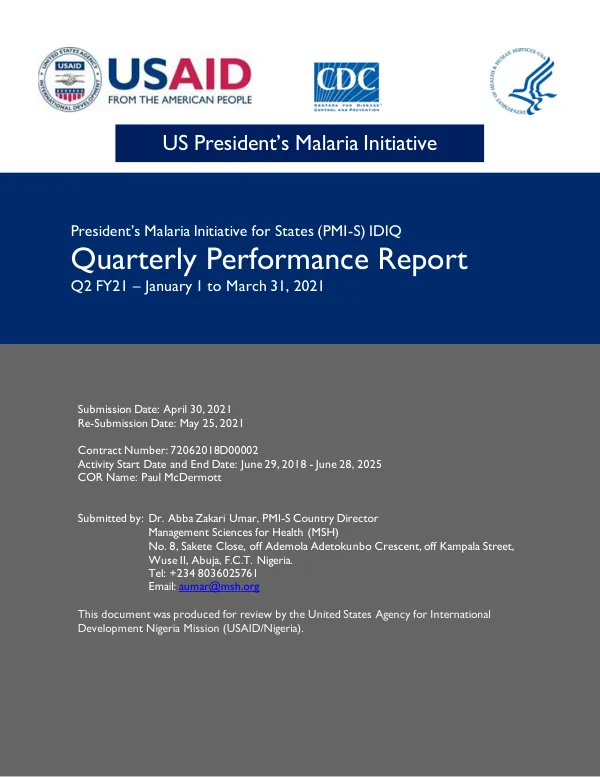
Quarterly Performance Report Q2 FY21 – January 1 to March 31, 2021 for the U.S. President’s Malaria Initiative for States (PMI-S) IDIQ
Sign inBANYAN GLOBAL
Quarterly Performance Report Q2 FY21 – January 1 to March 31, 2021 for the U.S. President’s Malaria Initiative for States (PMI-S) IDIQ
The U.S.
2021 · 54 pages
Sign in to readA free account is required to download.
Abstract
President's Malaria Initiative for States (PMI-S) Project is a collaborative effort between the United States Agency for International Development (USAID) and Management Sciences for Health (MSH) to reduce malaria-associated mortality in Nigeria. The project was initiated on June 29, 2018, and is set to conclude on June 28, 2025. The primary goal of the PMI-S project is to contribute to the reduction of all causes of under-five and maternal mortality by delivering quality services for the management of malaria and its complications, as well as prevention of malaria during pregnancy. The project's four main objectives are to increase malaria test rates among pregnant women and children under five, improve the quality of malaria case management, enhance the capacity of state governments to manage malaria programs, and increase the availability and accessibility of malaria commodities. To achieve these objectives, the project focuses on implementing evidence-based interventions, strengthening health systems, and promoting community engagement. Implementation of the project is ongoing, with significant progress made in the second quarter of fiscal year 2021. Key highlights of the quarter include the completion of a comprehensive assessment of malaria testing and treatment practices in the eight participating states, the development of a state-level malaria strategic plan, and the initiation of a community-based malaria prevention and treatment program. The project has also made notable progress in strengthening health systems, including the establishment of a state-level malaria technical working group and the development of a comprehensive monitoring and evaluation plan. Additionally, the project has engaged with various stakeholders, including state governments, local health authorities, and community leaders, to promote ownership and sustainability of the project's interventions. Despite the progress made, the project continues to face challenges, including limited resources, inadequate infrastructure, and resistance to change among some stakeholders. To address these challenges, the project has developed a comprehensive risk mitigation plan, which includes strategies for improving resource allocation, enhancing infrastructure development, and promoting stakeholder engagement. The project's implementation is guided by a robust monitoring and evaluation framework, which includes regular progress reviews, data analysis, and stakeholder feedback. The framework is designed to ensure that the project's interventions are evidence-based, effective, and sustainable. The PMI-S project has the potential to make a significant impact on reducing malaria-associated mortality in Nigeria. With continued support and commitment from stakeholders, the project is well-positioned to achieve its objectives and contribute to the vision of a malaria-free Nigeria.
Related documents