USAID DEC
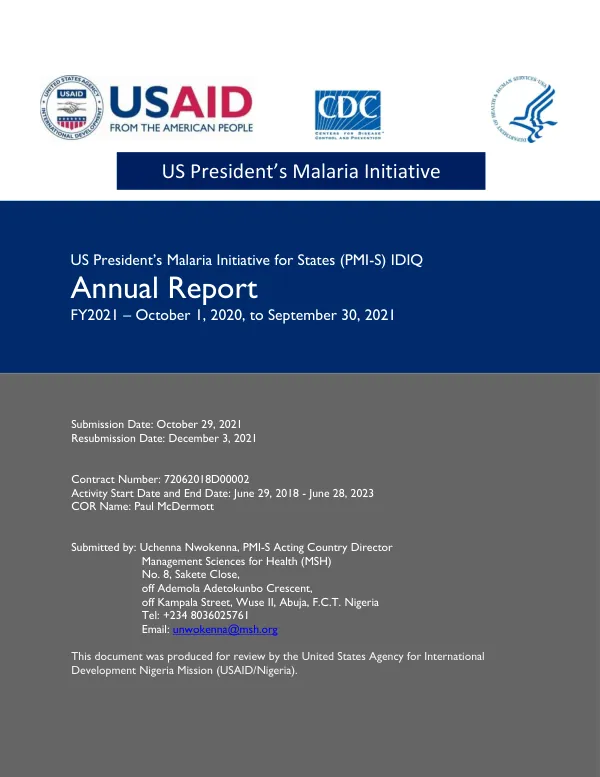
US President’s Malaria Initiative for States (PMI-S) IDIQ Annual Report FY21 (Oct 1, 2020 – Sep 30, 2021)
Sign inBANYAN GLOBAL
US President’s Malaria Initiative for States (PMI-S) IDIQ Annual Report FY21 (Oct 1, 2020 – Sep 30, 2021)
The U.S.
2021 · 112 pages
Sign in to readA free account is required to download.
Abstract
President's Malaria Initiative for States (PMI-S) project is a collaborative effort between the United States Agency for International Development (USAID) and Management Sciences for Health (MSH) to reduce malaria-associated mortality in Nigeria. The project was initiated on June 29, 2018, with a contract number of 72062018D00002 and is set to conclude on June 28, 2023. The primary objective of the PMI-S project is to contribute to the reduction of all causes of under-five and maternal mortality by delivering quality services for the management of malaria and its complications, as well as the prevention of malaria during pregnancy. The project aims to achieve four main objectives: increasing malaria test rates from 30% to 85%, providing appropriate malaria treatment in at least 85% of parasitological confirmed malaria cases, increasing the number of pregnant women receiving three or more doses of intermittent preventive treatment in pregnancy (IPTp), and reducing malaria-associated mortality. To achieve these objectives, the project focuses on improving the quality of malaria case management, increasing access to malaria testing and treatment, and enhancing the capacity of healthcare workers to manage malaria. The PMI-S project operates in eight states in Nigeria, including Akwa Ibom, Benue, Cross River, Ebonyi, Nasarawa, Oyo, Plateau, and Zamfara. The project's implementation is guided by the Nigeria's National Malaria Elimination Program (NMEP) and the PMI 2015-2020 goal of reducing malaria-associated mortality. The project's activities are designed to contribute to the vision of a malaria-free Nigeria and to support the country's efforts to achieve the Sustainable Development Goals (SDGs). The project's implementation progress is monitored and evaluated through the Activity, Monitoring, Evaluation, and Learning Plan (AMELP). The AMELP provides a framework for tracking progress, identifying challenges, and making adjustments to the project's implementation plan as needed. The project's performance is also evaluated through regular review meetings and the submission of quarterly and annual reports to USAID. The PMI-S project has made significant progress in achieving its objectives, including increasing malaria test rates, improving the quality of malaria case management, and enhancing the capacity of healthcare workers to manage malaria. However, the project also faces several challenges, including security concerns, limited access to healthcare services in some areas, and the need for further capacity building for healthcare workers. Despite these challenges, the project remains committed to its objectives and is working to address the challenges through a range of interventions, including technical assistance, training, and capacity building.
Related documents