USAID DEC
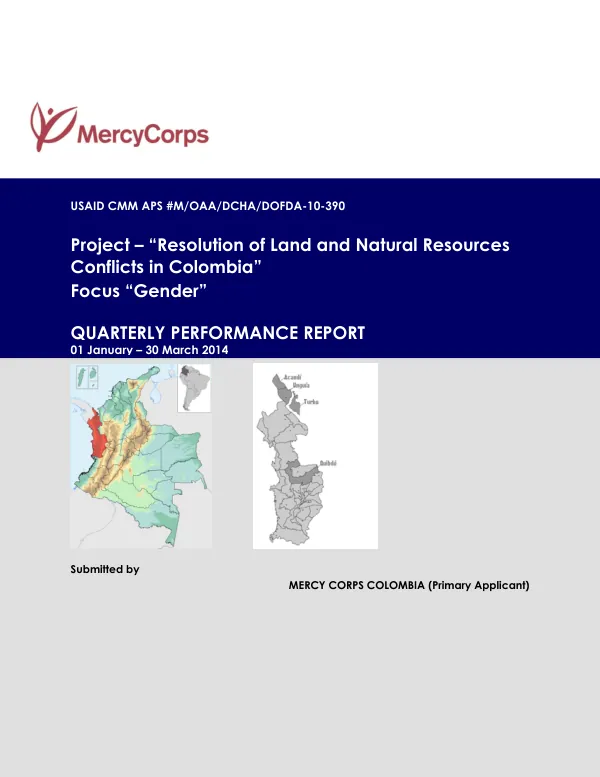
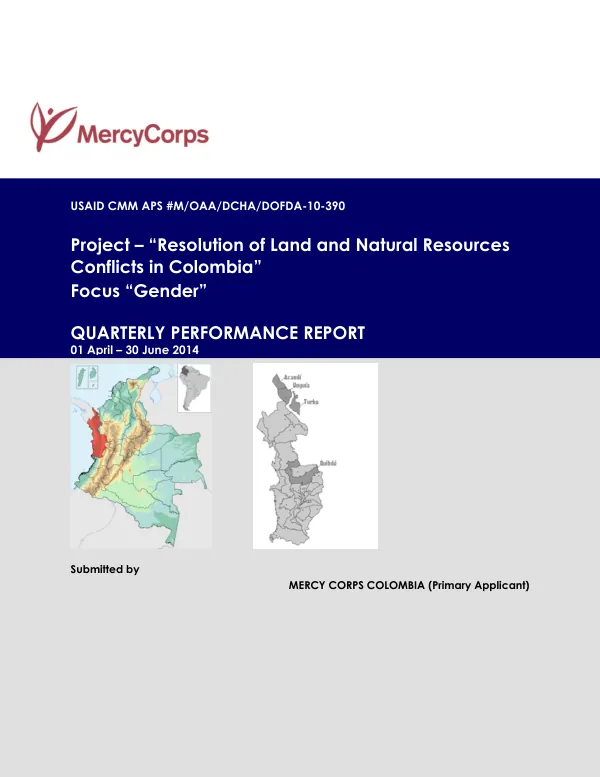
Quarterly Performance Report, Resolution of Land and Natural Resources Conflicts in Colombia
Sign inUSAID
Quarterly Performance Report, Resolution of Land and Natural Resources Conflicts in Colombia
In Colombia, the "Resolution of Land and Natural Resources Conflicts in Colombia" project, funded by USAID, focused on empowering Afro-Colombian women to gain new abilities for land conflict resolution and land tenancy security.
2014 · 11 pages
Sign in to readA free account is required to download.
Abstract
The project aimed to strengthen the Gender Commissions of the Afro-Colombian Community Councils and groups of women through exchanges of experiences and learned lessons in Colombia, Guatemala, and Bolivia on the subject of gender equality and land and natural resources conflict resolution. During the reporting period of April to June 2014, the project made significant progress. In Unguia, 19 additional cases of land and natural resources conflicts were resolved, benefiting 13 men and 2 women. A total of 182 participants were involved in reconciliation activities, with 160 men and 22 women participating in training sessions on GPS usage and interpretation of GIS maps for land tenancy security and planning of land use. The project also trained 220 women on Gender and New Masculinities, with 160 men also participating in the training process. A total of 264 persons participated in the training processes, with 116 men trained on the use of GPS. Methodological guides with protocols for land conflict resolution focused on gender equality and Afro-Colombian women's leadership approach were also disseminated to local community councils, with 171 guidelines distributed. The project's objective to establish rights for the use of the land of at least 100 Afro-Colombian women through usufruct documents and/or legal certainty of the titles of the government vacant lots was also achieved. A total of 272 land titles were awarded, with 171 women gaining access to public lands. The project is also reviewing the possibility of awarding property rights to 65 families with State vacant lands, benefiting farmers of the town of Unguia. Regional exchanges were also conducted, with 58 participants from three major community councils participating in the Regional Exchange in Quibdó, Chocó. The exchange helped ethnic authorities understand the challenges of promoting policies to enhance the participation of women and youth in the decision-making process on access and use of land and natural resources within the community councils. The project's indicators showed significant progress, with 40 conflicts related to land and natural resources resolved, benefiting 100 women. A total of 182 participants were involved in reconciliation activities, with 160 men and 22 women participating in training sessions. The project also achieved 100% of its targeted goal for Indicator No. 3, with 220 women trained on Gender and New Masculinities.