USAID DEC
Eighteenth Quarterly Report to USAID/Colombia: Victims Institutional Strengthening Program
Sign inINTERNATIONAL ORGANIZATION FOR MIGRATION
Eighteenth Quarterly Report to USAID/Colombia: Victims Institutional Strengthening Program
The Victims Institutional Strengthening Program (VISP) is a USAID-funded initiative aimed at providing accompaniment and technical support to the Government of Colombia (GOC) in implementing the Victims Law.
2016 · 31 pages
Sign in to readA free account is required to download.
Abstract
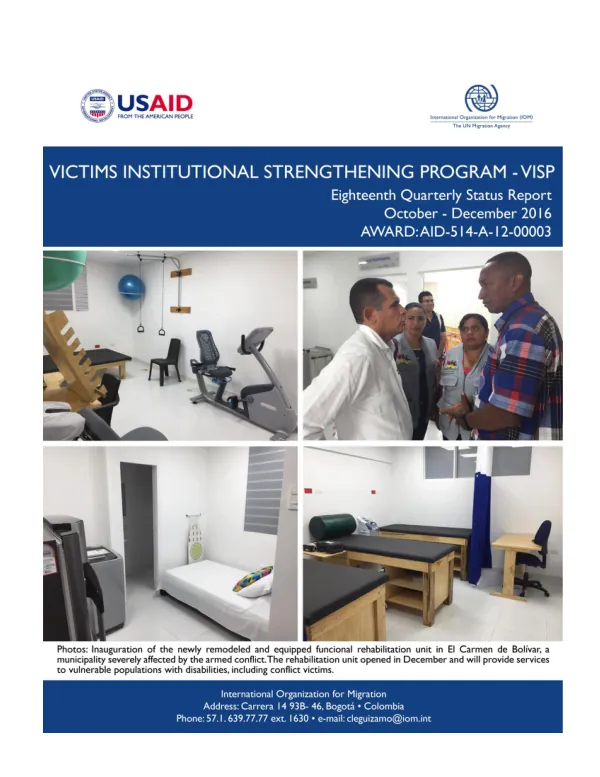
The program's strategic objective is to strengthen capacities and build necessary competencies for the timely and effective execution and implementation of the Victims Law. During the period from October 1 to December 31, 2016, VISP made significant progress in each of its four intermediate results. Intermediate Result 1 focused on strengthening the employability route with differential attention for conflict victims, advancing the formulation and implementation of decentralization projects in alliance with the Ministry of the Interior, and working with the Victims Unit to continue its implementation of the comprehensive route for victims' reparation. In November, the Victims Unit inaugurated a Regional Center for Attention and Comprehensive Reparation in Sincelejo, which received support from the program. Intermediate Result 2 involved completing the psychosocial toolboxes, working with key GOC partners to design "training trainers" plans to transfer these toolboxes to the regional level in 2017. VISP also inaugurated a remodeled and equipped functional rehabilitation center in El Carmen de Bolívar and finalized the Yerbateras del Amor process with female victims, publishing a guide of life stories with Heartland Alliance. Intermediate Result 3 focused on supporting reparations, with the program working to strategically plan with the Victims Unit for 2017 and supporting the National Center for Historical Memory (CNMH) to complete its Observatory on Memory and Conflict baseline on victims of forced disappearance. Intermediate Result 4 involved transferring the gender backpack to the regional level, completing an online training program on gender with 33 participants from different GOC institutions, and providing support for 16 Days of Activism campaigns. Three political and social factors affected the program's execution during this quarter. The approval of the adjusted peace accord faced a polarized environment and needed continual reinforcement during the referendum process and its progressive implementation. The GOC faced a lack of funds to implement the peace accord, as well as a rush to get the process off the ground in late December, in the context of GOC budgetary restrictions in 2017. Internal shifts within GOC institutions in the lead-up to campaigns for 2018 presidential and congressional elections, as well as uncertainty regarding changes pursuant to the incoming U.S. administration, also affected the program. Despite these challenges, VISP was able to reformulate its upcoming implementation phase for 2017 and continue working at the departmental level for an additional six months in 22 additional municipalities. The program provided rapid responses for local governments' institutional strengthening needs to implement the Victims Law and peace accords' points on victims. VISP also advanced in the preparation of territorial projects while continuing to consult with different levels of the Victims Unit, keeping its priorities and counterparts flexible. The program's progress was also marked by inter-agency coordination with other USAID operators, including the Human Rights Program in Nariño and UN Women in Cauca. VISP transferred the gender backpack to representatives of victims participation roundtables, the municipality's mayor's office, and VISP liaisons in Tumaco, and coordinated with UN Women to support the prioritization of activities in Cauca.