MINISTRY OF EDUCATION
School Feeding Response Activity (SFRA) Q2-FY2 Report
The school feeding response activity (SFRA) in Colombia aims to support the government's efforts to provide nutritional food sources for vulnerable Venezuelan children, Colombian returnee children, and host communities through a school feeding strategy.
2020 · 26 pages
Sign in to readA free account is required to download.
Abstract
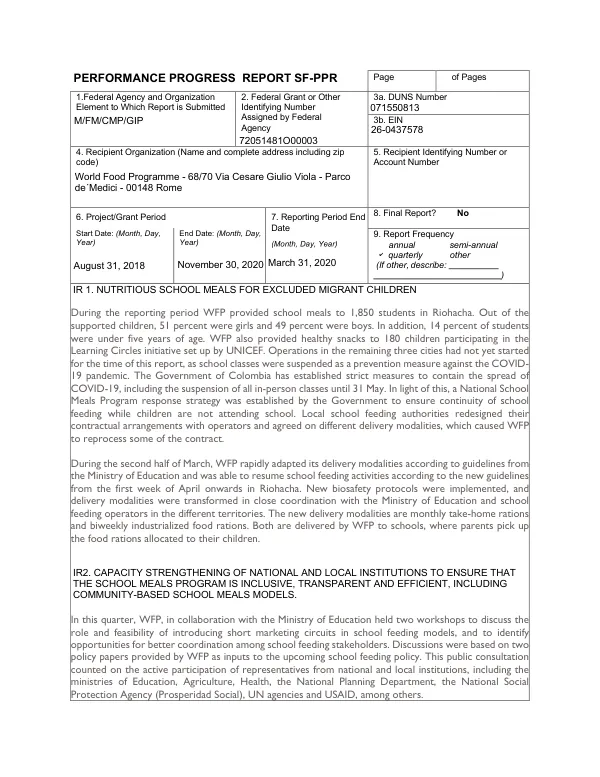
The activity also seeks to strengthen the national school feeding program through new methodologies and/or strategies that will be piloted and transferred to the government of Colombia. Implementation of the SFRA began in August 2018 and is set to conclude in November 2020. The World Food Programme (WFP) is the implementing organization, and the Municipal Education Secretaries are key program partners. The reporting period for this quarterly progress report spans from January 1, 2020, to March 31, 2020. As of February 2020, there were 1.82 million Venezuelans in Colombia, with nearly 60 percent in an irregular status, limiting their access to formal labor, social protection programs, and public health services. The COVID-19 outbreak has further strained vulnerable migrants, with the national government and local administrations implementing strict containment measures, including lockdowns and school suspensions. WFP complements the government's school meals program in the departments of Atlántico, La Guajira, Magdalena, Cesar, and Norte de Santander to promote the integration of migrant children into local communities. From January to March 2020, WFP supported 1,850 children with nutritious meals at schools in La Guajira. Enrollment of migrant children in the Colombian education system has been increasing, with 323,835 Venezuelan children enrolled as of March 2020. Of these, 41,812 are enrolled in the territories covered by this contribution, including 4,722 in Riohacha, 12,857 in Barranquilla, 8,834 in Santa Marta, and 15,399 in Cucuta. During the reporting period, 1,850 out of the targeted 6,000 children received school meals every day in Riohacha, including support for 41 Afro-Colombian children in Sierra Nevada and for migrant children in five UNICEF Learning Circles. In the remaining three cities, beneficiaries were identified and contracting processes for school feeding operators were started, but implementation was delayed in March due to the COVID-19 crisis. WFP rapidly adapted its delivery modalities according to guidelines from the Ministry of Education and was able to resume school feeding activities from the first week of April onwards in Riohacha. New biosafety protocols were implemented, and delivery modalities were transformed in close coordination with the Ministry of Education and school feeding operators in the different territories. The new delivery modalities include monthly take-home rations and biweekly industrialized food rations, both delivered by WFP to schools where parents pick up the food rations allocated to their children. This adaptation has ensured the continuation of school feeding activities amidst the COVID-19 crisis. In this quarter, WFP, in collaboration with the Ministry of Education, held two workshops to discuss the role and feasibility of introducing short marketing circuits in school feeding models and to identify opportunities for better coordination among school feeding stakeholders. Discussions were based on two policy papers provided by WFP as inputs to the upcoming school feeding policy. Main conclusions from these two workshops point at an increased coordination among national and local institutions, the adoption of differential approaches for school feeding, and a reassessment of the nature of school feeding programs as instruments to encourage school attendance or as a broader intervention based on the Right to Food. During the reporting period, WFP refined the last details of its social and behavioral change campaign for the prevention of xenophobia and the promotion of integration of migrant children. This campaign aims to promote a culture of acceptance and inclusion among local communities, schools, and government institutions. The SFRA has made significant progress in increasing school retention, academic advancement, and dietary diversity among migrant children. However, challenges remain, including the COVID-19 crisis, which has delayed implementation in some areas. WFP continues to adapt its delivery modalities to ensure the continuation of school feeding activities and to promote the integration of migrant children into local communities. The activity has also strengthened national and local governments' capacities to implement efficient school meals programs through workshops and policy discussions. Main conclusions from these workshops point at an increased coordination among national and local institutions, the adoption of differential approaches for school feeding, and a reassessment of the nature of school feeding programs. The SFRA has also encouraged community integration and prevented discrimination, xenophobia, and violence through its social and behavioral change campaign. This campaign aims to promote a culture of acceptance and inclusion among local communities, schools, and government institutions. Overall, the SFRA has made significant progress in supporting the government's efforts to provide nutritional food sources for vulnerable children and strengthening the national school feeding program. However, challenges remain, and WFP continues to adapt its delivery modalities to ensure the continuation of school feeding activities and to promote the integration of migrant children into local communities.