USAID DEC
Quarterly Performance Report: Tahafuz - Building Resilience through Community Based Disaster Risk Management in the Sindh Province of Pakistan
Sign inUSAID DEC
Quarterly Performance Report: Tahafuz - Building Resilience through Community Based Disaster Risk Management in the Sindh Province of Pakistan
The Tahafuz project, "Building Resilience through Community Based Disaster Risk Management in the Sindh Province of Pakistan," was initiated on January 7, 2015, with an expected completion date of June 30, 2016.
2016 · 7 pages
Sign in to readA free account is required to download.
Abstract
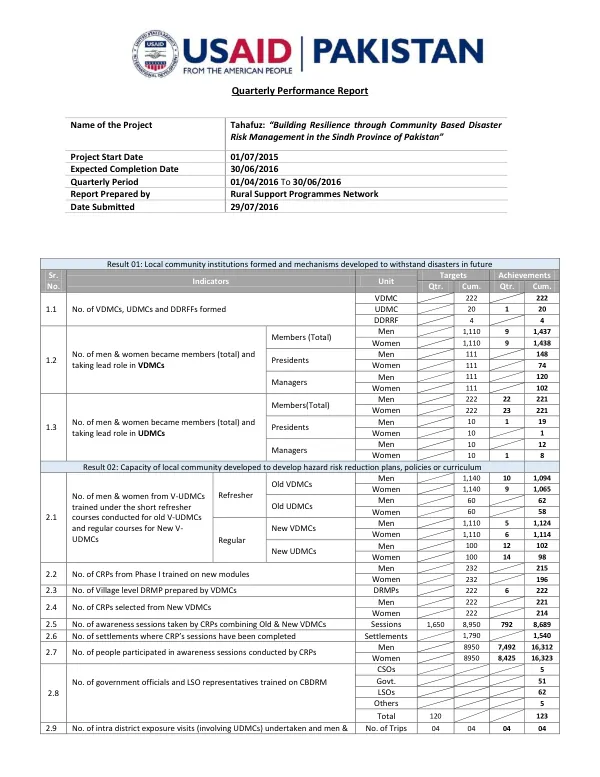
The project aimed to enhance the resilience of communities in the Sindh Province by developing their capacity to withstand disasters. During the reporting quarter, from April 1 to June 30, 2016, significant progress was made in achieving the project's objectives. Local community institutions, such as Village Disaster Management Committees (VDMCs) and Union Disaster Management Committees (UDMCs), were formed and mechanisms developed to withstand disasters in the future. A total of 222 VDMCs were established, with each committee consisting of at least ten members, including a gender-balanced representation. The VDMCs had a total of 2,875 members, with 1,437 women members, of which 74 were serving as presidents and 102 as managers. The UDMCs were formed at the union council level, with each committee consisting of two members, one man and one woman, from each VDMC. A total of 20 UDMCs were established, with 39 women members, of which 19 were staff members. The UDMCs were considered the extended arm of the VDMCs, providing opportunities for creating links, improving coordination between government and community, and advocating DRR relevant issues with the district government. Capacity building was a key aspect of the project, with various events organized to enhance the capacities of community members on disaster risk reduction. During the reporting quarter, RSPN achieved the project target of providing training to members of newly formed UDMCs. A total of 200 UDMC members, including 98 women, received training on Organizational Management and Development (OM&D) and Advocacy & Networking (A&N). Disaster Risk Management Plans (DRMPs) were developed by VDMC members, highlighting all potential risks, hazards, resources, and possible mitigation measures. A total of 222 DRMPs were formulated through VDMC members, with each plan comprising propositions of practical measures to cope with natural and man-made disasters. Community Critical Infrastructures (CCIs) were rehabilitated, with a total of 302 schemes rehabilitated during the project period, benefiting directly a total of 24,091 households in the project areas. Mock drill exercises were conducted by V/UDMCs to assess their level of preparedness, with various communities taking initiatives to handle any untoward situation during the monsoon season. The project also focused on linking institutions with official bodies, with a total of 4 meetings held at the district level, involving various stakeholders, including UDMC representatives, CSOs, government representatives, and other representatives. The project also organized training of trainers for project staff, with 40 staff members trained in the first quarter and 53 in the second quarter. Overall, the Tahafuz project made significant progress in achieving its objectives, with a focus on building the resilience of communities in the Sindh Province through community-based disaster risk management.