DAI GLOBAL, LLC
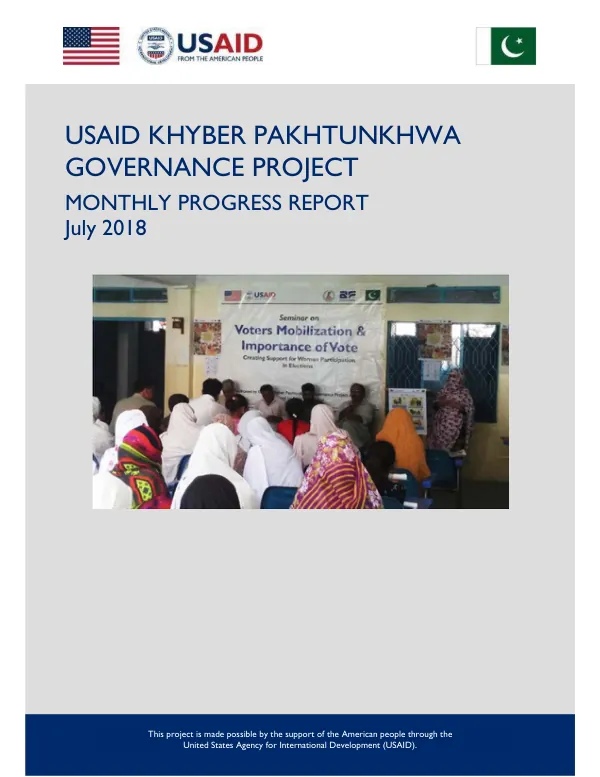
Khyber Pakhtunkhwa Governance Project Monthly Progress Report July 2018
Khyber Pakhtunkhwa Governance Project efforts contributed to effective governance in Khyber Pakhtunkhwa Province by addressing the most pressing governance needs of its elected officials, public administrators, and constituents.
2018 · 33 pages
Sign in to readA free account is required to download.
Abstract
The transition sought as part of the overall programmatic outcomes can be summarized through the Theory of Change as positive changes in attitude, perceptions, and behavior about the quality of governance in the province. During the reporting month, six new grants were signed and kick-off meetings held by the KPG Public Sector for capacity building and improved service delivery. These grants include Supporting Good Governance through Improved Access to Information (G-Pes-049), Making Child-Friendly Schools in District Bannu (G-Pes-052), Enhance Effective Public Procurement Practices for Better Governance (G-Pes-054), Supporting Capacity Building of Village Council (VC) and Neighborhood Council (NC) Secretaries and Finance Staff of Tehsil Municipal Administrations in Financial Management (G-Pes-055), Strengthening Water and Sanitation Services Company Kohat - Phase 2 (G-Pes-056), and Strengthening Water and Sanitation Services Company Mardan (G-Pes-057). Under the grant (G-Pes-032) "Strengthening of Right to Services Commission", KPG implementing partner Abacus Consulting conducted a five-day training in Abbottabad for Rights to Services Commission (RTSC) staff. The training focused on the use of seven statistical reports previously developed by an Abacus consultant for RTSC. The KPG team finalized the Final Evaluation Report for the grant (G-Pes-034) "Strengthening Provincial Housing Authority" and it will be shared with the COR for approval and closeout. In 26 districts, KPG, through its vendor Geo-Solutions under (G-Pes-038), conducted four rounds of a two-day training workshop on a new database system for 118 Zakat Management Information System (ZMIS) officials of KP Zakat and Ushr Department in Peshawar. The new database system will enable automation of all Zakat beneficiaries' records. Data for 23 district and provincial-level hospitals in the ZMIS database was compiled and entered by the vendor. However, the compilation of 50,000 Zakat beneficiaries' data entering into the new database system is in process. Under the grant activity (G-Pes-039) "Strengthening of Health Care Commission", KPG staff completed the final verification and disposition of the IT equipment and the grant will be officially closed after submission of the Final Report and Final Evaluation Report (FER) to the COR for approval. The "Training of Local Government Representatives in Bannu District - Phase 2", under the grant (G-Pes-040), was closed out by KPG. The KPG team also conducted a training on a new database system for 118 Zakat Management Information System (ZMIS) officials of KP Zakat and Ushr Department in Peshawar. The training aimed to enhance the officials' capacity to manage Zakat beneficiaries' records using the new database system. The training was conducted in four rounds, covering 26 districts, and was facilitated by Geo-Solutions, a vendor of KPG. The KPG team's efforts focused on strengthening the capacity of various institutions and stakeholders in Khyber Pakhtunkhwa Province. The team's work aimed to improve governance, enhance service delivery, and promote transparency and accountability in the province. The KPG team's achievements during the reporting month demonstrate its commitment to supporting the development of Khyber Pakhtunkhwa Province and improving the lives of its citizens.