CARE
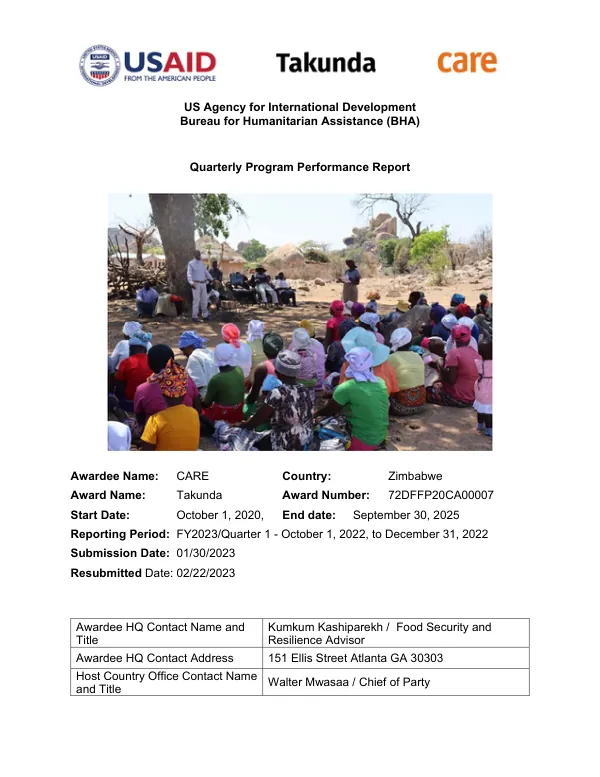
Quarterly Program Performance Report: Takunda #72DFFP20CA00007 - FY21Q2
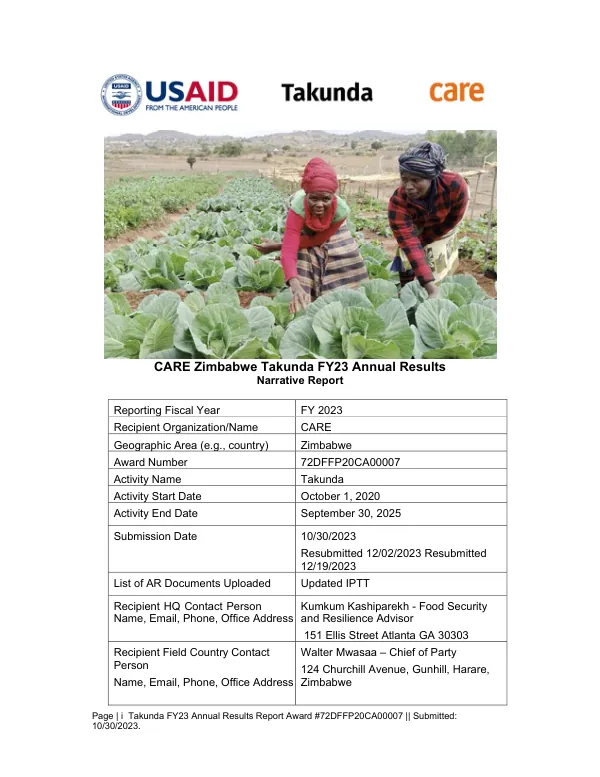
Takunda is a five-year Resilience Food Security Activity funded by USAID/BHA and implemented by a consortium primed by CARE in Zimbabwe.
2021 · 13 pages
Sign in to readA free account is required to download.
Abstract
The program started on October 1, 2020, and is currently in its refine and implement phase. Takunda's goal is to achieve sustainable, equitable, and resilient food, nutrition, and income security in Masvingo and Manicaland provinces of Zimbabwe. The program is implemented in the Buhera and Mutare Districts (in Manicaland Province) and in Chivi and Zaka Districts (in Masvingo Province). The second quarter of fiscal year 2021 was characterized by the continued prevalence of COVID-19, food insecurity, high commodity prices, and a deteriorating economic environment. In January, the Government of Zimbabwe imposed a national COVID-19 lockdown that moved the COVID-19 classification from level 2 to level 4. This lockdown lasted two months and was followed by a relaxation of lockdown measures from level 4 to level 1. The effects of COVID-19 and the associated lockdowns in Zimbabwe continue to erode incomes, which subsequently affect household access to food and health services. Takunda staff continued to comply with the Government of Zimbabwe, CARE, and other consortium member's COVID-19 Standard Operating Procedures (SOPs) in program activities. The key SOPs included maintaining social distancing, temperature checking, washing of hands and sanitizing, and the proper wearing of masks. There were no specific surges in infection among targeted rural populations and project sites, and most of the COVID-19 cases were reported in the urban centers. Zimbabwe recorded a favorable rainy season that was deemed to be above average and led to an improvement in food supply. Despite this favorable season, income and food access is expected to remain constrained in Southern and Western areas, where Takunda is operational, due to depressed income-earning activities. The Takunda program areas are characterized by a projected stressed food insecurity phase (IPC Phase 2) for the period of March - May 2021, requiring humanitarian assistance. This quarter was focused on getting the key planning processes of the Refine and Implement year underway. Takunda received support, guidance, and direction from the Program Cycle Support (PCS) team of the Implementer-Led Design, Evidence, Analysis and Learning (IDEAL) activity. PCS, in collaboration with USAID/BHA staff, supported Takunda to review its Theory of Change, identify key information gaps, and begin the process of filling these gaps. The inception workshop, gender and social dynamics, and community visioning workshops culminated in the identification and prioritization of evidence and knowledge gaps (formulated into formative studies, pilots, and scoping studies). At the end of these workshops and consultations, Takunda developed scopes of work for priority research and processes to take place during the refine and implement year. Four scopes of work were submitted to BHA and approved: namely, Gender Analysis (GA), Social Behavior Change (SBC) formative research, Agriculture Value Chain, and Off-Farm Opportunities, Capacities, Financial and Labor Market Assessment. In addition to the above studies, Takunda identified several micro-studies, pilots, and learning areas for implementation in the refine and implement year. The program conducted district and provincial stakeholder sensitization and inception meetings in the four operational districts. Takunda sensitized key district stakeholders, especially the District Food and Nutrition Committees (DFNCs), on the program's objectives and activities. The program also identified opportunities to engage with USAID-funded technical mechanisms, including Strengthening Capacity in Agriculture, Livelihood and Environment (SCALE), Learning Evaluation and Analysis (LEAP III), Practices, Research and Operations in Water, Sanitation and Hygiene (PRO-WASH), USAID Advancing Nutrition, and National Aeronautics and Space Administration (NASA), to support in the design of interventions, trainings, analysis of study outputs, and tracking progress of interventions. Takunda will continue to monitor changes in the operational environment and undertake necessary adaptive management if identified assumptions and risks do change and significantly affect program results. The program will also continue to engage with local leaders and communities to conduct early engagement activities and provide a conducive opportunity to implement program activities.