CARE
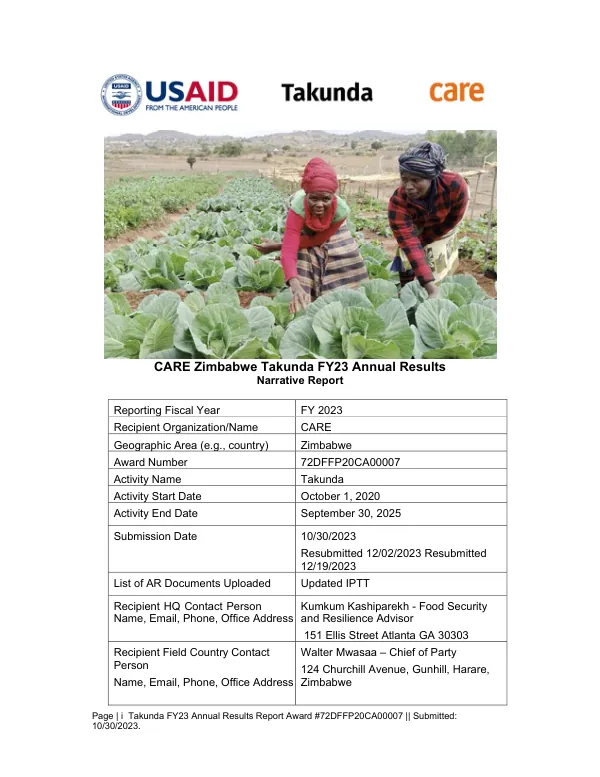
Takunda FY21 Annual Results Report Award #72DFFP20CA00007
Takunda is a five-year Resilience Food Security Activity implemented by a consortium primed by CARE in Zimbabwe.
2021 · 28 pages
Sign in to readA free account is required to download.
Abstract
The Activity focuses on Manicaland and Masvingo provinces, targeting 301,636 vulnerable and food insecure individuals from extremely poor and chronically vulnerable households. The goal of the Activity is sustainable, equitable, and resilient food, nutrition, and income security in targeted areas. The Activity engaged in start-up processes, including staff recruitments and office set up, an inception workshop led by USAID funded Program Cycle Support (PCS) mechanism, completing Initial Environmental Examination (IEE), Theory of Change reviews, Evidence Knowledge Gaps identification processes, development, and approval of studies Scope of Work (SOWs) and protocols. Takunda developed an R&I workplan and FY22 Pipeline Resources Estimate Proposal (PREP) which were approved by USAID. Takunda conducted stakeholder inception meetings in all the implementation districts, resulting in the acceptance of and support for the Activity across all the targeted districts. The Activity rolled out its community visioning (CV) process to 92 communities to generate community action plans through an inclusive process of prioritizing needs and aspirations. The community action plans have informed the Activity on existing structures, groups, and other ongoing projects and established entry points for relevant interventions. One of the community visioning participants in Chivi district stated, "We have seen many projects come and go but because they didn’t ask us, their projects came and went with them," and "We know why the last poultry and water supply project failed, we can work with you to make sure it doesn’t happen again!" Additionally, the Activity conducted a Well-Being Analysis (WBA) process in 170 communities to define vulnerability from a community perspective based on which individuals were ranked in the poor, middle-, or upper-income groups. On completion of the WBA process, a household level census was conducted to collect individual household demographics and other characteristics needed for enrollment into interventions. By the end of the FY21, 28,611 households against a target of 48,826 were registered. Takunda identified a number of knowledge gaps that needed to be filled in the R&I period, and 12 Scopes of Work and protocols were developed, including four priority studies: Gender Analysis, Social Behavior Change (SBC), Agricultural Value Chains, and Off-Farm Economic Opportunities and Labor Markets assessment. These studies commenced in FY21, but completion of field-level data collection for the SBC study was not complete. The Activity engaged in planning meetings with Innovations for Poverty Action (IPA) in readiness for the baseline evaluation. Takunda staff held planning meetings with IPA in readiness for the baseline evaluation, and the Activity conducted stakeholder inception meetings in all the implementation districts, resulting in the acceptance of and support for the Activity across all the targeted districts. The Activity's focus on community-led planning and decision-making is evident in the community visioning process, which has generated community action plans through an inclusive process of prioritizing needs and aspirations. The Activity's emphasis on understanding vulnerability from a community perspective is reflected in the Well-Being Analysis (WBA) process, which has helped to define vulnerability and identify entry points for relevant interventions. Takunda's approach to addressing knowledge gaps through the development of Scopes of Work and protocols is a key aspect of the Activity's R&I period. The four priority studies identified, including Gender Analysis, Social Behavior Change (SBC), Agricultural Value Chains, and Off-Farm Economic Opportunities and Labor Markets assessment, will provide critical insights into the complex issues affecting food security and resilience in the target areas.
Related documents