CENTER FOR EDUCATIONAL DEVELOPMENT
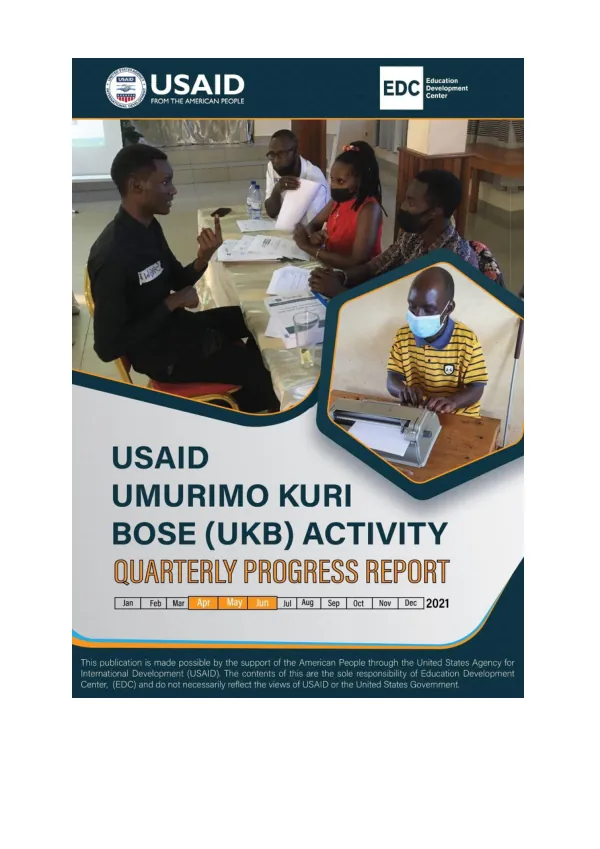
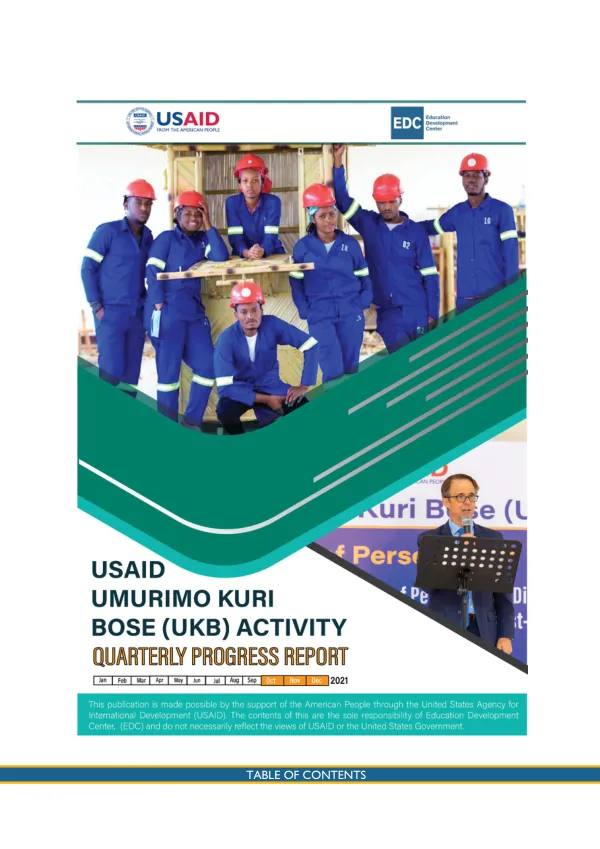
Quarterly Progress Report (QPR) for USAID Umurimo Kuri Bose (UKB)
Education Development Center, Inc.
2021 · 36 pages
Sign in to readA free account is required to download.
Abstract
(EDC) in coordination with a consortium of partners, including African Evangelist Enterprise (AEE), Akazi Kanoze Access (AKA), Benimpuhwe, the Rwandan National Union of the Deaf (RNUD), the Rwanda Union of the Blind (RUB), the Umbrella of Organizations of People with Disabilities in the Fight against HIV and AIDS in Health Promotion (UPHLS), and UWEZE Youth Empowerment, aims to foster a more inclusive workforce development system. The initiative, Umurimo Kuri Bose (UKB), focuses on increasing youth employability skills, empowerment, engagement, and equity, and promoting an inclusive and enabling environment for youth with disabilities to access and succeed in the workforce. UKB targets 1,560 youth, with a focus on youth with disabilities, in 12 districts in Rwanda. A subset of 360 youth without disabilities is included to promote an inclusive learning environment and address stigma against persons with disabilities. The initiative has enrolled its second cohort of youth, bringing the total enrollment to 1,596 youth, with 1,064 being youth with disabilities. To address the shortfall in enrollment, EDC is seeking out partners that provide technical training for youth with disabilities but lack work readiness training, work-based learning, and on-the-job training. Cohort 1 youth have begun transitioning to work and launching their own enterprises. These transitions will continue into the next quarter as these youth complete training and work-based learning. Cohort 2 youth are participating in WRN/BYOB training and will receive Resiliency and Human Rights training before transitioning to work readiness training and work-based learning. UKB has focused on two events and a social media campaign as part of Disability Week, highlighting disability inclusion and the inclusion of youth with disabilities in the workforce. The initiative has also hosted a site visit to the Masaka Resource Center for the Blind and the Masaka Business Incubation Center, highlighting the efforts of the Government of Rwanda and the United States Government to address disability inclusion. The initiative has also participated in the Global Youth Economic Opportunities (GYEO) Summit, where youth with and without disabilities shared their views on the barriers they face in accessing economic opportunities. These inputs will inform GYEO's 2030 strategy to meaningfully advance Sustainable Development Goal 8, Decent Work and Economic Growth. UKB has also launched a social media campaign using the hashtag #workbasedlearningday to highlight youth with disabilities in the workplace. The campaign encourages organizations and private sector partners to share photographs of youth with and without disabilities in the workplace to advocate for disability inclusion. The initiative aims to build partner capacity, deliver high-quality workforce development programs, and ensure the transition of youth with and without disabilities to work. UKB is shifting from EDC-led interventions to partner-led interventions, focusing on locally sustained activities beyond the life of the project. Intermediate Result 1: Employability Skills, Empowerment, Engagement, and Equity among Youth with Disabilities Increased This intermediate result is designed to build youth assets by working closely with Disability Organizations and Implementing Partners (DPOs/IPs) on program supply-side outcomes. This includes skills training, delivering work-based learning programs, and empowering youth through youth leadership and accompaniment to take the lead in charting their own lives. Sub-IR 1.1: Improved Employability Skills of Youth with Disabilities UKB has enrolled 874 Cohort 2 youth, with 591 being youth with disabilities. The additional 874 Cohort 2 youth include 596 females (66% of enrolees) and 278 males (34% of enrolees). This brings the total enrollment under UKB to 1,598 youth, exceeding the Life of Project (LOP) targets for overall youth enrollment.