CENTER FOR EDUCATIONAL DEVELOPMENT
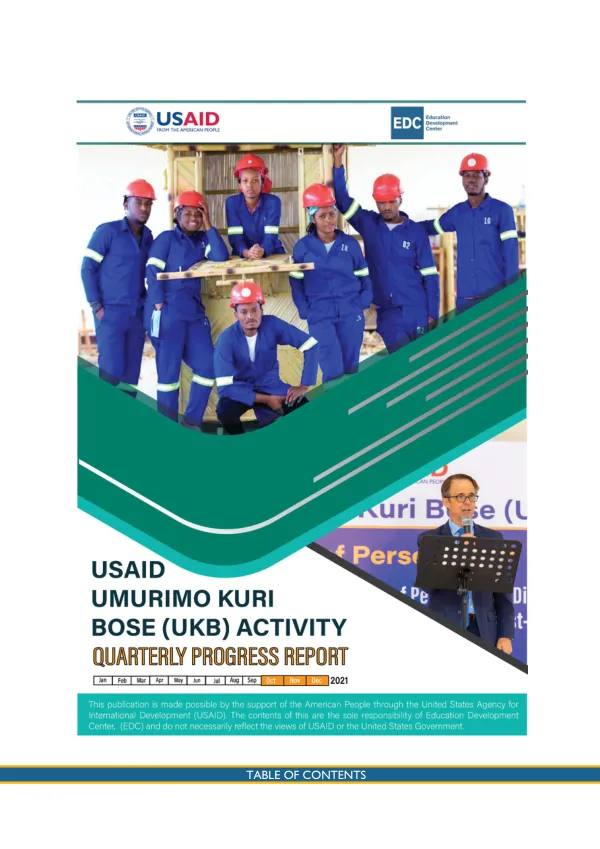
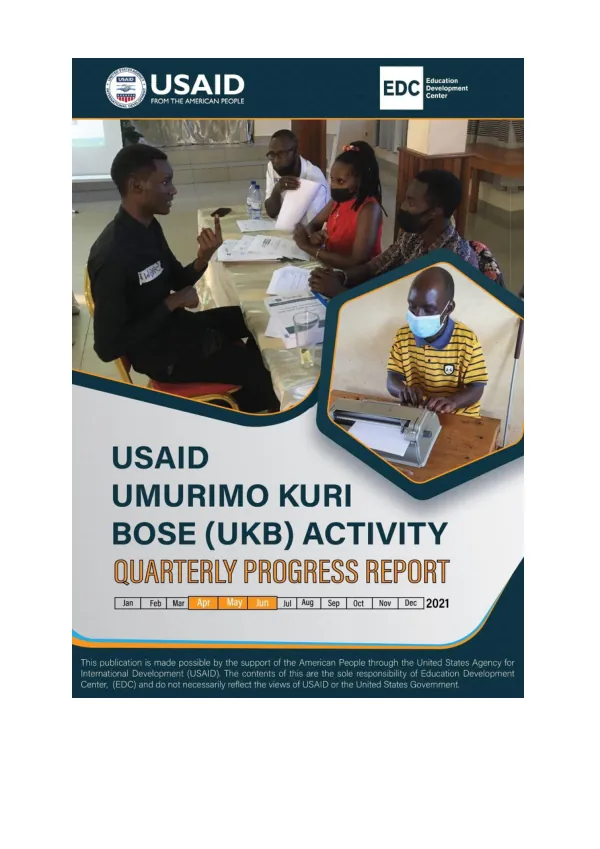
USAID Umurimo Kuri Bose Quarterly Progress Report: April - June 2021
The USAID Umurimo Kuri Bose program aims to foster a more inclusive workforce development system in Rwanda by increasing youth employability skills, empowerment, engagement, and equity, and promoting an inclusive and enabling environment for youth with disabilities to access and succeed in employment.
2021 · 35 pages
Sign in to readA free account is required to download.
Abstract
The program serves 1,560 youth, focusing on those with disabilities, in 12 districts in Rwanda. A subset of 360 youth without disabilities is also included to promote an inclusive learning environment and address stigma against people with disabilities. UKB conducted various activities in the April-June 2021 quarter, including workforce development activities, social services, community awareness raising, and disability mainstreaming training. The program supported 379 vulnerable persons in benefiting from USG-assisted social services and trained 29 companies and 7 Technical Vocational Education and Training (TVET) institutions on Disability Mainstreaming. Local Labor Market Assessments were completed, and a Gender and Social Inclusion Analysis was finalized. The program's Intermediate Result 1 focuses on increasing employability skills, empowerment, engagement, and equity among youth with disabilities. Sub-IR 1.1 aims to improve employability skills of youth with disabilities through skills training, on-the-job or work-based learning programs, and youth leadership and accompaniment. In this quarter, all cohort 1 youth were selected, with 748 youths selected across all districts, representing 71% of all selected youth with disabilities. The three main types of disabilities amongst UKB youth are physical, hearing, and visual, although youth with mental disabilities, albinism, and others are also enrolled. UKB collects data on enrollment according to the Washington Group and the disability categories outlined by the Government of Rwanda. Based on enrollment data, 50% of youth with disabilities have some primary school education, 39% have reached secondary school, while those who reached the university represent only 3% and illiterate youth 8% of the UKB Cohort 1 population. For youth without disabilities, primary school level represents 42%, secondary school is at 55%, university 1% and illiterate youth are 2%. The program's Disability Mainstreaming Training for WRN/BYOB Trainers aimed to ensure quality delivery of WRN/BYOB training to youth with disabilities. Trainers participated in the disability mainstreaming training, led by UPHLS, to prepare them to deliver workforce readiness training packages. The training focused on disability mainstreaming, which is essential for creating an inclusive and enabling environment for youth with disabilities to access and succeed in employment. UKB's implementation was impacted by the Government of Rwanda's reimposition of movement restrictions due to a surge in COVID-19 cases. Several ongoing activities were put on hold, including soft skills assessments and youth transition to workplaces. Assessments and accompaniment components will resume once movement restrictions allow. The Kigali-based Disability Mainstreaming training was canceled and will be rescheduled once movement restrictions allow. The program's progress and achievements demonstrate its commitment to fostering a more inclusive workforce development system in Rwanda. The program's focus on increasing employability skills, empowerment, engagement, and equity among youth with disabilities is essential for creating an inclusive and enabling environment for youth with disabilities to access and succeed in employment.