CREATIVE ASSOCIATES INTERNATIONAL INC.
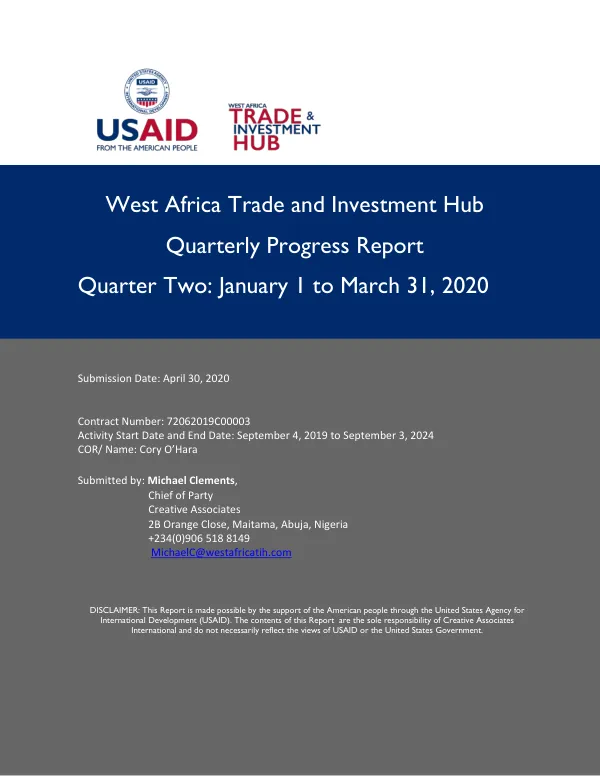
Quarterly Progress Report: West Africa Trade and Investment Hub
The West Africa Trade and Investment Hub Project is a five-year, $90 million trade and investment facilitation Activity that seeks to improve private sector competitiveness in West Africa through market-based approaches.
2020 · 27 pages
Sign in to readA free account is required to download.
Abstract
The project is an integral part of the Prosper Africa initiative and partners with the U.S. and West African private sector firms to generate new private-sector investment in key sectors to create jobs and increase trade between the U.S. and West Africa, including through increased utilization of the African Growth and Opportunity Act (AGOA). The project comprises two main components: (i) design and administration of a grant-making facility for private sector partnerships and (ii) technical assistance that directly supports, coordinates, and engages with qualifying recipients to achieve USAID's trade and food security objectives. The project focuses on co-investment partnerships that increase agricultural productivity and profitability of smallholder farmers in Nigeria under a Research and Development (R&D) Fund towards innovating and modernizing practices across five targeted value chains. Through this co-investment facility and technical assistance, the project will improve companies' ability to expand business operations, increase productivity, and create jobs that build on the talents and aspirations of West Africa's growing population. The project will collaborate on specific commercial opportunities with firms, service providers, research organizations, and other business network actors to access private capital that will contribute to the creation of large-scale jobs, exports, and investment, particularly with strong demonstrated or potential links to the U.S. companies and investors. The project has set ambitious targets, including achieving a minimum of $306 million in new investment, 40,000 new jobs, and $240 million in exports. The project is also innovating catalytic grants under contract for co-investments, first loss provisions for new fund structures, special purpose vehicles, digital platforms, and transaction advisory services. The project's progress is being monitored through a range of standard indicators, including the value of exports in targeted agricultural and non-agricultural commodities, the value of new USG commitments and private sector investment leveraged by the USG to support food security and nutrition, and the number of new jobs created by assisted firms/associations/entities. As of the end of the reporting period, the project has made significant progress in achieving its targets. The project has leveraged $0 in new USG commitments and private sector investment to support food security and nutrition, and $0 in new USG commitments and private sector investment to support non-agricultural commodities. The project has also created 0 new jobs, and the value of exports in targeted agricultural and non-agricultural commodities from supported firms/associations/entities is $0. However, the project has made progress in other areas, including increasing the percentage of female participants in USG-assisted programs designed to increase access to productive economic resources to 8.7%, and increasing the number of persons trained with USG assistance to advance outcomes consistent with gender equality or female empowerment through their roles in public or private sector institutions or organizations to 27. The project has also made progress in increasing the yield of targeted agricultural commodities among program participants. The yield of rice is 2.9, maize is 2.1, cowpea is 1.1, and soybean is 0.9. The project has also made progress in establishing buyer/seller linkages in targeted agricultural/non-agricultural sector as a result of USG assistance, with 0 linkages established as of the end of the reporting period. Overall, the project is making progress in achieving its targets and improving private sector competitiveness in West Africa.