USAID DEC
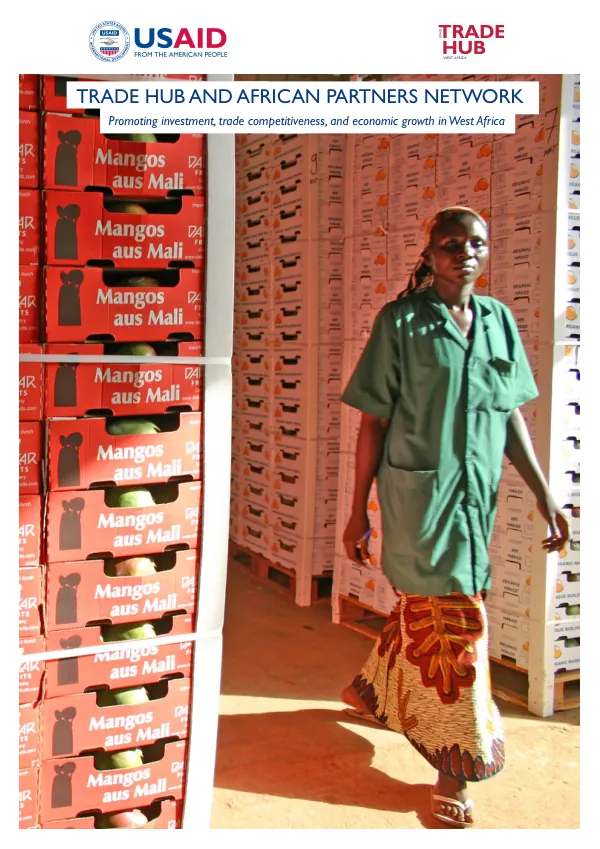
Trade Hub and African Partners Network Value Chain Financing Constraints and Investment Opportunities Report
Sign inABT ASSOCIATES
Trade Hub and African Partners Network Value Chain Financing Constraints and Investment Opportunities Report
The USAID Trade Hub and African Partners' Network Project aims to increase West Africa's trade, investment, and jobs through agricultural trade development.
2014 · 59 pages
Sign in to readA free account is required to download.
Abstract
The project's Access to Finance (A2F) Component will contribute to this mandate by leveraging $62.5 million in investment in global and regional value chains. This includes $25 million in loans serving approximately 102 firms and providing technical assistance and training to 125 small and medium-size enterprises (SME) and micro-enterprises. The A2F Component will facilitate the financing of investment by working in collaboration with four partner groups: businesses/firms implementing investments, finance access facilitators (FAFs) subcontractors, financial institutions (FIs) extending financing, and strategic partners/trade associations providing referrals and technical and market-linkages support. The A2F Component works closely with the Trade Hub's value chain component staff to benefit from their industry knowledge, technical expertise, and regional contacts. Field visits were conducted in seven countries within the West African trade corridors prioritized by USAID and the Trade Hub. These visits, led by four persons from Banyan Global and SSG Advisors, followed prior desktop reviews and were concluded by debriefings in Accra with Trade Hub management, colleagues, and USAID staff. The study and this report focus on the value-added, global value chains, including cashew, shea, mango, and textiles/apparel. The regional food value chain will be studied in an A2F review and field visit to take place in January 2015. The field teams met with a total of 170 stakeholders, including firms, FIs, associations, donors, government authorities, and FAFs. The field visits served to better understand FIs' financing constraints in the region and help shape the A2F short- and long-term strategy. Specifically, the field visits assessed the region's financial/business climate, identified investment leads, and raised the region's awareness of the Trade Hub's and A2F's activities. The A2F teams also interviewed FAF candidates and explored areas of mutual interest with potential association partners. The overall conclusion of the field visits was that there are sound investment prospects, a strong need for financial facilitation, and a willingness among partners to collaborate. With regard to FIs, there is a growing interest in agribusiness opportunities availed by global demand for Sub-Sahara Africa's value-added exports and improved margins due to higher worldwide commodity prices. FIs recognize that their in-house knowledge and resources to reach and serve agribusinesses are inadequate, and they desire to rectify this situation. The A2F Component will work to address these challenges and facilitate the financing of investment in West Africa's value chains. The A2F Component will prioritize the cashew, shea, mango, and textiles/apparel value chains, which have been identified as having significant investment potential. The component will work with FIs to provide financing for these value chains, as well as with FAFs to generate investment leads and proposals. The A2F Component will also work with strategic partners/trade associations to provide referrals and technical and market-linkages support. The Trade Hub's Access to Finance Component will play a critical role in facilitating the financing of investment in West Africa's value chains. By working with FIs, FAFs, and strategic partners/trade associations, the A2F Component will help to address the financing constraints faced by FIs and facilitate the growth of West Africa's value chains. This will contribute to the Trade Hub's mandate of increasing West Africa's trade, investment, and jobs through agricultural trade development.
Related documents