ASSIST IMPACT
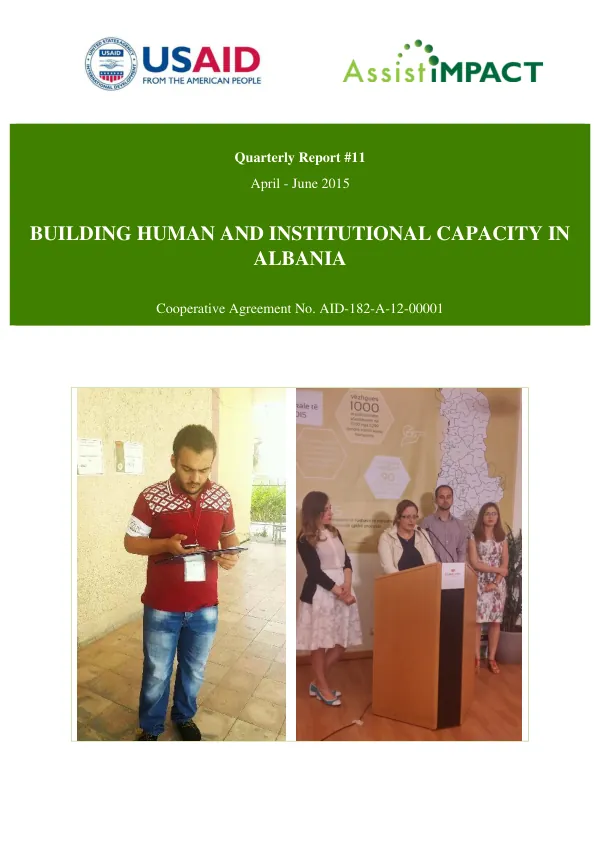
Quarterly Report #10: Building Human and Institutional Capacity in Albania
The Building Human and Institutional Capacity (BHIC) project in Albania aims to build the capacity of institutions, governmental, non-governmental, and private sector entities, as well as leaders and technical experts.
2015 · 18 pages
Sign in to readA free account is required to download.
Abstract
The project's overarching goal is to support Albania's European integration through strengthened democratic institutions and inclusive economic growth. The BHIC project focuses on building capacity to address two Development Objectives: strengthened rule of law and improved governance, and conditions created for broad-based, sustainable, and inclusive economic growth. The project's goals have been revised to achieve the following results by the end of the three and a half-year period: strengthening the performance of at least 13 Albanian central and local government organizations, including Albanian ministries and municipalities; strengthening the performance of at least 55 Albanian non-governmental organizations and private sector entities; building the performance of at least 55 leaders of Albanian governmental, private sector, and non-governmental organizations and institutions; and building the expertise of at least 370 technical specialists. During the 10th quarter of the project, 24 programs initiated in December 2014 or before were in various stages of implementation. Fifteen new programs were initiated during this quarter, including eight democracy grants and seven were completed. As the quarter ended, 42 programs were in various phases of preparation/implementation. Capacity building activities were conducted in support of institutions/organizations. The Professional Training Center in Fier offered a course for garment and footwear machine maintenance, which saw 14 participants completing the 8-week advanced level course and 12 completing the internship. The state Agency for the Support of Civil Society (AMSHC) received a three-day training in proposal writing, and a new professional training course was developed for footwear operators for the Professional Training Center in Durres. Matching grants were awarded to three garment/footwear firms in Fier, Blue Sky, Krel's Luck, and Picari, in exchange for donated machines for the Center and internships for the participants. The firms were provided with matching grants to purchase new machinery, which has allowed them to hire additional operators and improve their competitiveness. A grant to Aleanca to establish and operate the first LGBT shelter in Albania progressed well. The shelter is set up to house up to eight persons for up to six months and provide them with counseling and facilitate their attendance in vocational courses aimed at job skills. During this period, the shelter provided housing and services to seven members of the LGBT community. The Coalition for Free and Fair Elections and Sustainable Democracy (CFFESD) published its "Survey on Health Centers in Albania," which used statistically based observation methods. The publication was launched during a well-attended public event, and the Ministry of Health was notably collaborative, indicating its intention to utilize the findings to target specific improvements. Capacity building for non-governmental institutions also continued, with a grant to Protik continuing to help them offer high-level ICT technical training courses. Matching grants were awarded to three garment/footwear firms in Fier, and a grant to Aleanca to establish and operate the first LGBT shelter in Albania progressed well. The BHIC project has made significant progress in building the capacity of institutions, governmental, non-governmental, and private sector entities, as well as leaders and technical experts. The project's revised goals aim to strengthen the performance of Albanian institutions, build the performance of leaders and technical specialists, and create conditions for broad-based, sustainable, and inclusive economic growth. Capacity building activities continued to focus on strengthening the performance of Albanian institutions, including the state Agency for the Support of Civil Society (AMSHC) and the Professional Training Center in Fier. Matching grants were awarded to three garment/footwear firms in Fier, which has allowed them to hire additional operators and improve their competitiveness. The BHIC project has also made significant progress in supporting the development of Albania's LGBT community. A grant to Aleanca to establish and operate the first LGBT shelter in Albania progressed well, and the shelter provided housing and services to seven members of the LGBT community. Capacity building activities will continue to focus on strengthening the performance of Albanian institutions, building the performance of leaders and technical specialists, and creating conditions for broad-based, sustainable, and inclusive economic growth. The project's revised goals aim to achieve significant results and support Albania's European integration through strengthened democratic institutions and inclusive economic growth.