ASSIST IMPACT
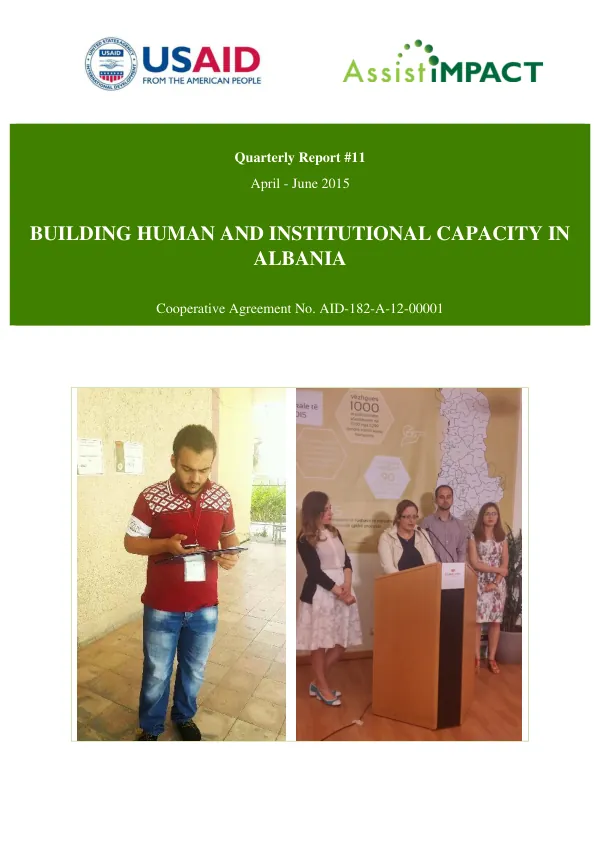
Quarterly Report #11: Building Human and Institutional Capacity in Albania
The Building Human and Institutional Capacity (BHIC) project in Albania aims to build the capacity of institutions, governmental, non-governmental, and private sector entities, as well as leaders and technical experts.
2015 · 23 pages
Sign in to readA free account is required to download.
Abstract
The project's overarching goal is to support Albania's European integration through strengthened democratic institutions and inclusive economic growth. The BHIC project focuses on building capacity to address two Development Objectives: strengthened rule of law and improved governance, and conditions created for broad-based, sustainable, and inclusive economic growth. To achieve these objectives, the BHIC project provides a flexible approach to meeting capacity building needs, including in-country, U.S., and third-country training of current and potential leaders and experts, institutional assessments of key private organizations/public institutions, targeted technical assistance, and focused grants. The project has achieved or exceeded all its goals by the end of September 2014, and new goals have been proposed for the remaining period. During the 11th quarter of the project, 31 programs were in various stages of implementation, including training, technical assistance, and grants. Seven new programs were initiated, and seven were completed. The programs focused on various areas, such as strengthened rule of law and improved governance, conditions for broad-based, sustainable, and inclusive economic growth, and support to LGBT. Capacity building activities were conducted in support of institutions/organizations, including capacity building for governmental institutions and non-governmental institutions. The Central Elections Commission (CEC) received IT support for the administration of the June 21, 2015 municipal elections, which enabled the CEC to provide up-to-date voting information and results of the ballot counting. The CEC website was viewed by more than 141,000 users over 6.3 million times. The BHIC project also supported the training of footwear operators at the Professional Training Center in Durres, which provided participants with essential instructional equipment and a capable instructor. The program also provided matching grants for new equipment to participating firms. Additionally, the project supported the preparation of a 100-page Compendium of best practices regarding municipal Public-Private Partnerships, which was shared electronically with Assist Impact partners. The Coalition for Free and Fair Elections and Sustainable Democracy (CFFESD) trained and deployed more than 1000 long-term and short-term observers to monitor the June 21, 2015 municipal elections. The observers reported in to the CFFESD call center, enabling the Coalition to provide informative, timely press releases to the media. The CFFESD observed that voting procedures were conducted largely peacefully in voting centers throughout the country, without major irregularities that could influence the outcome of the elections.