ASSIST IMPACT
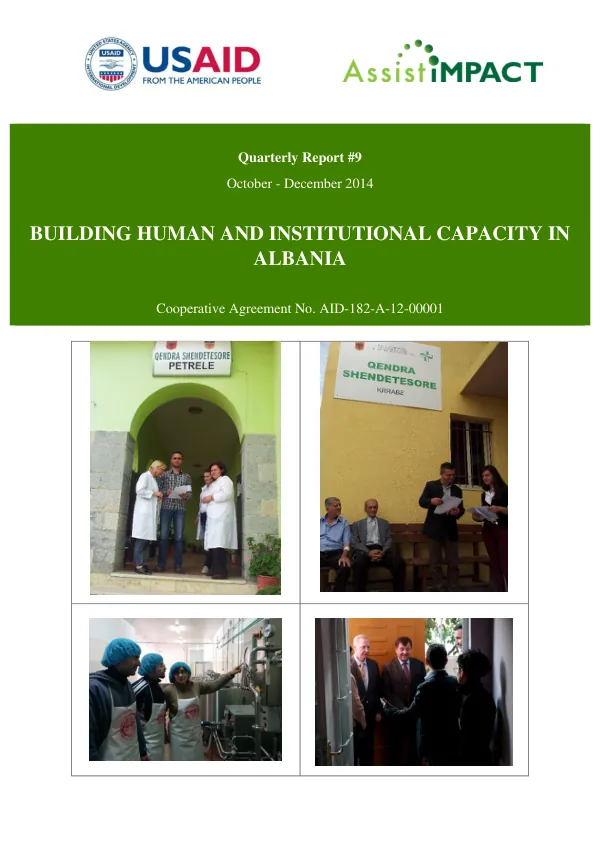
Quarterly Report #9: Building Human and Institutional Capacity in Albania
The Building Human and Institutional Capacity (BHIC) project in Albania aims to build the capacity of institutions, governmental, non-governmental, and private sector entities, as well as leaders and technical experts.
2014 · 20 pages
Sign in to readA free account is required to download.
Abstract
The project's overarching goal is to support Albania's European integration through strengthened democratic institutions and inclusive economic growth. The BHIC project focuses on building capacity to address two Development Objectives: strengthened rule of law and improved governance, and conditions created for broad-based, sustainable, and inclusive economic growth. The project's goals have been revised to achieve the following results by the end of the three and a quarter-year period: strengthening the performance of at least 13 Albanian central and local government organizations, including Albanian ministries and municipalities; strengthening the performance of at least 55 Albanian non-governmental organizations and private sector entities; building the performance of at least 55 leaders of Albanian governmental, private sector, and non-governmental organizations and institutions; and building the expertise of at least 370 technical specialists. During the 9th quarter of the project, two programs initiated in FY2013 continued, both regarding Public-Private Partnerships. Six new programs were initiated, and twelve were completed. Thirty programs begun in FY2014 or before were in various stages of implementation. These programs include women's empowerment grants, garment machine matching grants, technical assistance for public-private partnerships, and grants for youth empowerment and LGBT support. Capacity building activities were conducted in support of institutions and organizations. The Professional Training Center in Shkoder continued to receive support for the master technicians who taught the 8-week advanced level course in garment machine maintenance. The course offered at the Professional Training Center in Fier for both garment and footwear machine maintenance began in October with 17 attending and 14 completing the 8-week course. The state Agency for the Support of Civil Society was provided technical assistance to produce a five-year strategic plan. The cities of Kucova, Elbasan, and Saranda were all provided with feasibilities for public-private partnerships. The City of Kucova organized a public meeting with interested citizens, organizations, and institutions to hear about and discuss the planned PPP for recycling. The feasibility study for a Public Parking PPP in Elbasan revealed a challenge regarding the changes the municipality made after reconstruction of the main roads and how it affected parking. The feasibility study for a public beach management PPP in Saranda confirmed the need to increase the contract period and daily fees applied to the businesses. A grant to Protik allowed them to fulfill their goal of offering high-level ICT technical training courses while experimenting with true market interest. The first training in "Cyber Security and Business Resilience Tutorial (CERT-RMM)" took place on 4-5 November 2014 with a total of 7 participants. Protik had managed to sell a total of 5 training seats at full market price and provided free seats to the remaining participants through the grant. The BHIC project has made significant progress in building the capacity of institutions, governmental, non-governmental, and private sector entities, as well as leaders and technical experts. The project's revised goals aim to achieve even greater results by the end of the three and a quarter-year period. The capacity building activities conducted during the 9th quarter have contributed to the project's overall objectives, and the feasibility studies for public-private partnerships have provided valuable insights for the development of these initiatives.