SAFERWORLD
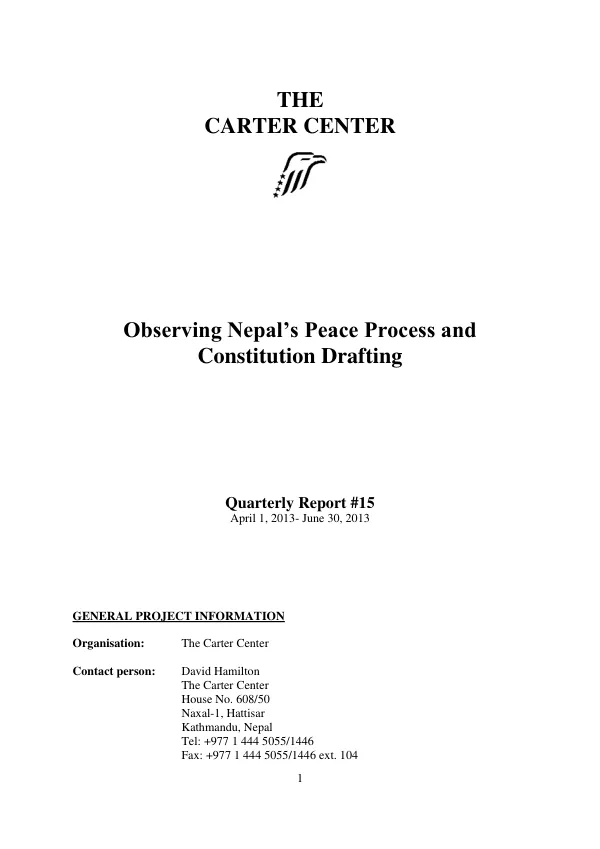
Quarterly Report #15: Observing Nepal’s Peace Process and Constitution Drafting
The Carter Center's Observing Nepal's Peace Process and Constitution Drafting project began in September 2009 with a goal of establishing a consolidated post-conflict democracy in Nepal.
2013 · 7 pages
Sign in to readA free account is required to download.
Abstract
The project, funded by USAID, aimed to observe the peace process and constitution drafting, with a focus on promoting public participation and inclusiveness. Regional and district observation teams were deployed to track the peace process, including the implementation of key political agreements, public engagement with the Constituent Assembly at the local level, and the effectiveness of local governance. The teams conducted over 640 meetings during the reporting period, including 80 at headquarters and 560 field team interviews. Observers also held two LTO training sessions, one in April and the second in June, to enhance their skills and knowledge. The Carter Center's observation efforts focused on several key areas, including the constitutional process, voter registration, identity-based groups, the peace process, political parties, and the security environment. The teams also tracked the functioning of the Constituent Assembly and the government, paying particular attention to efforts to increase public participation and involve historically marginalized groups. The Carter Center released two public reports during the reporting period, including a special report on recent voter registration findings and a bi-monthly political observation report. The organization also engaged with national and local political leaders to address political solutions and share findings from the observers. Interlocutors expressed positive feedback about the Carter Center's reports and inquired about the findings from the observers. The Carter Center's observation teams were paired with international and national observers to maximize their combined strengths and understand local dynamics. The teams also communicated national findings to the local level, sharing factual information on various parts of Nepal's transition as requested by interested groups. The organization ensured gender and social inclusiveness in project activities, beneficiaries, and staff, with 56% of national staff belonging to a marginalized group and 50% of international observers being female. The Carter Center received a formal invitation from the Election Commission of Nepal to observe the "Voter Register with Photograph Program." The organization conducted a limited observation of the program, deploying existing observation teams to report on voter registration in their deployment locations. The teams visited multiple districts to assess the Election Commission's "display, claims, and objections" period and "Missed Voter Registration" exercise. Observers also made follow-up enquiries with DEOs and other local government and election officials about voter registration, obstructions, and other potential election security risks. The Carter Center collaborated closely with the ECN, UNDP, IFES, and domestic observer networks and civil society organizations engaged with the process. The organization met several times with the ECN, UNDP, IFES, and NEOC, providing helpful consultation for their observation strategy and training and input for their LTO teams and observation documents. Carter Center representatives also attended a dinner hosted by NDI that included USAID, IFES, UNDP-ESP, US Embassy, and ECN, discussing preparations for November elections and the role of women in Nepali politics. The Carter Center's project has made significant progress towards its stated goal and objectives, with a focus on promoting public participation and inclusiveness in Nepal's peace process and constitution drafting. The organization's observation efforts have provided valuable insights into the country's transition, and its collaboration with national and local stakeholders has helped to build trust and promote dialogue.