ACDI/VOCA
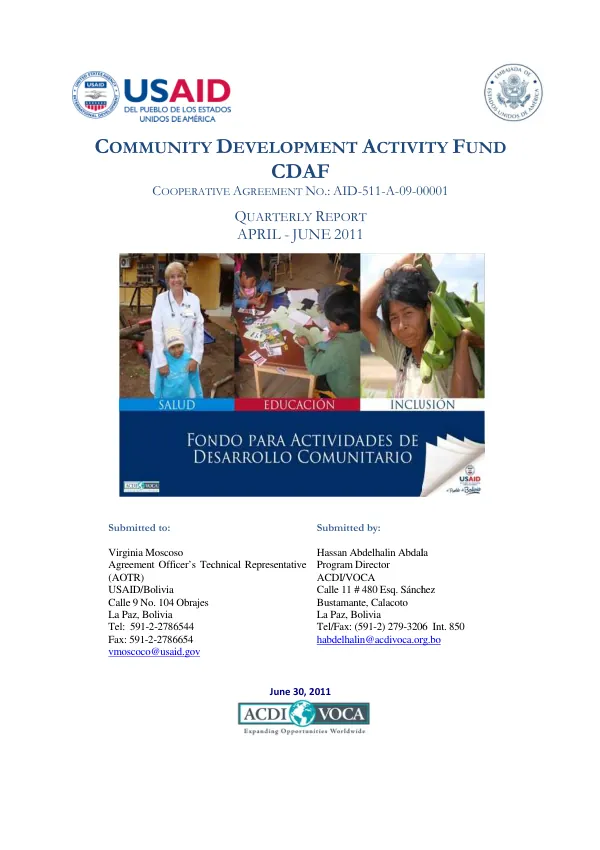
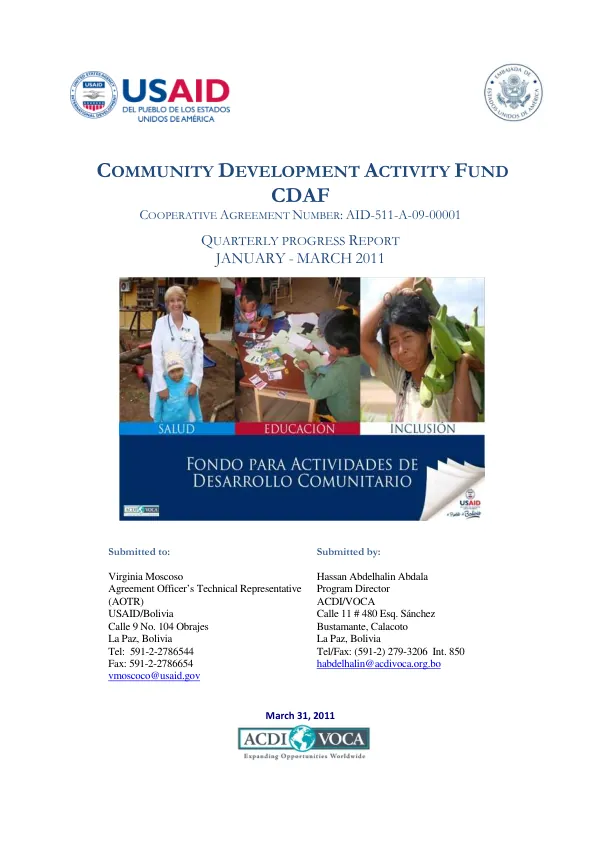
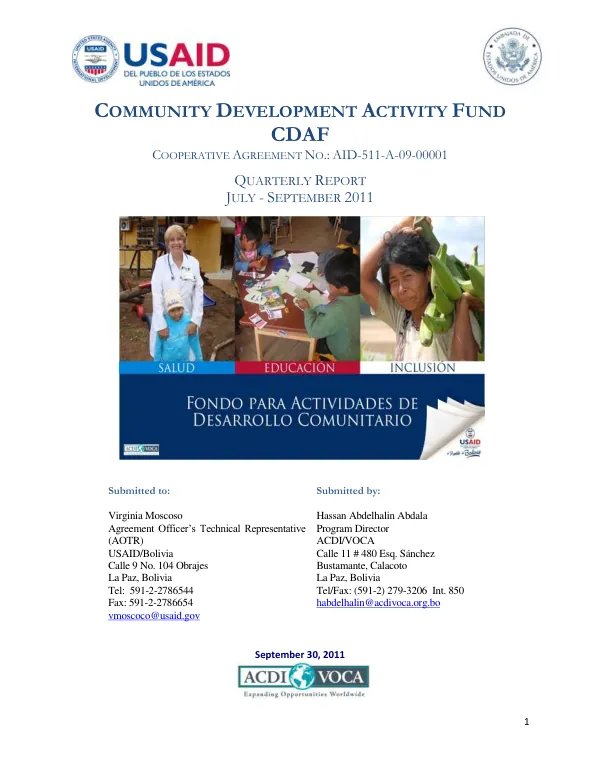
Quarterly Report: Community Development Activity Fund – CDAF Program
The Community Development Activity Fund (CDAF) Program began on September 30, 2009, with the overall goal of supporting communities throughout Bolivia in meeting their basic needs.
2011 · 24 pages
Sign in to readA free account is required to download.
Abstract
The project's purpose is to assist underserved communities in resolving specific, self-identified problems through small grants. The objectives are to finance small-scale development activities that build local problem-solving capacities and contribute to promoting a better understanding of the United States Government and its development assistance in Bolivia. To achieve these goals and objectives, ACDI/VOCA implements the CDAF Program in close coordination and consultation with USAID and through a series of activities designed to empower communities to achieve their social and economic development objectives. Over the five-year life of the project, the CDAF Program will implement more than 90 small-grant projects throughout Bolivia, with particular emphasis on benefitting traditionally excluded segments of the population, including women and indigenous groups. During the fourth quarter of FY 2011 (July 1 - September 31, 2011), the CDAF Program completed several key activities. An amendment to the CDAF project's indicators was sent to USAID for approval, and USAID approved the CDAF Grants Manual and Performance Management Plan (PMP). CDAF staff took part in meetings, visits, and follow-up sessions for various projects undertaken in different municipalities and departments. The CDAF's information system, Sistema de Información del Fondo para Actividades de Desarrollo Comunitario (SICDAF), was activated during this quarter. Two agreements were signed to initiate projects: one with the authorities of the community of Vichaya and the municipality of Caquiaviri for the construction of bathroom facilities in the Unidad Educativa (U.E.) Antonio Díaz Villamil, and another with the Jiliri Mallku from the community of Desaguadero for the construction of two classrooms in the U.E. José Ballivián. Monitoring of projects in the departments of Cochabamba, Oruruo, and La Paz continued under the responsibility of Licenciado Sergio Urioste. Meetings were held with Dr. Virginia Moscoso (AOTR-USAID) to analyze adjustments to be included in the amendment to the CDAF project award. Applications for new projects were reviewed for potential approval, visits to the field were scheduled, and follow-up issues for already completed projects were discussed. Meetings were also held with the Bolivia Communications Activity (BCA), which provided the CDAF project with materials to support activities that draw on the participation of USAID and/or the Embassy of the United States. Field visits were conducted in July and August to monitor and evaluate concluded CDAF projects. In July, meetings were held with representatives of the community of San Pedro of Desaguadero, who signed an agreement with CDAF. Similar meetings were held with the community of Vichaya in the municipality of Caquiaviri. In August, CDAF staff and USAID representatives undertook a monitoring visit to the municipality of Aiquile – Cochabamba to evaluate bathroom facilities constructed with CDAF funds. The team also visited the Mosoj Yan Association to conduct monitoring and evaluation of a concluded project. The CDAF Program's activities during the fourth quarter of FY 2011 demonstrate its commitment to supporting communities throughout Bolivia in meeting their basic needs. The program's focus on empowering communities to achieve their social and economic development objectives is evident in its implementation of small-grant projects and its efforts to promote a better understanding of the United States Government and its development assistance in Bolivia.