USAID DEC
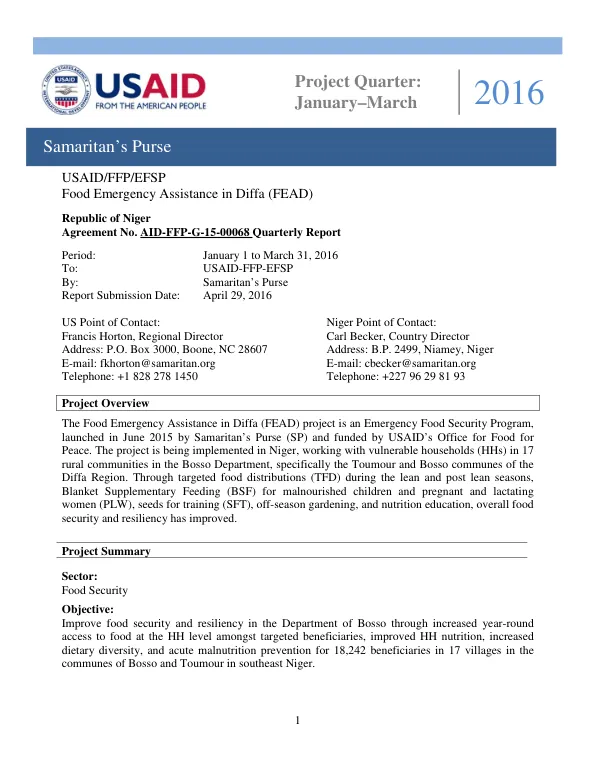
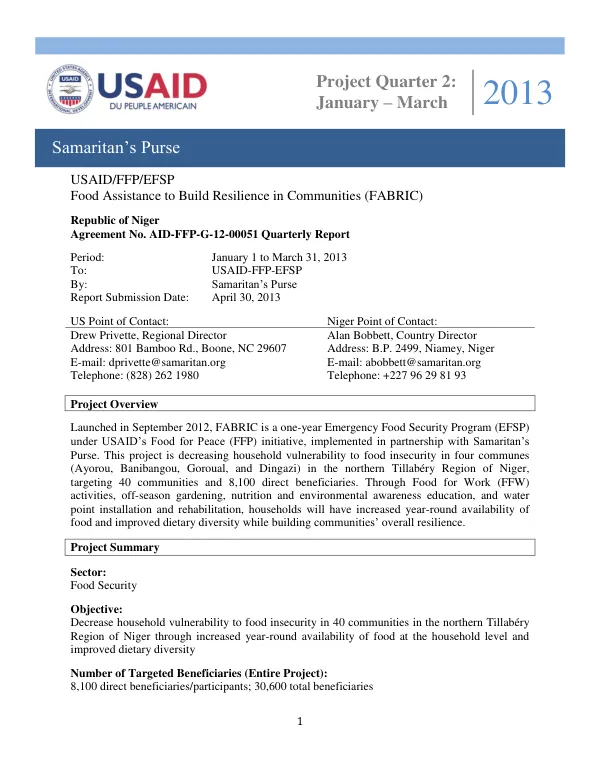
Quarterly Report: Food Assistance to Build Resilience in Communities (FABRIC) in the Republic of Niger
Sign inSAMARITAN'S PURSE
Quarterly Report: Food Assistance to Build Resilience in Communities (FABRIC) in the Republic of Niger
The Food Assistance to Build Resilience in Communities (FABRIC) project in the Republic of Niger was launched in September 2012 as a one-year Emergency Food Security Program under USAID's Food for Peace initiative.
2013 · 5 pages
Sign in to readA free account is required to download.
Abstract
Implemented in partnership with Samaritan's Purse, the project aims to decrease household vulnerability to food insecurity in four communes (Ayorou, Banibangou, Goroual, and Dingazi) in the northern Tillabéry Region of Niger, targeting 40 communities and 8,100 direct beneficiaries. The project's main objective is to increase year-round availability of food at the household level and improve dietary diversity through Food for Work (FFW) activities, off-season gardening, nutrition and environmental awareness education, and water point installation and rehabilitation. The project targets 40 communities and 8,100 direct beneficiaries, with a total of 30,600 total beneficiaries. In the second quarter of 2013 (January to March), FFW activities began in the commune of Ayorou in December 2012 and continued throughout January and February 2013, with 992 participants. In March, FFW activities were launched in the remaining three communes (Banibangou, Dingazi, and Goroual), while they simultaneously continued in the commune of Ayorou. A total of 2,981 participants took part in FFW activities in the four communes this quarter, which explains why only 494 ha of land (out of the 544 ha planned) were rehabilitated from January to March, and 425.058 MT of millet, beans, and oil was distributed (out of the 434 MT planned). Cumulatively, 46% of the total amount of project food commodities have been distributed, and 43% of the total targeted land has been restored through the construction of 280,479 demi lunes, 317 banquettes, and 114,689 zai holes. Grass seed has begun to be collected locally, purchased, and sown in demi lunes and banquettes to stimulate grass growth. In preparation for the establishment of tree nurseries, all participants have been trained. A total of 952 FFW participants, mostly from the commune of Ayorou, have attended training sessions on all sustainable environment topics organized in cooperation with the Department of Environment and Agriculture. Between January and March, 4,600 gardening participants tended vegetables at 20 garden sites. With technical support from Samaritan's Purse, vegetables grew as expected, and the bulk of the produce was harvested by the end of March. Beneficiaries plan to consume the majority of vegetables harvested, and anticipate selling surplus produce. To protect crops against livestock and to promote future planting at the garden sites, 17 fences were constructed (construction is ongoing on the remaining three fences). Since January, gardening activities have been accompanied by nutrition education. To date, 3,264 of the 4,600 gardening participants have attended all nutrition awareness sessions, including cooking demonstrations and health and nutrition education. The project has made significant progress in increasing the availability of food commodities and restoring land. Results showed that even though the lean season has begun, significantly fewer beneficiaries are experiencing moderate or severe hunger and resorting to coping mechanisms, due to the increased availability of food commodities provided through FABRIC. The project's performance indicators show that most activity indicators were measured through monthly project, field, and distribution reports, while the results listed were collected through post-distribution monitoring.
Related documents