COOPERATIVE FOR ASSISTANCE AND RELIEF EVERYWHERE INTERNATIONAL
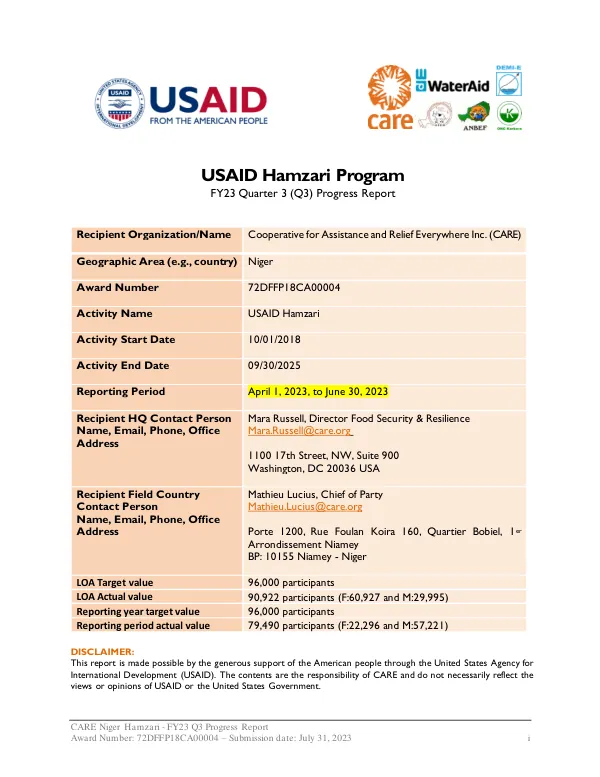
CARE Niger Hamzari - FY23 Q3 Progress Report
The USAID Hamzari Program in Niger aims to achieve sustainable, equitable, and resilient food and nutrition security for vulnerable groups in the Maradi Region.
2023 · 33 pages
Sign in to readA free account is required to download.
Abstract
The program targets all vulnerable households in three communes: Chadakori, Guidan Sori, and Guidan Roumdji, within the Guidan Roumdji Department. The program's geographic focus is on the Maradi Region, where the majority of the population relies on subsistence farming and faces significant challenges related to food insecurity and malnutrition. The program's overall goal is to reduce extreme vulnerability among vulnerable women, youth, and marginalized households. To achieve this goal, the program has four main purposes: (1) reducing extreme vulnerability, (2) improving nutritional status among children under 5 years of age, adolescent girls, and women of reproductive age, (3) improving access to and use of equitable and sustainable WASH services, and (4) enhancing sustainable, diversified livelihood opportunities for poor women, youth, and other vulnerable groups. The program's first purpose focuses on increasing social capital and resilience within, between, and beyond communities through self-governing collectives and platforms. This is achieved through sub-purpose 1.1, which aims to increase absorptive and adaptive capacity, building resilience to shocks and stressors for women, youth, and marginalized households' participants. The program also focuses on improving optimal Maternal, Infant and Young Child Feeding (MIYCF) and Reproductive Maternal, Newborn, Child, and Adolescent Health (RMNCAH) practices, as well as increasing utilization of RMNCAH and Nutrition Services. The program's third purpose aims to improve access to and use of equitable and sustainable WASH services to reduce disease and malnutrition among vulnerable populations. This is achieved through sub-purpose 3.1, which focuses on reducing disease due to fecal-oral transmission, sub-purpose 3.2, which aims to improve hygiene among women, youth, and other vulnerable groups, and sub-purpose 3.3, which seeks to increase access to water for women, youth, disabled, and vulnerable households. The program's fourth purpose focuses on enhancing sustainable, diversified livelihood opportunities for poor women, youth, and other vulnerable groups. This is achieved through sub-purpose 4.1, which aims to increase diversified crop and livestock production among poor women, youth, and other vulnerable groups participants, sub-purpose 4.2, which seeks to increase income from off and non-farm opportunities for poor women, youth, and other vulnerable household participants, and sub-purpose 4.3, which aims to enhance sustainable linkages with market systems for women, youth, and other vulnerable groups participants. The program's monitoring and evaluation framework is designed to track progress towards its goals and objectives. The framework includes indicators for monitoring and evaluation, as well as knowledge management, learning, and communications. The program also engages in partnerships, collaborations, and linkages with other organizations to leverage resources and expertise. As of the end of the third quarter of FY23, the program has made significant progress towards its goals. The program has reached 79,490 participants, exceeding the reporting period actual value of 96,000 participants. The program has also achieved notable results in terms of improved nutritional status, increased access to WASH services, and enhanced livelihood opportunities for vulnerable groups. However, the program continues to face challenges related to insecurity, limited access to markets, and inadequate infrastructure. The program's plans for the next quarter include continuing to implement its activities, monitoring progress, and addressing challenges. The program also aims to strengthen its partnerships and collaborations, as well as enhance its knowledge management, learning, and communications framework.