SAMARITAN'S PURSE
Quarterly Report: Food Emergency Assistance in Diffa (FEAD) Project in Niger
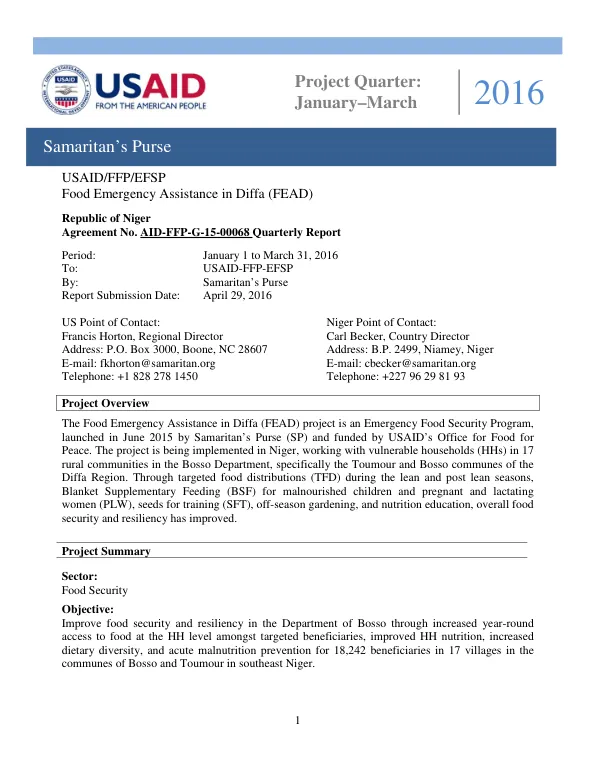
The Food Emergency Assistance in Diffa (FEAD) project is an Emergency Food Security Program launched in June 2015 by Samaritan's Purse (SP) and funded by USAID's Office for Food for Peace.
2016 · 5 pages
Sign in to readA free account is required to download.
Abstract
The project is being implemented in Niger, working with vulnerable households (HHs) in 17 rural communities in the Bosso Department, specifically the Toumour and Bosso communes of the Diffa Region. The project's main objective is to improve food security and resiliency in the Department of Bosso through increased year-round access to food at the HH level amongst targeted beneficiaries, improved HH nutrition, increased dietary diversity, and acute malnutrition prevention for 18,242 beneficiaries in 17 villages in the communes of Bosso and Toumour in southeast Niger. During the January to March 2016 quarter, the FEAD project continued to work with vulnerable households, distributing food commodities and nutrition supplements to prevent acute malnutrition and mortality (NSPAMM) rations. A total of 804.540 MT of food commodities and 46.290 MT of NSPAMM rations were distributed, with 30.850 MT of commodities remaining after all planned distributions. The project also conducted two post-distribution-monitoring surveys and two distribution-monitoring surveys for sites and beneficiaries on the days of distribution. Additionally, two price monitoring surveys were conducted in local markets. The FEAD project has continued to work with women's gardening groups in Toumour and N'gouba, with beneficiaries successfully growing vegetables such as cabbage and onions. Beneficiaries in Toumour also grew tomatoes, onions, hibiscus, carrots, and cabbage by pumping water from a nearby pond. The project also conducted health and nutrition trainings, with 80 women participating in six sessions, surpassing the project target. Women's training on village savings and credit was also completed, with 80 women trained in productive safety nets through savings and credit education in two sessions. The security situation in the region improved slightly in January and February but became more sporadic in March, with Boko Haram attacks on military vehicles and villages. To mitigate the risks, SP attends the weekly security meeting among NGOs and communicates on a regular basis with military contacts and village point persons concerning security developments and recommendations. Irrigation has continued to be a challenge in the N'gouba village, with two technicians visiting the site in January and recommending drilling a deeper borehole. Samaritan's Purse is in the process of drilling a second borehole. The FEAD project has also adapted to changes in the WFP strategy, with a new agreement signed to take into account the changes. The project has continued to distribute food commodities and nutrition supplements, with a total of 804.540 MT of food commodities and 46.290 MT of NSPAMM rations distributed during the quarter. The project has also conducted monitoring and evaluation activities, including post-distribution-monitoring surveys and distribution-monitoring surveys. The project has continued to work with women's gardening groups and has conducted health and nutrition trainings, with 80 women participating in six sessions.