CENTER FOR EDUCATIONAL DEVELOPMENT
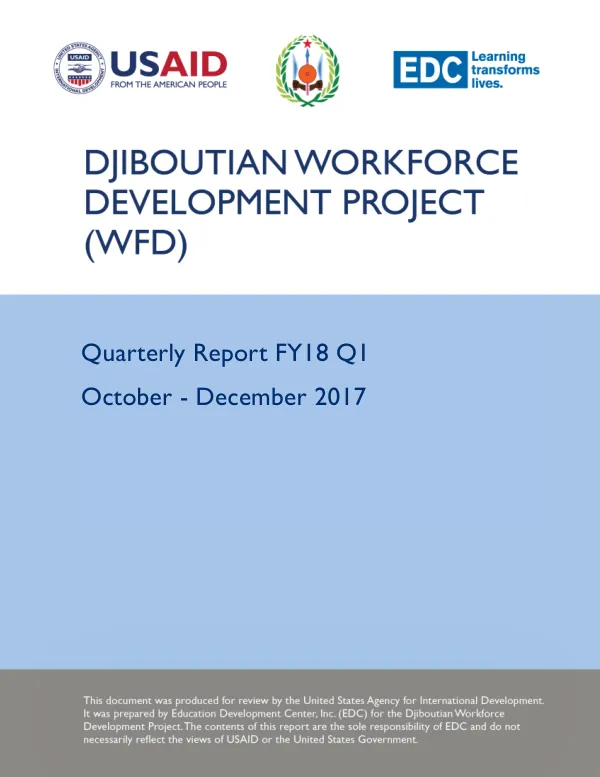
Quarterly Report FY18 Q1: October - December 2017
The Djiboutian Workforce Development Project (WFD) is a project aimed at improving the workforce development in Djibouti.
2018 · 89 pages
Sign in to readA free account is required to download.
Abstract
The project is implemented by the Education Development Center (EDC) and is funded by the United States Agency for International Development (USAID). The project aims to improve the technical and vocational education and training (TVET) system in Djibouti, with a focus on improving the employability of young people. The project focuses on three main areas: vocational workforce readiness, demand-driven vocational training, and job placement and retention. The project aims to improve the quality of vocational training, increase the number of youth who complete vocational training, and improve the employability of young people. During the first quarter of FY18, the project focused on preparing for the launch of youth job seeker training in January 2018. A Training of Trainers workshop was conducted for WFD partners, including ANEFIP, the Chamber of Commerce, and MENFOP. The workshop covered Modules 0-4 of the adapted Work Ready Now! curriculum. The project also initiated gender sensitization workshops for TVET teachers and administrators. Over 70 participants from the Lycée Industriel et Commercial and the Lycée Technique de Gabode discussed gender concerns and proposed solutions during these workshops. Additionally, the project initiated discussions with the MENFOP Gender Office and Information and Orientation Service office to discuss possible technical assistance to these offices. The project also revised the project Logframe to address concerns of the Chamber of Commerce about neglecting needed technical assistance for the Chamber’s Center of Excellence for training school leavers for the labor market. The project also initiated discussions with ANEFIP leadership to revise the findings of the Organizational Capacity Assessment, select capacity building priorities, and plan capacity building activities. The project also initiated discussions with the Ministry of Finance, the Club de Jeunes Entrepreneurs, and the Ministry of Education and Professional Training (MENFOP) to discuss possible collaborations and partnerships. The project also participated in the Chamber of Commerce International Trade Fair, where the WFD Gender Specialist, Ms. Youssouf, spoke as part of a four-woman panel on women’s leadership in business. The project also initiated discussions with the National Institute of Public Administration to discuss possible collaboration and partnership. The project also initiated discussions with the National Office of Labor Statistics (ONEQ) to discuss possible collaboration and partnership. The project also initiated the development of a digital job-matching platform, which aims to connect job seekers with employers. The project also initiated the development of a revised logical framework, which aims to improve the project's monitoring and evaluation system. The project also initiated the development of a financial management system, which aims to improve the project's financial management and reporting. The project also initiated the development of a financial management plan, which aims to ensure the project's financial sustainability. The project also initiated the development of a capacity building plan, which aims to improve the capacity of the project's partners and stakeholders. The project also initiated the development of a capacity building plan for the ANEFIP headquarters, which aims to improve the capacity of the ANEFIP staff. The project also initiated the development of a project evaluation plan, which aims to evaluate the project's effectiveness and impact. The project also initiated the development of a project evaluation report, which aims to evaluate the project's performance and achievements. The project also initiated the development of a project evaluation report, which aims to evaluate the project's performance and achievements. The report highlights the project's achievements and challenges, and provides recommendations for future improvements.